The Structural Shift
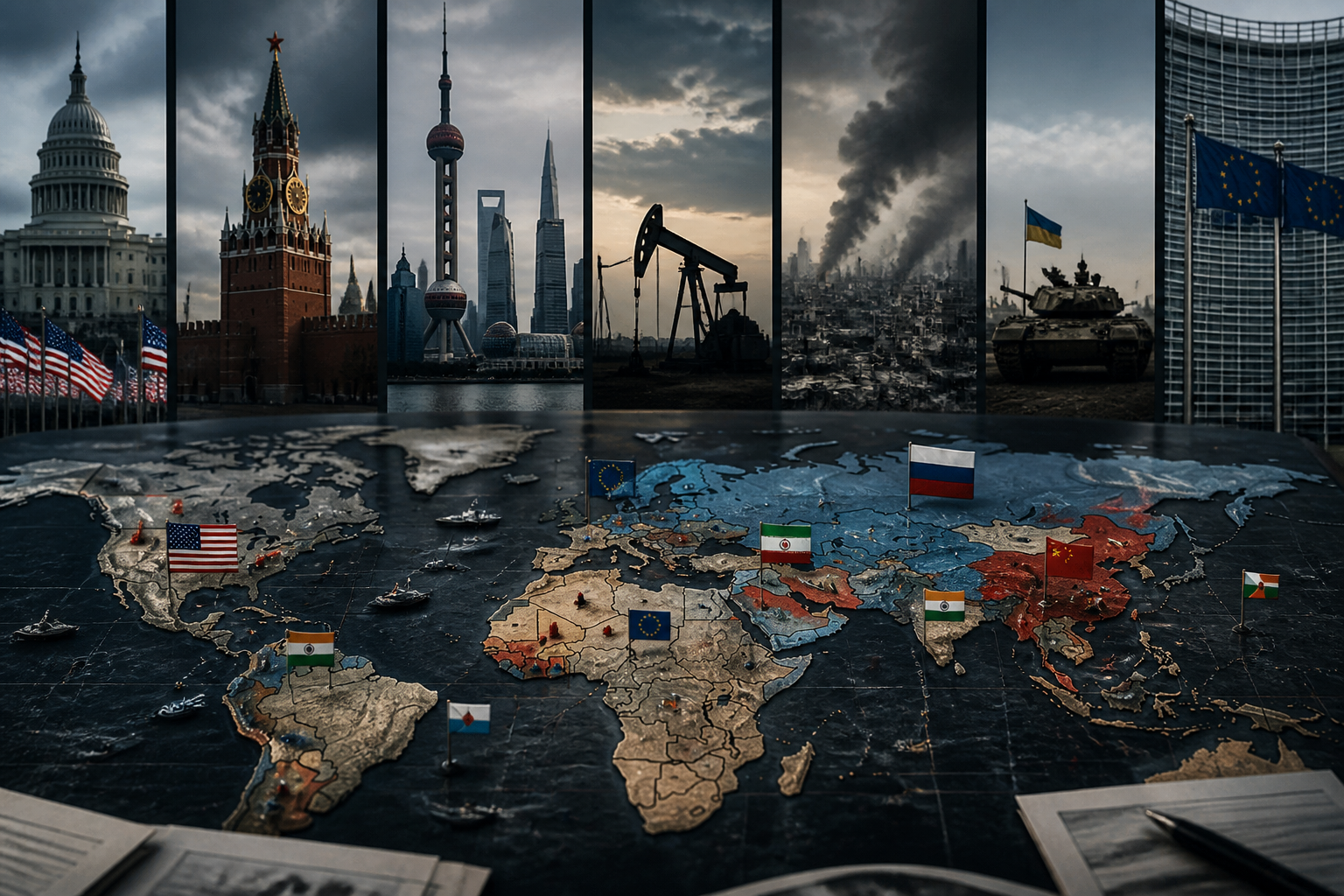
The global order is currently transitioning from a system governed by institutional rules to one dictated by raw physical constraints. Over the next twelve months, we should not look for a return to stability, but rather for the completion of the transition to a fragmented, multi-polar landscape. The primary driver is no longer ideological; it is the urgent need for domestic resilience in an era of unreliable supply chains and contested resources.
We expect three core themes to dominate: the consolidation of regional 'fortress' economies, the use of critical mineral cartels as diplomatic leverage, and the emergence of middle powers—such as Turkey, Indonesia, and Brazil—as the new arbiters of global influence. The era of the unipolar policeman is over. The era of the strategic opportunist has begun.
The End of Global Efficiency
For three decades, the world operated on the principle of efficiency: goods should be produced where it is cheapest. That logic has inverted. Security of supply now trumps cost. This is the 'Second-Order Effect' of the current geopolitical climate. National governments are prioritising 'friend-shoring' and domestic subsidies, essentially re-nationalising economic policy.
This shift is most visible in the technology sector. The battle over semiconductors is not merely about chips; it is about the sovereign capacity to process data and project power. Over the coming year, expect the 'Silicon Curtain' to harden. Nations will be forced to choose between technical ecosystems, creating a bifurcated global economy that increases costs for everyone but provides a security floor for the winners.
The Historical Parallel: The 1890s Surge
To understand today, we must look at the 1890s. This was a period when the first wave of globalisation—anchored by the British Empire—began to crack under the pressure of rising industrial powers like Germany and the United States. Then, as now, technological leaps (electricity and chemicals) disrupted established hierarchies. Then, as now, the response was a retreat into protectionism and the building of blue-water navies to protect trade routes.
The risk in this parallel is the 'Thucydides Trap', but the contemporary nuance is deeper. Unlike the 1890s, the world today is more digitally integrated but physically more vulnerable. The 'great game' is no longer just about territory; it is about the control of the undersea cables and satellite constellations that facilitate that territory's wealth.
What Most People Miss: The Mineral Chokepoint
Analysis often focuses on oil and gas as the primary levers of geopolitical pressure. This is a mistake. The real silent war is being fought over the 'green' transition. The move toward renewable energy does not eliminate resource dependency; it simply shifts it from the Persian Gulf to the Lithium Triangle of South America and the processing hubs of East Asia.
Most commentators miss the fact that China controls roughly 80% of the worldwide supply of several key rare earth elements. Over the next year, we anticipate Beijing will begin to use export controls not as a reactive measure, but as a proactive diplomatic tool. This is 'Resource Gallicism'—using the monopoly on the future's raw materials to dictate the present's political terms.
Strategic Consequences
First, we will see a decline in the relevance of traditional international institutions. The UN and the WTO are increasingly bypassed in favour of minilateralism—smaller, functional groupings like the Quad or the expanded BRICS. These groups are more nimble because they are based on shared interests rather than shared values.
Second, inflation will be structurally higher. Moving production from low-cost centres to high-cost 'friendly' nations is inherently inflationary. Central banks will struggle because the causes of this inflation are geopolitical, not purely monetary. They cannot print more lithium or fabricate more workers.
"Geopolitics is the study of how geography, technology, and demography constrain the choices of leaders. Currently, those constraints are tightening everywhere at once."
What to Watch
- The Turkish Pivot: Watch how Ankara balances its NATO obligations with its role as a bridge to Eurasia. Turkey’s control over the Black Sea access will make it the most influential middle power of the year.
- Subsea Infrastructure: An increase in 'accidental' damage to undersea data and energy cables. This is the new grey-zone warfare—plausible deniability with maximum economic impact.
- The Mexican Manufacturing Boom: As the US decouples from China, Mexico is the primary beneficiary. Watch for trade tensions as the US seeks more control over the internal security of its southern neighbour.
- Sovereign Wealth Activism: Gulf states will move from passive investors to strategic actors, using their capital to secure long-term food and water security through land acquisitions in Africa and Central Asia.
The KJ Verdict
The world is not descending into chaos, but into a more rigid and expensive order. The fundamental incentive driving every major capital is the fear of being left behind in a fractured world. This leads to defensive crouches: stockpiling, subsidies, and strategic alliances. Over the next twelve months, the winners will be those who control physical reality—rare earths, deep-water ports, and energy pipelines. Those who rely purely on financial services and digital mastery will find their leverage significantly diminished. We are witnessing the return of the material world.