KJ ReportsKJ Reports

What has caused India’s unprecedented COVID crisis?

Hazem Zahab29 April 20211,392

Listen to this article

KJ narrates this report in his own voice

What has caused India’s unprecedented COVID crisis?

India Covid 19 crisis

India’s total COVID-19 cases passed 18 million on Thursday after another world record number of daily infections, as gravediggers worked around the clock to bury victims and hundreds more were cremated in makeshift pyres in parks and parking lots.

India reported 379,257 new infections and 3,645 new deaths on Thursday, health ministry data showed,the highest number of fatalities in a single day since the start of the pandemic.

The world’s second most populous nation is in deep crisis, with hospitals and morgues overwhelmed.

Mumbai gravedigger Sayyed Munir Kamruddin, 52, said he and his colleagues were working non-stop to bury victims.

“I’m not scared of COVID, I’ve worked with courage. It’s all about courage, not about fear,” he said. “This is our only job. Getting the body, removing it from the ambulance, and then burying it.” read more

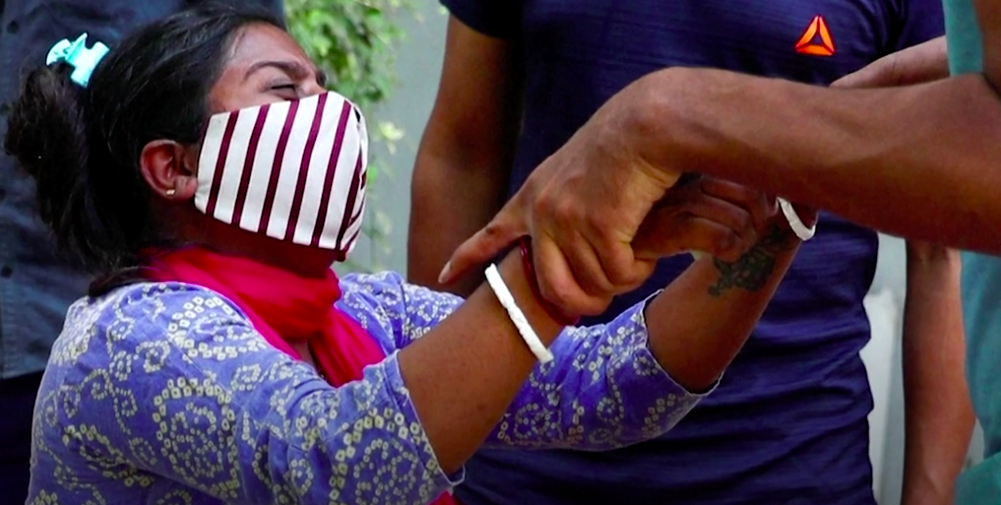
Each day, thousands of Indians search frantically for hospital beds and life-saving oxygen for sick relatives, using social media apps and personal contacts. Hospital beds that become available, especially in intensive care units (ICUs), are snapped up in minutes.

“The ferocity of the second wave took everyone by surprise,” K. VijayRaghavan, principal scientific adviser to the government, was quoted as saying in the Indian Express newspaper.

“While we were all aware of second waves in other countries, we had vaccines at hand, and no indications from modelling exercises suggested the scale of the surge.”

India’s military has begun moving key supplies, such as oxygen, across the nation and will open its healthcare facilities to civilians.

Hotels and railway coaches have been converted into critical care facilities to make up for the shortage of hospital beds.

India’s best hope is to vaccinate its vast population, experts say, and on Wednesday it opened registration for all above the age of 18 to receive shots from Saturday.

But although it is the world’s biggest producer of vaccines, India does not have the stocks for the estimated 800 million now eligible.

Main causes

The new outbreak in India is so severe that hospitals are running out of oxygen and beds, and many people who have been taken ill are being turned away.

Oxygen shortages are still affecting badly hit regions despite the measures to boost supply, transport and storage.

Reports have emerged of hospitals asking patients to arrange for their own cylinders and of people dying even after being admitted due to low oxygen supplies.

Social media platforms have been filled with posts by desperate families hunting for cylinders and refills.

Meanwhile, there is a growing black market for cylinders and concentrators sold far above their usual retail prices.

The shortages have sparked outrage and frustration in New Delhi.

“The government did not plan in time,” sales executive Prabhat Kumar told AFP.

“Had it been prepared, we would not have to suffer like this for beds and oxygen.”

Fuelling the catastrophe was a series of crowded events, like mass rallies by politicians such as Prime Minister Narendra Modi, religious holidays and pilgrimages on the Ganges river.

As governing Bharatiya Janata Party (BJP) ministers, including Modi, touted victory over the virus, people relaxed their vigilance and stopped wearing masks and maintaining social distancing.

Now India is enduring its darkest chapter yet, with mass funeral pyres, burials and a collapse of the healthcare system compounded by shortages of oxygen, ventilators and hospital beds.

What’s next?

India’s coronavirus struggle will have global implications, as well as economic implications on the nation.

An unprecedented rise in Covid-19 cases is likely to slow down India’s economic recovery, but the overall impact will be milder in comparison to last year’s devastation. Experts say that extent of economic loss during the second wave will primarily depend on how fast the chain of infections can be broken.

While Covid-19 containment rules are less stringent compared to last year’s nationwide lockdown, economic activity is gradually declining as more states opt for stricter norms to contain rapidly rising daily cases.

The more the virus spreads, the more chances it has to mutate and create variants that could eventually resist current vaccines, threatening to undermine other countries’ progress in containing the pandemic, experts warn.
“If we don’t help in India, I worry about an explosion of cases” around the world, said Dr. Ashish Jha, dean of the Brown University School of Public Health. That’s why India’s Covid outbreak is a global problem that needs a coordinated response.
Some countries are already scrambling to send supplies.
US oxygen concentrators — medical devices that compress oxygen from the air — arrived earlier this week, and on Wednesday the UK, Italy and Germany committed more medical equipment, as Russian planes took off from Zhukovsky for Delhi carrying medicine, monitors and ventilators.
While the immediate priority is saving the lives of those already sick, vaccinating the country is considered crucial to stop the virus from spreading. But, despite being home to the world’s biggest vaccine producer, India doesn’t have enough doses, and there’s no fast and simple way to make more.
Western countries have been criticized for vaccine stockpiling, but on Wednesday, British Health Secretary Matt Hancock said the UK didn’t have any spare vaccines to send.
US President Joe Biden said on Tuesday he had spoken with Indian Prime Minister Narendra Modi and confirmed the US intends to send coronavirus vaccines to India. Earlier in the week, the US said it would share 60 million AstraZeneca doses with other countries, but didn’t specify which nations or when. Delivering them could take months, the White House warned.
Therefore, although the international response has been slow, as the implications of the crisis in India become increasingly evident, global aid is increasing, and there is hope that the trend can eventually be reversed.
#covid#covid-19#india

Related Intelligence

More articles
The Aden Choke: Global Maritime Liberalism Under Final Siege
Geopolitics

The Aden Choke: Global Maritime Liberalism Under Final Siege

The Red Sea crisis has evolved from a regional skirmish into a systemic failure of Western sea power. As non-state actors disrupt the Suez artery, the era of guaranteed oceanic freedom is ending, replaced by a fragmented, costly reality.

8 Sept 2026

The Qasem Gambit: Why Tehran’s Maritime Strategy Breaks US Naval Power
Middle East

The Qasem Gambit: Why Tehran’s Maritime Strategy Breaks US Naval Power

Iran’s evolution into a sophisticated anti-access maritime power has rendered the traditional US carrier strike group obsolete in the Persian Gulf, forcing a fundamental rethink of Western power projection in the Middle East.

8 Sept 2026

The Fujairah Paradox: The End of the Western Security Umbrella
Middle East

The Fujairah Paradox: The End of the Western Security Umbrella

As Iranian drone incursions breach the strategic Port of Fujairah, the UAE is quietly dismantling its reliance on Western protection. This shift marks the rise of a new, transactional security architecture in the Gulf.

7 Sept 2026

The Emirates Buffer: Abu Dhabi’s Strategic Disengagement
Middle East

The Emirates Buffer: Abu Dhabi’s Strategic Disengagement

As tensions between Washington and Tehran reach a volatile equilibrium, the United Arab Emirates is quietly decoupling its security architecture from Western-led containment to pursue a policy of radical neutrality and economic preservation.

7 Sept 2026

The Larak Conundrum: Tehran’s Shift to Preemptive Deterrence
Middle East

The Larak Conundrum: Tehran’s Shift to Preemptive Deterrence

Iran has abandoned the doctrine of 'strategic patience' for a model of proactive intervention. This shift signals the death of managed escalation and introduces a volatile new era for global energy security and maritime power.

6 Sept 2026

The Larak Escalation: Tehran’s New Doctrine of Preemptive Defence
Middle East

The Larak Escalation: Tehran’s New Doctrine of Preemptive Defence

Iran has abandoned its long-standing policy of 'strategic patience' for a high-risk preemptive doctrine. By striking first near Larak, Tehran signals that the era of proportional response is dead, reshapping the Persian Gulf power map.

6 Sept 2026