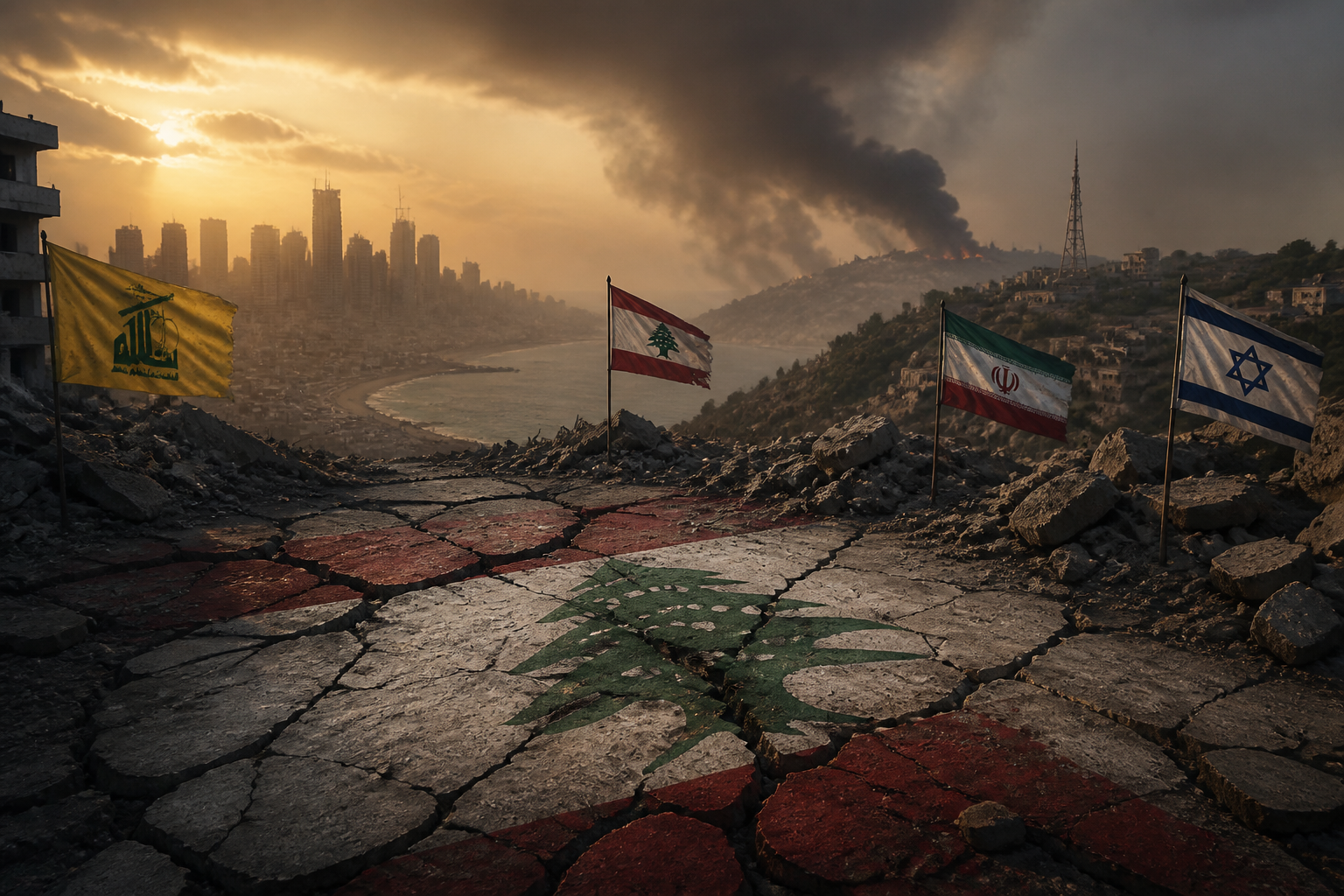
Lebanon has ceased to function as a sovereign entity. The collapse is not merely a protracted economic depression or a failure of governance, but the final structural dissolution of the 1920 colonial design. Power has fully retreated from the centre to the peripheries, leaving a hollowed-out administrative shell in Beirut while the real levers of survival—security, electricity, and credit—are managed by sub-state actors and local oligarchs. To understand why Lebanon cannot simply be fixed with a bailout, one must look at the incentives that make failure more profitable for its elite than reform.
The Architecture of an Intentional Collapse
The death of the Lebanese state was not an accident of history. It was a mathematical certainty built into the post-civil war settlement. The Taif Agreement did not end the war; it merely moved it into the cabinet room. The sectarian distribution of power created a system of vetoes where no single entity could govern, but every entity could plunder. This was a system of competitive extraction.
For decades, the Banque du Liban operated what was essentially a sovereign Ponzi scheme. It offered high interest rates to commercial banks to attract US dollar deposits, using that cash to peg the Lebanese pound and fund a bloated, patronage-heavy state budget. When the flow of new dollars stopped, the system imploded. The incentive for the political class was never to build a productive economy, but to maintain a liquid patronage network to ensure sectarian loyalty. Today, that liquidity is gone, and the loyalty is now enforced through direct provision of services by militias and local strongmen rather than the state.
The Fractured Map: A New Geography of Power
As the central state’s ability to project power vanished, Lebanon’s geography reverted to its historical communal fault lines. We are witnessing the emergence of 'cantonisation' by stealth. In the south and the Bekaa, the resistance economy provides a parallel social safety net. In predominantly Christian or Druze areas, local municipalities and private security firms have taken over the roles of the police and the utility provider. Status is no longer defined by a Lebanese passport, but by which communal 'life-raft' an individual can cling to.
This fragmentation has global consequences. Lebanon is now a primary node in the shadow economies of the Levant. With no functioning central bank or customs authority, it has become a grey-zone hub for Captagon trafficking, illicit gold transfers, and sanction-circumvention for regional actors. Money follows the path of least resistance; in Lebanon, the lack of oversight is a feature, not a bug, for those operating outside the global financial system.
A Historical Parallel: The Failure of the Mamluk Frontier
To find a historical analogue, one must look back to the late Mamluk period in the Levant during the 15th century. As the central authority in Cairo weakened due to economic mismanagement and plague, the periphery—modern-day Lebanon—fractured into feudal fiefdoms. Local warlords and religious minorities retreated to the mountains, paying nominal lip service to the centre while governing themselves entirely. Stability was only restored when a stronger external power, the Ottomans, imposed a new administrative order from without. Lebanon today is in that pre-Ottoman state of suspended animation, waiting for a regional hegemon to dictate its next chapter.
What Most People Miss: The 'Refugee' Weaponisation
The standard narrative focuses on the burden of the 1.5 million Syrian refugees on Lebanon’s infrastructure. What most analysts miss is that the presence of this population has become a strategic asset for the Lebanese ruling class. The crisis allows the elite to hold the European Union hostage. By threatening to 'open the seas' to migrant boats, Beirut’s politicians have successfully extorted billions in 'stabilisation' funds that bypass genuine reform requirements. The suffering of the displaced is not a problem to be solved for the Lebanese elite; it is a revenue stream and a diplomatic lever.
Strategic Consequences: The Mediterranean Underbelly
The vacuum in Lebanon creates a permanent instability on the Mediterranean's eastern rim. This has three primary second-order effects:
- Security Spillover: The blurring of the line between the Lebanese Armed Forces (LAF) and non-state actors means western military aid increasingly risk subsidising the very threats it intends to contain.
- Energy Paralysis: Despite the discovery of offshore gas, the lack of a credible legal framework and the constant threat of maritime escalation mean these resources will likely remain in the seabed, depriving Europe of a potential alternative to Russian or Qatari energy.
- Iranian Consolidation: As the traditional state withers, the actor with the most disciplined parallel structure—Hezbollah—becomes the only entity capable of maintaining order. A failed Lebanon is a consolidated corridor for the 'Axis of Resistance'.
What to Watch
- The LAF’s Cohesion: The Lebanese Armed Forces are the last symbol of national unity. If the salary subsidies provided by foreign powers (primarily the US and Qatar) cease, the army will desert along sectarian lines, marking the formal start of a new civil conflict.
- Total Grid Failure: Transition from intermittent state power to 100% private/militia-controlled solar and generator grids in specific districts.
- Mediterranean Naval Posture: Increased frequency of European naval patrols to intercept human trafficking and smuggling vessels departing from Tripoli’s lawless ports.
The KJ Verdict
Lebanon is not going to have a 'Phoenix moment'. The structural incentives for its leaders remain aligned with the status quo of managed decline. For the international community, the choice is no longer about saving the Lebanese state, but about managing its carcass. Expect a formal move toward federalism—either by law or by fact—as the different regions of the country realise that the Beirut-centric model is dead. For investors and strategists, Lebanon is no longer a country; it is a collection of tribes with a flag. Treat it as such.