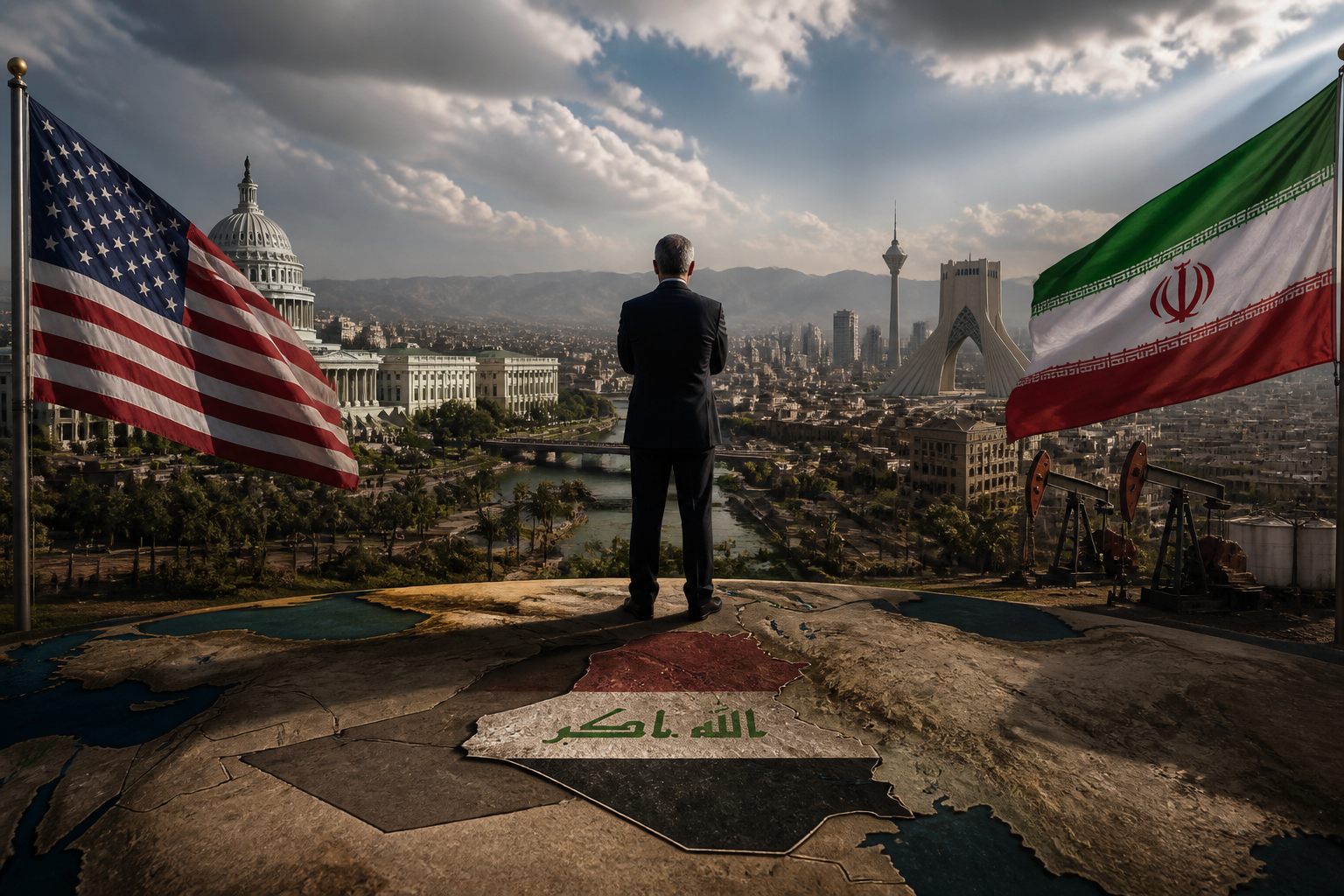
Iraq is not a state in transition; it is a state in equilibrium. For two decades, conventional wisdom suggested that Baghdad would eventually tilt decisively toward either Washington or Tehran. That view is flawed. The Iraqi state has evolved into a unique geopolitical mechanism designed to process the interests of its two primary antagonists simultaneously. To lean too far toward the West invites domestic kinetic instability from the Hashd al-Shaabi; to lean too far toward the East invites the collapse of the Iraqi banking system and the end of the US dollar supply. Iraq maintains its sovereignty not by strength, but by becoming too complicated for either side to lose.
The Financial Guillotine
The primary lever of American power in Iraq is no longer the presence of the 2,500 troops remaining in the country. It is the New York Federal Reserve. Iraq’s oil revenues are deposited into an account in New York, and the flow of physical dollars to Baghdad is controlled by the US Treasury. In the last eighteen months, Washington has shifted from passive observer to active gatekeeper. By imposing strict transparency requirements on the Central Bank of Iraq’s dollar auctions, the US has effectively throttled the mechanism through which Iran previously accessed hard currency. This is the real frontline. The Iraqi government must now prove every dollar’s destination, a requirement that clashes directly with the informal, patronage-based economy that sustains Tehran’s local allies.
The Paramilitary Veto
If Washington controls the money, Tehran controls the security environment. The Coordination Framework—the dominant Shia political bloc—provides the legislative cover for a security architecture that is increasingly independent of the formal ministry structures. For Iran, Iraq serves as the essential land bridge to the Levant and a strategic depth that ensures any future conflict with the West is fought on Iraqi soil rather than Iranian. This gives Tehran a 'kinetic veto'. Whenever the US pushes too hard on financial transparency or energy independence, the security situation deteriorates. It is a calibrated pressure valve designed to remind Baghdad of the cost of total alignment with the West.
The Historical Parallel: Cold War Austria
To understand modern Iraq, one should look at the State Treaty of 1955 that defined Austria during the Cold War. Like Iraq, Austria was occupied by competing powers with irreconcilable ideologies. The solution was not a victory for one side, but a forced neutrality that turned the country into a 'functional buffer'. Iraq is currently undergoing this 'Austrianisation'. Both the US and Iran have realised that a total victory in Iraq is too expensive and risky. Instead, they have settled for a stalemate where Iraq is stable enough to export oil but too divided to become a platform for the other’s total dominance.
What Most People Miss: The Gas Dependency Trap
The headline conflict is often focused on militias and drone strikes, but the real structural chain is energy. Despite possessing some of the world’s largest oil reserves, Iraq remains chronically dependent on Iranian natural gas to power its electricity grid. Iraq flairs more gas than almost any nation on earth because it lacks the infrastructure to capture it. This is not an accident. It is a deliberate failure of the political class to ensure that the umbilical cord to Tehran remains uncut. Even if the US were to offer total financial integration, Iraq cannot keep its lights on without Iranian cooperation. This creates a ceiling on how much Iraq can ever distance itself from its eastern neighbour.
Strategic Consequences
The most significant second-order effect of this tug-of-war is the hollowing out of the Iraqi state’s institutional credibility. When sovereignty is divided, the rule of law is impossible. Public contracts are split like spoils of war between pro-Western technocrats and pro-Iranian commanders. This leads to a 'rentier-proxy' model where the population is pacified by public sector jobs funded by oil, while the real power resides in unofficial shadow committees. The risk is that this model is only sustainable as long as oil prices remain high and the US is willing to play the long game. If either variable changes, the buffer state collapses into a failed state.
The Iraqi state does not exist to serve its citizens; it exists to manage the friction between the two powers that share house within its borders.
What to Watch
- The TBI Sanctions: Watch for any US Treasury moves against the Trade Bank of Iraq. This would signal a shift from 'containment' to 'economic warfare'.
- TotalEnergies Progress: The $27 billion deal to capture flared gas and solar power is the most significant threat to Iranian influence. Monitor its implementation speed.
- The 2025 Provincial Elections: Watch for the rising influence of localist movements that reject both Washington and Tehran in favour of 'Iraq First' nationalism.
- The Erbil-Baghdad Pipeline: Resuming Kurdish oil exports through Turkey would signal a reassertion of central authority over sectarian interests.
The KJ Verdict
The idea that Iraq will 'choose' a side is a Western projection. The Iraqi political elite have no incentive to choose. Choosing a side means losing the protection or the patronage of the other. The current status quo—where Iraq is a financial lung for Iran and an energy-security partner for the US—is the only configuration that prevents total civil collapse. Expect a continuation of this 'managed instability'. The world should stop looking for a winning side in Iraq and start preparing for a decade where Baghdad remains a grey zone: too integrated to fail, but too compromised to thrive. The dual sovereignty is not a bug; it is the system’s primary feature.