
KJ ReportsKJ Reports

Saudi king gives Pakistan’s prime minister an ultimatum over Qatar

16 June 2017545

Listen to this article

KJ narrates this report in his own voice

Saudi king gives Pakistan’s prime minister an ultimatum over Qatar

Read original article on the Middle East Monitor or read a quick summary below;

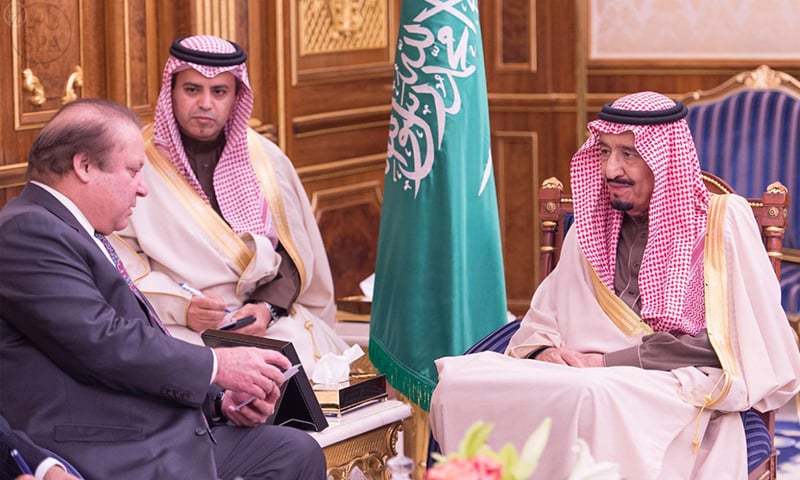
  1. King Salman of Saudi Arabia has given Pakistan’s prime minister an ultimatum over Qatar. In an attempt to force Nawaz Sharif to take sides, the monarch jibed, “Are you with us or with Qatar?” the Express Tribune has reported.
  2. The king posed the question during a meeting between the two leaders in Jeddah on Monday as part of the effort to find a diplomatic solution to the Qatar crisis. “Pakistan has told Saudi Arabia it will not take sides in the brewing diplomatic crisis in the Middle East after Riyadh asked Islamabad ‘are you with us or with Qatar’,” the newspaper pointed out.
  3. Pakistan has been treading a careful path since Saudi and other Gulf countries cut diplomatic ties with Qatar. However, the Saudi government wants Pakistan to side with the kingdom.
  4. Citing a senior government official, who was briefed on the talks at the monarch’s palace in Jeddah, the Express Tribune said that Pakistan would not take sides in any event that would create divisions within the Muslim world. “Nevertheless, in order to placate Saudi Arabia, Pakistan offered to use its influence over Qatar to defuse the situation. For this purpose, the prime minister will undertake visits to Kuwait, Qatar and Turkey,” the newspaper added.
  5. Sharif travelled to Jeddah accompanied by army chief General Qamar Javed Bajwa and other senior officials to discuss the emerging situation in the Gulf. It is thought that Prime Minister Sharif’s mediation visit to Saudi did not achieve any immediate breakthrough.

 

#gulf-crisis#nawaz-sharif#pakistan#pakistan-qatar#qatar-crisis

Related Intelligence

More articles
The Shattered Shield: Why the Middle East Containment Era Is Over
Middle East

The Shattered Shield: Why the Middle East Containment Era Is Over

As direct hostilities between Iran and Israel bypass traditional Western red lines, the decades-long American strategy of regional containment has collapsed, leaving a vacuum where total war is now a structural probability.

14 Jun 2026

The Price of Restoration: Why Modern Warfare Prefers Stasis
Middle East

The Price of Restoration: Why Modern Warfare Prefers Stasis

While the Iran-US conflict cycles through fragile ceasefires and violent escalations, a deeper economic logic is emerging. Total victory is being sidelined by the lucrative prospects of managed reconstruction and regional integration.

13 Jun 2026

The Deadlock of Calm: Why Washington and Tehran Cannot Close the Deal
Middle East

The Deadlock of Calm: Why Washington and Tehran Cannot Close the Deal

A fragile ceasefire has frozen the Middle East, yet structural domestic survival and regional leverage prevent both the United States and Iran from moving beyond a tactical pause into a permanent settlement.

8 Jun 2026

The Ethiopia-Somaliland Axis: Redefining the Horn’s Power Map
Middle East

The Ethiopia-Somaliland Axis: Redefining the Horn’s Power Map

Ethiopia’s push for sea access via Somaliland is more than a trade deal. It is a structural shift forcing a realignment between Nile basin interests and Red Sea security architectures.

1 Jun 2026

Chokepoint Logic: Why Hormuz Remains the World’s Only True Thermostat
Middle East

Chokepoint Logic: Why Hormuz Remains the World’s Only True Thermostat

Despite the rise of American shale and the green energy transition, the Strait of Hormuz remains the single most critical vulnerability in the global economy. Power here is measured in barrels and leverage, not just navies.

15 May 2026

The Levantine Void: Lebanon’s Final Descent into State Dissolution
Middle East

The Levantine Void: Lebanon’s Final Descent into State Dissolution

Lebanon is no longer a state in crisis; it is a geographic theatre where the concept of the nation has been replaced by a fragmented security patchwork. Here is the structural reality of why the old Lebanon cannot return.

1 May 2026