The Logic of the Long Stall
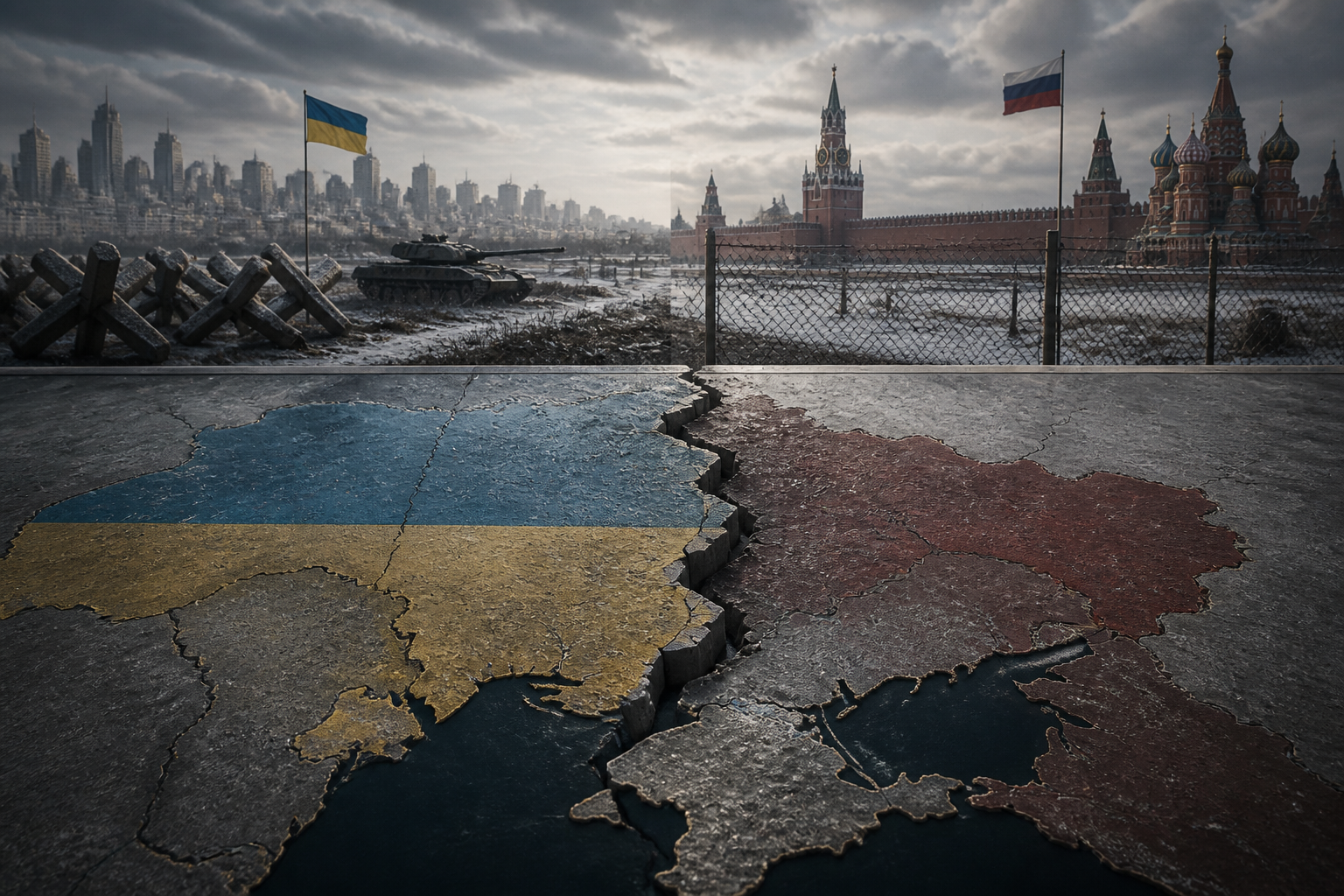
The conflict in Ukraine is no longer a war of manoeuvre; it has become a war of industrial capacity and political patience. To understand what a frozen conflict means, we must look past the daily tactical shifts and examine the structural incentives for the world’s major players. For the West, the primary objective has quietly shifted from a total Ukrainian victory to the prevention of a NATO-Russia escalation. For Moscow, the goal is now the exhaustion of the Western domestic political consensus. Both paths lead to the same destination: a de facto partition that no one will formally recognise but everyone will eventually respect.
The Incentive to Stop
Wars end when the cost of continued fighting exceeds the perceived benefit of the next square kilometre of territory. We are approaching that point. Ukraine faces a demographic deficit that no amount of Western weaponry can solve. Russia faces a technological degradation that limits its ability to project power beyond its current defensive lines. The frozen conflict is not a failure of strategy; it is the natural equilibrium of two exhausted powers.
The primary beneficiary of a frozen frontline is the global financial system, which craves predictability. A static border allows for the re-establishment of energy corridors (albeit directed eastward) and the stabilisation of global grain markets. The loser is the concept of international law, as the line of contact becomes a 'hard' border that validates the use of force through longevity.
Historical Parallel: The Korean Precedent
The most instructive parallel is the 1953 Korean Armistice. In Korea, neither side achieved their total political objective. The peninsula remained divided, millions were displaced, and no formal peace treaty was ever signed. Yet, the 'frozen' nature of that conflict allowed South Korea to integrate into the global economy and become an industrial powerhouse, while the North became a contained, if dangerous, garrison state.
In Eurasia, we are likely to see a 'Koreaisation' of Ukraine. This involves a highly militarised Line of Control, a lack of diplomatic recognition for annexed territories, and a security guarantee for the rump state that stops just short of full defensive treaty membership. The border will not be a point of transit, but a scar across the continent.
What Most People Miss: The 'Buffer' Paradox
Most analysts focus on what Ukraine loses in a frozen conflict: land, resources, and access to the Sea of Azov. What is often missed is what Russia loses: its primary lever of influence over the entirety of Ukraine. By seizing and freezing 20% of the country, Moscow has effectively pushed the remaining 80% into a permanent, hostile, and Western-aligned posture. Russia has traded strategic depth in the form of a neutral Ukraine for tactical depth in the form of the Donbas.
Furthermore, the frozen conflict creates a 'grey zone' economy. These regions become black holes for capital, governed by local warlords and security services, serving as hubs for illicit trade that bypasses sanctions. This doesn't just hurt Ukraine; it creates a permanent criminalised frontier on Russia’s own doorstep.
The Second-Order Effects
A frozen map reshapes European security for a generation. We will see three distinct shifts:
- The Permanent Eastern Front: Poland, the Baltics, and Finland will become the new 'West Berlin' of the 21st century—highly militarised, heavily subsidised, and perpetually on high alert.
- The Fragmentation of the EU: Tensions will rise between 'Frontline States' (Poland/Baltics) who want total Russian defeat, and 'Rearward States' (France/Germany) who want a return to cheap energy and continental stability.
- Ukraine as a Fortress: Without full NATO membership, Ukraine will be forced to become the most militarised society in Europe, developing a domestic arms industry that will eventually compete with Western manufacturers.
What to Watch
- The Reconstruction Clause: Watch if Western aid shifts from 'ammunition' to 'infrastructure' before a formal ceasefire. This signals an acceptance of the current borders.
- The Black Sea Transit: Any long-term agreement on grain corridors that bypasses the need for Russian approval will indicate a hardening of the maritime border.
- Russian Demobilisation: Moscow’s refusal to demobilise troops after a lull in fighting would signal that the 'freeze' is merely a pause for rearmament.
The KJ Verdict
The future of Eurasia is not a peace treaty, but a fence. We are moving toward a world where 'resolved' conflicts are a luxury of the past. The map of Ukraine will remain blurred—red in some places, blue in others, but solidified by concrete and trenches. This status quo is sub-optimal for all, yet it is the only outcome that currently satisfies the primary incentive of the great powers: the avoidance of a third world war. Expect the line of control to become the most important geopolitical reality of the decade, defining the limit of Western expansion and the exhaustion of Russian ambition.