KJ ReportsKJ Reports

How Islam Spread to Russia

29 April 20214,044

Listen to this article

KJ narrates this report in his own voice

How Islam Spread to Russia

This video and article was based on excellent research by Elmira Akhmetova. The full article can be read here.

According to early Arab sources, Islam first entered the territory of modern Russia in the seventh century.

In 737 C.E. the Muslim army achieved a victory over the Khazar Kingdom, the strongest military power in the region.

The army was led by general Marwan, who later became Marwan II the last caliph of the Umayyad dynasty.

With the success of Marwan II, the Northern Caucasus, as well as the lower Volga region became a part of the Umayyad Empire.

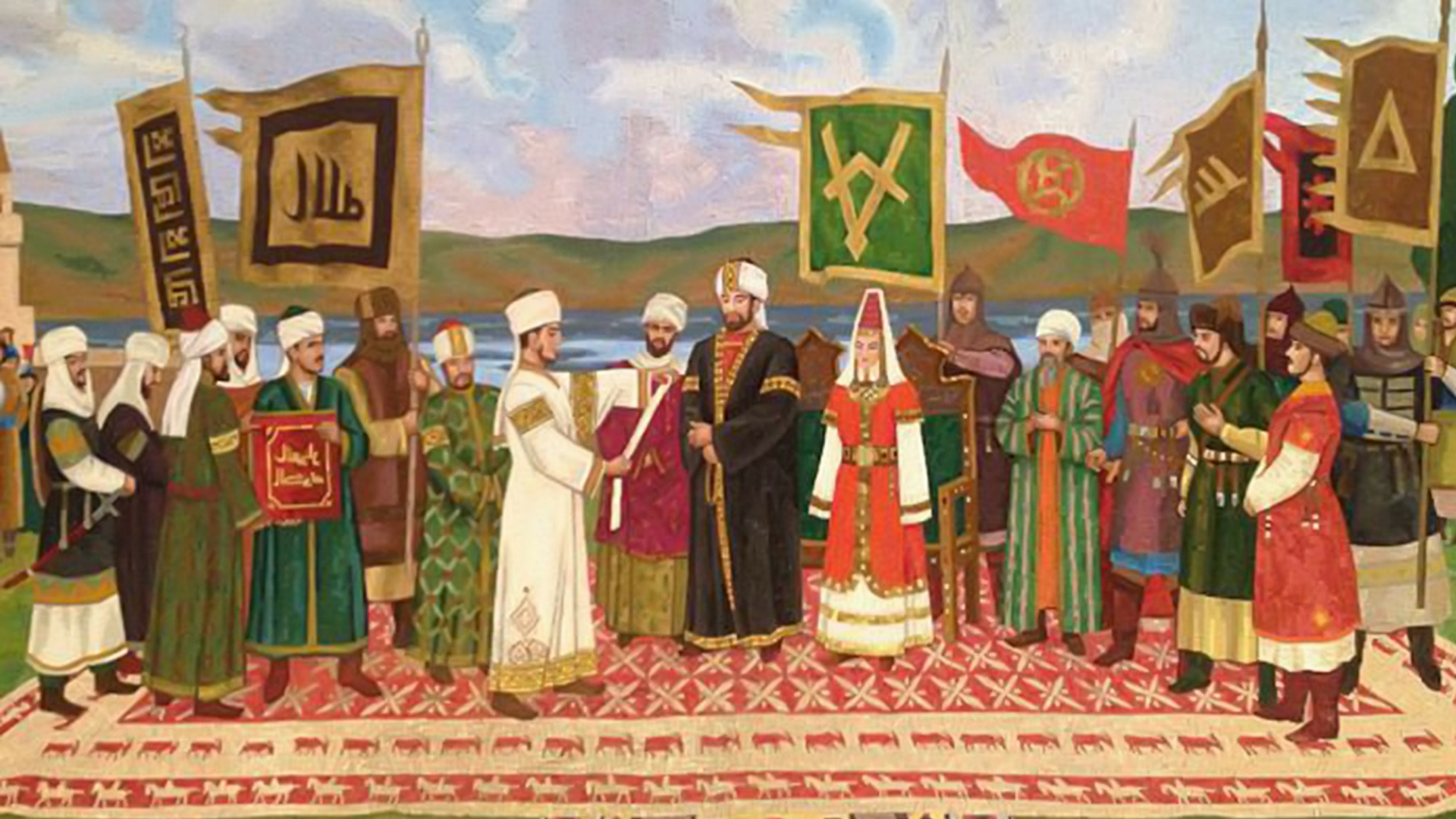
The first autonomous Muslim region in Russia was the Bulghar Kingdom in the Middle Volga region.

The ruler of the Bulghar, Bin Salki Belekvar, requested the Abbasid caliph, al-Muqtadir, to dispatch Islamic scholars to teach Islam.

This autonomous state existed from the eighth century until its invasion by the Mongols in 1236 C.E.

The next wave of the spread of Islam in Russia took place during the “Golden Horde” province of the Chenghizid Empire.

Under the rule of Uzbek Khan (1312-42), Islam became the official religion of the entire kingdom ran by the Volga Bulghar.

The territories of Christian subjects, such as the Russians, Armenians, Circassians and Crimean Greeks paid the “jizyah”.

These vassal states were never forced into the Golden Horde and were able to preserve their religion under Muslim rule.

But the political status of Islam was due to be reversed drastically in the region by the mid-sixteenth century.

The newly-established mighty Russian state under the Ivan IV (the Terrible), invaded the Kazan and Astra khan states.

Over the next three centuries, Russia expanded into Muslim-inhabited lands of Siberia, the Caucasus and Central Asia.

In 1859, Muslims of Dagestan lost their country to Tsarist Russia after 34 years of resistance under Imam Shamil (1797-1871).

The Russian victory had a devastating impact on Caucasian Muslims. Thousands were deported to Siberia.

Hundreds of thousands more were forced to flee to the Ottoman Empire.

Russia’s conquest of Central Asia was completed in 1885. By the 20th century, Russia had over 14 million Muslims.

From then on, Muslims were faced with coercive Christianization and Russification, which was central to Moscow’s policy.

Unknown to many, Islam has a long history in Russia. Today there remains 16-20 million Muslims in Russia
#history#islam#russia

Related Intelligence

More articles
The Beijing Buffer: China’s Strategic Checkmate in the Persian Gulf
China

The Beijing Buffer: China’s Strategic Checkmate in the Persian Gulf

Beijing’s mediation of the US-Iran accord signals a fundamental shift in maritime power. By positioning itself as the indispensable guarantor of Gulf stability, China has effectively neutralized decades of Western naval dominance.

20 Jun 2026

The APRA Mandate: Australia’s Financial Hedging for a Post-US Order
United States

The APRA Mandate: Australia’s Financial Hedging for a Post-US Order

As Canberra adjusts its regulatory framework to account for intensifying geopolitical shocks, a deeper shift is occurring: Australia is decoupling its financial stability from the total reliance on the American security umbrella.

19 Jun 2026

The Silicon Strait: China’s Data Hegemony in the South China Sea
China

The Silicon Strait: China’s Data Hegemony in the South China Sea

Beijing is transforming the South China Sea from a contested waterway into a high-tech data corridor. By integrating AI infrastructure with maritime power, China is effectively bypassing the strategic vulnerability of the Malacca Strait.

18 Jun 2026

The Bismarckian Pivot: India’s German Deep-Tech Realignment
South Asia

The Bismarckian Pivot: India’s German Deep-Tech Realignment

As New Delhi systematically decouples from its legacy Russian military dependency, a new strategic architecture is emerging. Berlin is no longer just a trading partner; it is becoming India’s primary engine for industrial sovereignty.

17 Jun 2026

The Uralic Lever: Russia’s Strategic Pivot to New Delhi
Russia

The Uralic Lever: Russia’s Strategic Pivot to New Delhi

Moscow is trading short-term energy profits for a permanent strategic alliance with India. This shift signals the end of Russian dependency on European markets and the birth of a new Eurasian power axis.

17 Jun 2026

The Iranian Chokepoint: Why $200 Oil is Tehran’s Strategic Veto
Middle East

The Iranian Chokepoint: Why $200 Oil is Tehran’s Strategic Veto

As regional tensions escalate, Iran’s ability to throttle the Strait of Hormuz has transformed from a military threat into a sophisticated macroeconomic weapon designed to neutralise Western sanctions and leverage global energy markets.

16 Jun 2026