Tensions rise after Turkish soldier is killed
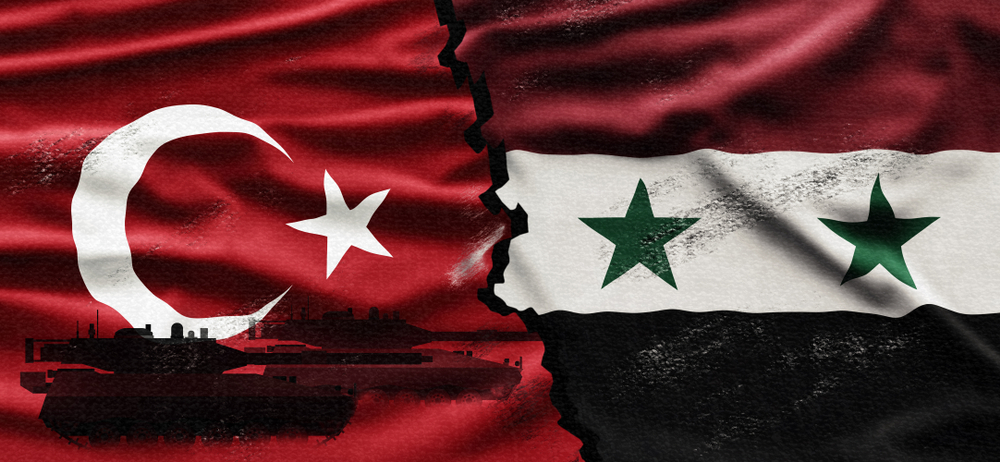
In the past months, tensions between the Assad regime and Turkey have reached unprecedented levels, as advances made by the regime in Idlib and Aleppo have threatened and even directly attacked Turkish military posts in the area.
Most recently, the Turkish defence ministry said a Turkish soldier had been killed in Syria’s Idlib province in a bomb attack by government forces, becoming Turkey’s 16th military death during a month in which talks between Ankara and Moscow have failed to de-escalate a recent spike in the fighting. As highlighted in an earlier article, this has led to the danger of breaking down relations between Turkey and Russia.
Turkey has sent thousands of troops and equipment to the region just south of its border to head off the government forces’ campaign driven by Russian air raids. Already hosting some 3.7 million Syrian refugees. In recent days, alarmingly to Assad and his Russian allies, Turkey-backed opposition fighters have recaptured a town in northwestern Syria after clashes with government-allied fighters. Turkish state media and a war monitor reported on Monday that rebels seized the town of Nairab, considered a gateway to the strategic town of Saraqeb, which lies close to a junction between two major highways.
The surge in fighting, as the Syrian government tries to retake the country’s last rebel-held province, has created the largest displacement of people in the war’s nine-year history. About 700,000 people have fled their homes in Idlib since December, the United Nations said Tuesday. Many are living in tents near the Turkish border, and there have been recent reports of children freezing to death.
As Turkey and the rebels appear to make advances and are countering the regime’s push, Turkey’s army is increasing direct involvement and is increasing the chances of a full-scale offensive into Syria.
Last hope of negotiations?
As tensions increase at a rapid pace, hopes for positive negotiations have reduced, but there is still openness from Turkey to negotiate and organize talks with Russia, Germany and France.
Turkey’s President Recep Tayyip Erdogan on Saturday said he would hold a summit with the leaders of Russia, France, and Germany on March 5 to discuss the situation in Syria’s last rebel enclave of Idlib, where a recent push by regime forces has displaced nearly a million people. “We will come together on March 5 and discuss these issues,” Erdogan said in a televised speech, following a phone call on Friday with Russian President Vladimir Putin, and his teleconference with French President Emmanuel Macron and German Chancellor Angela Merkel. “I expressed our determination on (Idlib) clearly to Vladimir Putin yesterday. I also mentioned it to Angela Merkel and Emmanuel Macron,” Erdogan said. “On March 5, we will meet with Putin, Macron, and Merkel, and we will talk about these again.”
Macron and Merkel on Friday expressed concern about the humanitarian situation in Idlib and urged an end to the conflict, while the Kremlin said it was discussing the possibility of holding a four-way summit. The Turkish president told Putin over the phone on Friday that the solution was to return to the Sochi agreement they signed in 2018, which allowed Turkey to establish military posts across Idlib designed to prevent a Syrian government assault.
It is therefore clear that there is still willingness from the main sides to negotiate, however, the preview of this negotiation does not look good, as Turkey looks to maintain an agreement that Russia and Syria have broken. A compromise will be crucial in determining the quality and success of these negotiations.
Erdogan under pressure
Turkish PM Erdogan is facing a difficult situation, as his position in Syria is threatened, and millions of refugees are flooding into Turkey from the nation. Relations with Russia are at threat, while he is expected by the Turish people to stand strong and maintain Turkish interests in Syria.
Some say that Erdogan cannot afford to back down from its Syria policies since the crisis in the war-torn country is an existential one for him. Meanwhile, already under domestic pressure to encourage refugees to return to Syria, a huge wave of new refugees would kill his future re-election prospects. Worse still for Turkey, a defeat in Idlib could irreversibly damage its military presence elsewhere in northern Syria, which is viewed internally as a crucially important buffer protecting the homeland from Kurdish-led terrorist threats.
This month, as many as 17 Turkish soldiers have been killed by Syrian regime forces in the northwest Idlib province and several Turkish military observation posts — which Ankara thought were safe under deals with Russia, a key Damascus ally — ended up being surrounded in areas retaken by the regime. Desperate to prevent a victory by his sworn enemy Assad and a new influx of refugees swarming to Turkey’s border gates, Erdogan has threatened an operation against Damascus forces unless they pull back by the end of February.
This is a difficult situation for Erdogan, where he must stick to the nation’s policy in Syria while also attempting to limit the refugee influx into Turkey. This may prevent him from launching a full-scale offensive in Syria, and simply strengthen existing military posts.