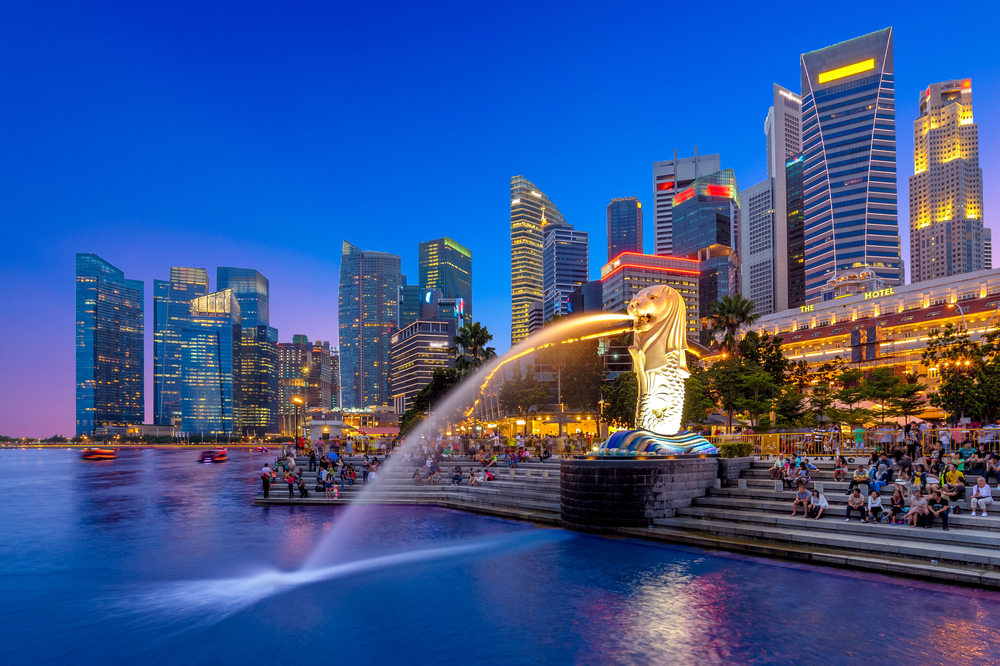
Mainstream media tend to portray Singapore as a city-state whose main business is international banking, commerce, high end manufacturing and education. Some critics describe the small Asian country as a dictatorship, totalitarian and even fascist state. As always, the truth lies somewhere in the middle.
DEMOCRACY OR DICTATORSHIP
It is quite debatable whether Singapore is a democratic society. It is extremely difficult to define democracy in the first place, as that word lost its original meaning a long time ago. If modern democracy is simply the political weapon of money, then Singapore can be listed as a democratic nation. Some authors argue that the Southeast Asian city-state is more like a dictatorship operating under the guise of a functioning democracy. In any case, it is a very functional country of 5.5 million about the size of Saint Petersburg in Russia.
Lee Kuan Yew, the founding father of Singapore who served as the country’s prime minister for 31 years, legitimized the idea that it is possible to have progress without democracy.
“The exuberance of democracy leads to undisciplined and disorderly conditions which are inimical to development,” LKY once said.
Some authors claim that the Chinese leadership favors Singaporean-style governance as a feasible model for the future. The so called Singapore model is a direct product of Lee’s personality, as well as the decision of the global finance capital to house one of its headquarters in this tiny piece of land. Since Singapore has very few natural resources, major world powers do not have any interests to compete over the control of the Singaporean territory. The very foundation of this city-state in 1965 is likely a product of a deal between various global oligarchic groups. Singapore’s most important raison d’être is to serve as a financial center in Southeast Asia and to maintain the global finance system in this part of the world.
Some researchers call Singapore a benevolent dictatorship. It is a system in which an authoritarian leader exercises absolute political power over the state but is perceived to do so with regard for benefit of the population as a whole. Besides the deceased Lee Kuan Yew, this label has been applied to leaders such as Saddam Hussein of Iraq, Muammar Gaddafi of Libya, and Josip Broz Tito of Yugoslavia. However, unlike Saddam and Gaddafi, LKY was never overthrown by the West, and unlike in the case of former Yugoslavia, the Western powers never took part in the breakup of Singapore, which could mean that major global actors have certain benefits from the existence of the entity such as Singapore.
It is worth noting that last year the city-state was ranked the fourth most competitive financial center in the world. According to Murray Hunter, an associate professor at the University Malaysia Perlis, Singapore is run in a manner to which a British colonial administrator would have aspired. He argues that the strong control of Lee Kuan Yew was the dominant driver of society. LKY opened the country to foreign trade and investment but held a choke hold on politics, keeping the media tamed and the tiny opposition cowed. When Singapore attained self-government in 1959, only nine percent of Singaporeans resided in public housing. Today, 80 percent of the population lives a government built apartment.
Also, today 90 percent of land is owned by the state as opposed to 49 percent in 1965. Finally, four in ten people in Singapore are migrants, which is also the case in many oil-rich Middle East countries. Migration is expected to continue as the local Singapore population is rapidly aging.
BETWEEN CHINA AND THE US
According to the doctrine of Singapore’s ruling party, the People’s Action Party, a good government is one with the ability to convince its citizens to compromise individual liberties for long-term collective interests. In Singapore an authoritarian government is seen as necessary to protect the country from being bullied in the neighborhood.
Singapore is striving to maintain a strategic balance among the United States and China, as relations in the region shift. From the geopolitical perspective, the country has avoided picking sides and maintains good relations with much of the world.
As Simon Tay, Chairman of the Singapore Institute of International Affairs, points out, in today’s world the UK no longer provides the dominant framework for global order; the US does. Singapore recognized this and started to step up engagements with the US decades ago.
Last year Singaporean authorities reportedly said they would renew a memorandum of understanding that gives Washington access to Singapore’s air and naval bases. The city state has also ordered several F-35 combat jets, manufactured by US group Lockheed Martin, to replace its ageing F-16s. It is also worth mentioning that from 1966 Israeli military advisers were brought in to train the Singaporean military. Israel also supplied Singapore with military hardware including tanks and missiles.
According to the Financial Times, both China and the US are critical commercial partners for the city state. China is Singapore’s largest trading partner as well as the top recipient of the city state’s outward direct investment, while the US is the biggest source of foreign direct investment for the island nation.
“While Singapore shares many economic and cultural ties with China, it has also emerged as a viable alternative for investors who would like to capitalize on China’s rapid economic growth but do not want to be invested directly in China’s capital markets” wrote scholar Woo Jun Jie.
Simon Tay, on the other hand, emphasizes that Singapore’s interests are not to permanently ally with one major power or another.
“Beyond these two great powers, it is increasingly important to work with the Association of Southeast Asian Nations, and others farther away like Japan, France and Germany and other like-minded partners in Europe, and Canada – all those who support a rules-based and inclusive order in Asia and across the world” wrote Tay.
Singapore is very westernized. English is the main language, and even though Chinese make the majority of population the government is not embracing Chinese culture. In fact, it is quite questionable whether cultural life exists in Singapore at all.
SINGAPORE AS A FINANCIAL OUTPOST
Author Audrey Jiajia Li claims that an effective legal system is crucial to the success of Singapore’s governance approach and a key reason Singapore stays nearly corruption-free. However, Singapore’s position as one of the world’s leading financial centers and a trade hub make it particularly vulnerable to money laundering due to large cross-border flows.
Some critics argue that late Lee Kuan Yew has managed to intimidate and subjugate through bribes, monetary favors and high salaries, the top echelons of the power, namely the judiciary and top civil servants, to obey him and fulfil all of his demands.
Gopalan Nair, a US based blogger who claims to be a Singaporean dissident, wrote that the true Singapore is the decadent corrupt one party state where the government seeks to exercise strict control over all aspects of public discourse. According to Nair, Singapore is a system where the family of the deceased Lee Kuan Yew, as well as a small circle of chosen people, run the show. In any case, since modern Singapore was founded in 1819 when Stamford Raffles, a British colonial officer, established a trading post of the East India Company on the main island, it is no surprise that, to this day, the tiny nation serves as a major financial outpost for the global elite.