For many historians, the arrival of the Mongols in Baghdad is the single most devastating moment in the history of the Muslim Middle East.
It’s easy to see why—and hard to argue otherwise—because the ransacking of Baghdad would mark the end of the Islamic Golden Age.
Baghdad had been established in 762 by the Abbasid Caliph al-Mansur. Throughout its history, it had been the capital of the Muslims, as well as the world in general.
The libraries of Baghdad were unrivaled. The House of Wisdom, established soon after the city was built, was a magnet for the most intelligent scientists, thinkers, mathematicians, and linguists of the world.
But by the mid-1200s, the Abbasid Caliphate was nothing but a shell of its former self, having no power outside of Baghdad.
Most of Persia was disunited as the Khwarazmian Empire had mostly deteriorated by then. The Ayyubid state established by Salah al-Din was only in control of small parts of Iraq and Syria.
The Abbasid army was effectively non-existent, and only served as bodyguards of the caliph. And the scientific achievements of the Muslim world were now centered in places such as Cairo, Muslim Spain, and India.
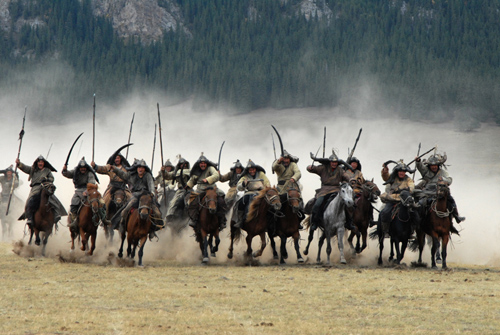
It was at this historic and landmark city that the Mongols arrived in 1258. Their army, estimated at over 150,000 soldiers, stood before the city that was just a shadow of the great capital of the Muslim world of the 800s.
The siege began in mid-January and only lasted two weeks. On February 10th, 1258, the Mongols entered the city of the caliphs.
A full week of pillage and destruction commenced. The Mongols showed no discretion, destroying mosques, hospitals, libraries, and palaces.
The books from Baghdad’s libraries were thrown into the Tigris River in such quantities that the river ran black with the ink from the books.
The loss of life is estimated that between 200,000 and 1,000,000 people were butchered in that one week of destruction.
Baghdad was left completely depopulated and uninhabitable. It would take centuries for Baghdad to regain any sort of prominence as an important city.
After Baghdad, the Mongols continued on westward. They conquered Syria from the Ayyubids, with help from the Armenians and neutrality from the Crusaders.
In Palestine they reached the extent of their conquests. The new Mamluk Sultanate of Egypt, under the leadership of Baibars defeated the Mongols at the Battle of Ain Jalut in 1260.
This prevented a Mongol invasion of the Holy Lands of Makkah, Madinah, and Jerusalem. This also ensured the safety of the only remaining powerful Muslim empire of the time, the Mamluks.
Despite ultimately being unsuccessful in their attempt to destroy Islam, the Mongols left a deep political, economic, and military scar in the heart of the Muslim world.
Entire regions were depopulated. Irrigation canals, fields of crops, and economic infrastructure were destroyed beyond repair.
The political institutions, such as the caliphate, that held the Muslim world together for centuries were simply abolished.
The Mongol Il-Khanate established by Hulagu’s descendants would rule over Persia, Iraq, and Anatolia for over 100 years.
Over decades and centuries, the Mongols in Southwest Asia slowly converted to Islam and became absorbed in a Persian/Turkish culture.
The Mongol invasion is one of the most demoralizing times of Islamic history, but from which we can learn an important lesson.
The Muslim world was largely unable to repel the Mongol invasion due to disunity and weak political and military institutions.
Throughout Islamic history, disunity has always led to invasion and defeat, while unity has led to great Islamic times that benefited the entire world.
Don’t forget to subscribe to our YouTube Channel
Support our content by becoming a KJ Patreon
https://www.patreon.com/kjvids
Website – www.kjvids.co.uk
Facebook – www.facebook.com/KJVids
Twitter – www.twitter.com/kjvids2016
Instagram – www.instagram.com/kjvidsofficial
All Rights Reserved. Contact info@kjvids.co.uk if you are interested in licensing our content, advertising or working with us in other ways.