Turkish and US top diplomats meet
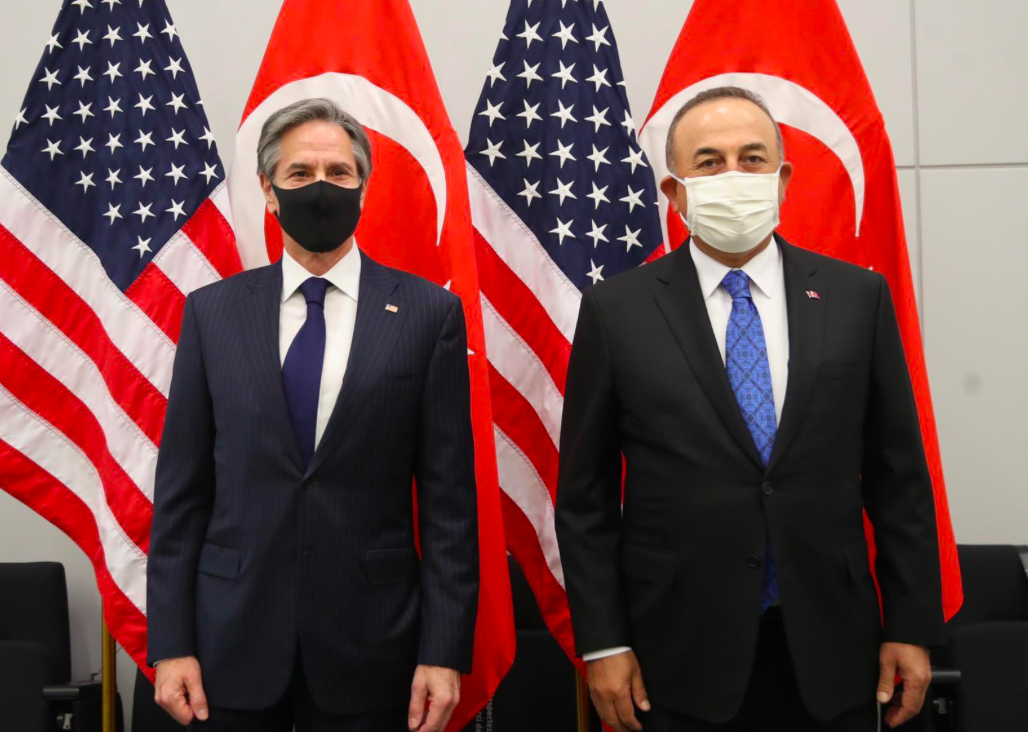
Turkey’s Foreign Minister Mevlut Cavusoglu met with US Secretary of State Anthony Blinken in Brussels on Wednesday.
FM Cavusoglu stated that he and his US counterpart Blinken discussed all aspects of bilateral relations in a constructive meeting.
Afghanistan, Cyprus, Eastern Mediterranean, Syria, Iraq, Libya and fight against terrorism were discussed.
Underlining that Turkey wants to host a conference on Afghanistan in April, he said Turkish officials would meet with all parties to decide on a date.
After brief talks, Turkey’s Foreign Minister Mevlut Cavusoglu said on Wednesday that he and his US counterpart plan to hold a more comprehensive meeting in either the US or Turkey.
“We agreed with the US secretary of state to hold a broader meeting in either the US or Turkey,” Cavusoglu told reporters in Brussels.
Cavusoglu’s remarks came after he met with Anthony Blinken on the sidelines of a NATO foreign ministers’ meeting. He said today’s meeting lasted less than an hour.
US ties with YPG a major roadblock
The US’s continued and even improved ties with the PKK-affiliated YPG has been a major thorn in US-Turkey ties.
Furthermore, the United States warned on Wednesday that efforts to bar the main pro-Kurdish party in Turkey would undermine the nation’s democracy.
A Turkish prosecutor has asked the Constitutional Court to shut down the Peoples’ Democratic Party (HDP), the third-largest group in parliament. The party stands accused of links to the PKK, recognized as a terrorist organization by the EU and US.
“We are… monitoring the initiation of efforts to dissolve the People’s Democratic Party, a decision that would unduly subvert the will of Turkish voters, further undermine democracy in Turkey, and deny millions of Turkish citizens their chosen representation,” State Department spokesman Ned Price said in a statement.
“We call on the government of Turkey to respect freedom of expression in line with protections in the Turkish constitution and with Turkey’s international obligations,” he added.
Wednesday’s request to ban the party came from a Supreme Court prosecutor who is investigating the HDP.
Furthermore, the United States deputy special envoy to Syria celebrated Nevruz with the leader of the YPG, the Syrian branch of the PKK terrorist group, Ferhat Abdi Şahin, codenamed Mazloum Kobani, despite its NATO ally Turkey’s concerns over the terrorist group and Washington’s recognition of the PKK as a terrorist organization.
If relations between Turkey and the US are to be direct and sincere, then the US will have to end its support for the YPG or at least hide it. Otherwise, it will act as a thorn in the alliance between the two biggest powers in NATO.
Turkey’s use of Russian systems a worry
On Turkey’s purchase of the Russian S-400 defense missile system which was brought up during the meeting, Cavusoglu reiterated that Turkey has already purchased the system and the deal was concluded.
He ruled out reversing the decision but repeated Turkey’s offer to set up a commission with the US to clarify any technical issues.
The US has claimed the Russian system poses a threat to NATO weapons systems.
Turkey says its efforts to buy missile defense from the West were rebuffed, and also that the S-400 and NATO systems would not be integrated, so there is no threat.
The US’s worry about Russian systems on Turkish soil does not end there, as Russia’s announcement that it is ready to hold negotiations with Ankara on the delivery of Su-35 and Su-57 fighter aircraft if requested may cause further tensions between the US and Turkey, experts say.
Turkey hired a Washington-based law firm last month to lobby for its readmission to the US F-35 fighter jet program after it was suspended following its purchase of the Russian air defense system. Washington says the presence of the Russian S-400 system in Turkey would be incompatible with NATO systems and expose the F-35s to possible Russian ploys.
Turkey’s previous order for about 100 F-35s was also canceled by the US, pushing Ankara to search for alternatives from other procurers and to focus on building its own fighter jet.
On March 12, Valeria Reshetnikova, the spokesperson for Russia’s Federal Service for Military and Technical Cooperation (FSMTC), said: “As for Ankara’s potential plans of purchasing Russian Su-35 and Su-57 fighters, the Turkish side has been informed about their technical specifications in full. If there is a request from Turkey for these planes, we are ready for negotiations on this issue.”
“The Turkish side has for quite long stated its intention to implement the project of developing its own TF-X fifth-generation fighter. Russia earlier indicated that it was ready to consider the possibility of cooperation under this program. However, we have not received the corresponding request from Ankara so far,” Reshetnikova said.
Such Turkish-Russian cooperation has worried the US. However, Aydin Sezer, an expert on Turkey-Russia relations, said the latest call by Russia to negotiate the purchase of Russian-made aircraft is a tactical move to keep Moscow-Ankara military cooperation on the Western agenda. “The Kremlin knows very well that Turkey will not purchase a Russian jet,” Sezer told Arab News. “Even if it decides to buy it, it will receive it in 10 years’ time at the earliest. Russia wanted to remind Turkey of its unfulfilled commitments while trying to break ties between Turkey and the Biden administration from the very beginning,” he said.
Should Turkey make it clear that they indeed do not intend to do so to the Biden administration, relations could improve much more smoothly. Furthermore, According to Sezer, Turkey’s recent foreign policy moves have disturbed Russian policymakers.
“Ankara pledged to buy the second batch of S-400s last year, but since two months there is no attempt from Ankara to negotiate it as if it suddenly forgot all its previous commitments,” he said.