Terror attacks in Northern Syria
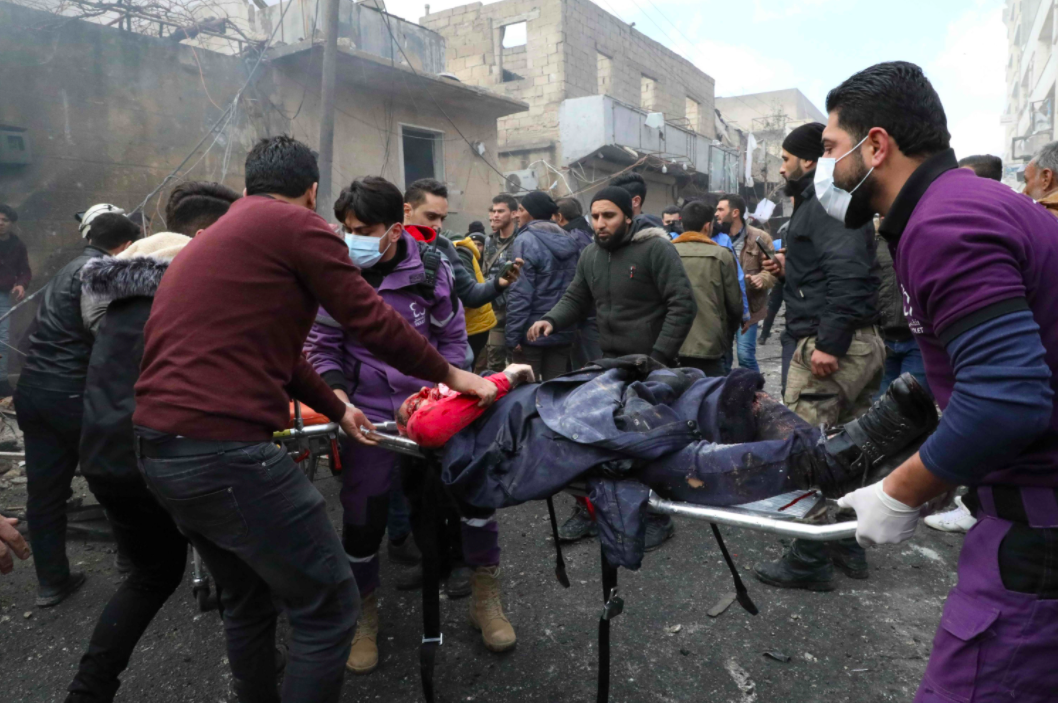
A car bomb exploded on Sunday in northwestern Syria’s Azaz killing four people, a war monitor reported, making it the second attack of its kind in the region in two days.
At least 22 others were injured in the explosion in the town of Azaz in the countryside of the northern province of Aleppo, the Syrian Observatory for Human Rights added.
The explosion also resulted in heavy material damage, the Britain-based monitor added without details.
The blast took place near the town’s cultural center which is being used as the opposition government’s base, a local police source told Deutsche Presse-Agentur (dpa).
On Saturday, a car bomb believed to have been deployed and detonated by YPG terrorists in the center of the northern Syrian town of Afrin claimed the lives of six civilians, including a child.
The car, which contained explosives, blew up in a neighborhood where workshops are located during the afternoon rush hour on the first working day of the week. The blast killed a child, three other civilians and an unidentified person, the Syrian Observatory for Human Rights (SOHR) said in remarks carried by the Agence France-Presse (AFP).
The attacks took place in highly congested and densely populated areas, which are near government buildings and an NGO cultural center.
So far, responsibility has not been claimed for either attack.
Afrin and other districts under Turkish control are regularly targeted by the YPG, which seized control of large swathes of land in the northern parts of the war-torn country with the Bashar Assad regime’s blessing when clashes intensified back in 2012.
Ankara considers the YPG, which was deployed by the U.S.-led anti-Daesh coalition under the pretext of fighting the terrorist group on the ground, a grave national security threat.
The US’s support for the YPG
The U.S. began supporting the YPG somewhat reluctantly, as an expedient way to counter the rise of Islamic State (IS) in 2014 without deploying large numbers of U.S. troops to Iraq.
The catalyst for U.S. backing of the YPG was the IS siege of the northern Syrian town of Kobane, close to the Turkish border. During that battle, the U.S. began conducting airstrikes in support of the Kurdish fighters, who eventually broke the siege.
At the time, some inside the U.S. government opposed teaming up with a group opposed to Turkey, a NATO ally. Apart from causing friction with Turkey, critics said the Kurdish group alienated some of Syria’s Arab population.
After halting the IS offensive, the U.S. continued to support the YPG as a “reliable ally” against Islamic State. An anonymous U.S. State Department official was quoted as describing the U.S. relationship with the YPG as “temporary, transactional, and tactical.” While the U.S. withdrew from northern Syria in late 2019, it still maintains ties with the group.
The U.S. has tried to assuage Turkish security concerns throughout the Syria conflict with steps that include pressuring the YPG to dismantle fortifications along the border with Turkey. The U.S. military allies also urged the YPG to change its “brand,” leading to the creation of a coalition known as the Syrian Democratic Forces (SDF).
Although the United States and Turkey designate the PKK as a terrorist group, U.S. policymakers have said that they view the YPG in Syria as a separate group from the PKK. However, this contradicts the US Justice Department’s statement last month, saying that the YPG is a “sub-affiliate of” the PKK.
The US condemns the attack: Will the US reconsider its support?
The United States condemned the trio of terrorist attacks suspected to have been carried out by PKK’s Syrian offshoot YPG terrorists in northern Syria that killed at least 20 civilians, including women and children, over the weekend. Washington failed to make any reference to the terrorists or review its relations with the group, however, despite the fact that local security forces have blamed the YPG for the deadly assaults.
“The United States condemns the terrorist attacks this past weekend in Azaz, al-Bab and Afrin that resulted in the deaths of at least 20 civilians, including children,” said State Department Spokesperson Ned Price in a statement on Monday, without referring to the YPG.
“The United States is deeply alarmed by the frequency of such attacks in recent months, including the repeated use of vehicle-borne improvised explosive devices,” said the statement.
“Those responsible for perpetrating the violence should be brought to justice. Their actions endanger the Syrian people and threaten to destabilize the region further,” it added, even as the U.S. openly supports and previously provided assistance to the terrorist group despite Turkey’s opposition.
According to local security sources, YPG terrorists continue to carry out attacks but do not claim responsibility if civilians are harmed.
Among this condemnation, the question surfaces as to what stance new American president Joe Biden will take towards the YPG. Early signs have not shown anything conclusive, although the recent condemnation could point towards a withdrawal of US support for the group, other signs have shown contradictory tendencies.
The YPG is reportedly according to a statement by Ferhat Abdi Şahin, code-named Mazloum Kobani, signaling that Washington is eager to continue its trend of supporting terrorist forces in the region, he said during an interview with the United Arab Emirates (UAE)-based Al Arabiya.
Şahin said the election of Biden gives him “more hope to find a realistic solution to the Syrian crisis.” Experts have noted that relations between Turkey and the U.S. can only improve if the Biden administration shifts its YPG policy in Syria.
Current indicators however, show that the Biden administration intends to continue, and possibly enhance the US’s support for the YPG, which could be a major blow to US-Turkey relations.