
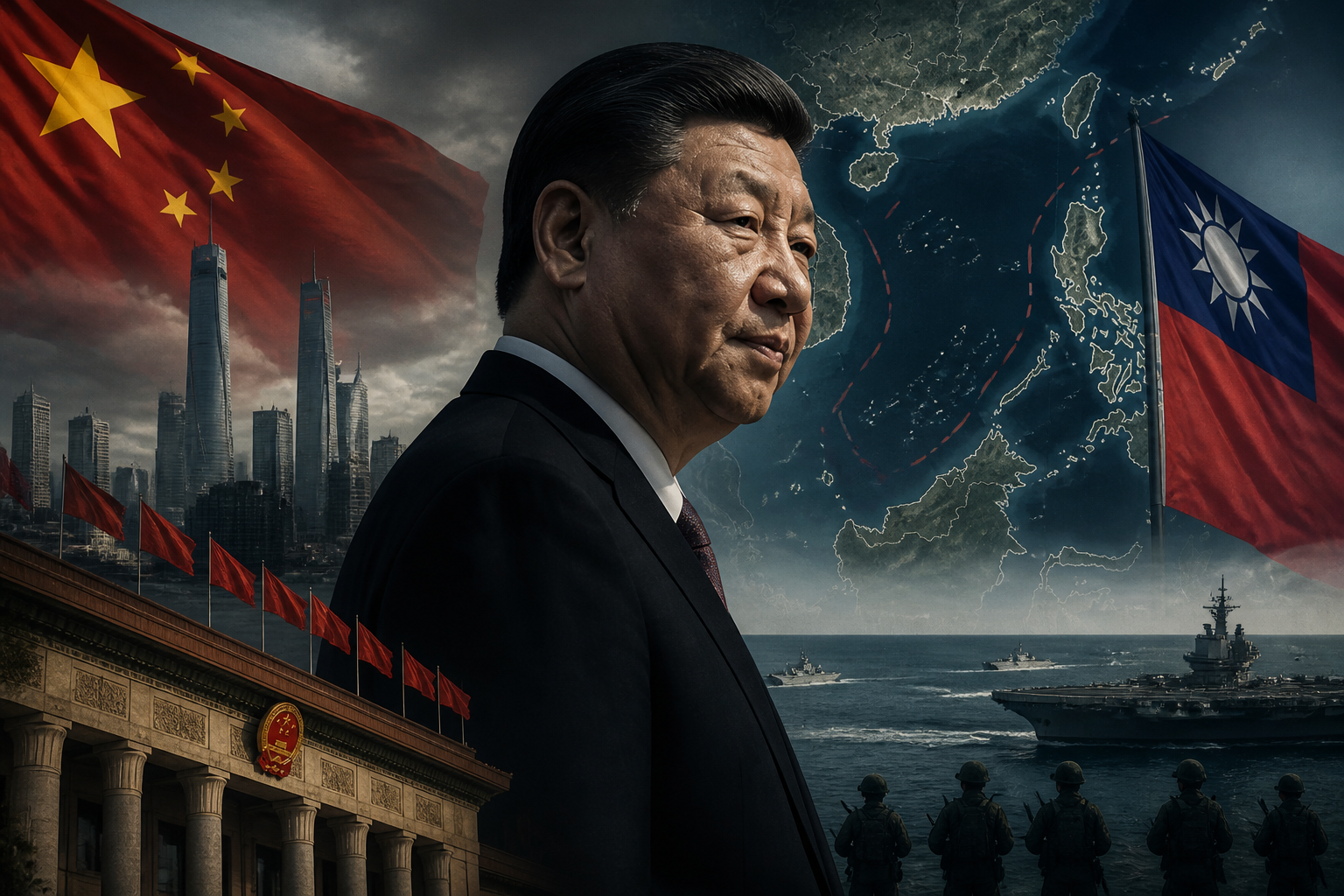
The centralisation of power in China under Xi Jinping is not a sign of confidence, but an admission of fragility. For four decades, the Chinese Communist Party (CCP) operated on a silent pact: the state provided growth and order, and the people provided compliance. As that growth slows, the pact is being rewritten. Xi is shifting the state’s primary output from prosperity to security. This transformation is logical from the perspective of regime survival, but it carries a staggering price. By prioritising loyalty over competence and control over innovation, the leadership is inadvertently dismantling the very engines of the Chinese miracle.
The Core Incentive: Survival over Surplus
To understand why Beijing is tightening its grip, one must look at the incentive structure of the modern CCP. In the 1990s and 2000s, local officials were rewarded for GDP growth. This created a competitive, if often corrupt, laboratory for economic expansion. Today, the metric has changed. A provincial governor is now more likely to be purged for a perceived lapse in ideological discipline or a security breach than for a missed growth target. When security becomes the only KPI that matters, risk-taking vanishes. This is why we see 'policy paralysis' at the local level. Officials are waiting for explicit instructions from the top before acting, fearing that any independent initiative could be branded as dissent.
The Economic Friction of Ideology
The price of control is most visible in the private sector. The crackdowns on tech giants and the tutoring industry were not merely about reining in 'excesses'. They were preemptive strikes against alternative power centres. In Xi’s worldview, any entity that can aggregate data, influence public opinion, or mobilise capital outside the direct supervision of the Party is a latent threat. The second-order effect is a 'quiet quitting' of the Chinese entrepreneur. Capital is fleeing to Singapore and Tokyo, not because it seeks higher returns, but because it seeks safety from the arbitrary whims of an absolute central authority.
The central paradox of Xi’s era is that the more the Party secures its hold on society, the less capable that society becomes of solving the complex problems required to escape the middle-income trap.
A Historical Parallel: The Late Ming Stagnation
Historical parallels are often sought in the Mao era, but the late Ming Dynasty offers a more chilling comparison. The Ming state, also obsessed with internal security and ideological purity, increasingly turned inward. It restricted maritime trade, intensified domestic surveillance through the secret police, and centralised all decision-making in the Forbidden City. The result was a state that appeared formidable on paper but was structurally unable to adapt to external shocks or internal dissent. Like the Ming, the current leadership sees decentralised power as the root of chaos, failing to realise that decentralisation was the source of the system’s resilience.
What Most People Miss: The Bureaucratic Brain Drain
Mainstream analysis focuses on the billionaire class, but the more significant damage is occurring within the technocracy. The CCP’s strength used to lie in its ability to recruit the 'best and brightest' into the civil service. Today, the environment of constant rectification drives and ideological study is repelling the pragmatists. We are seeing a brain drain out of the government and into the background. When the technocrats—those who understand debt cycles, semiconductor physics, and international law—are replaced by 'red' sycophants, the quality of governance collapses. Bad data flows up because no one wants to report failure, leading to a feedback loop of catastrophic policy errors.
Strategic Consequences: The Fragile Superpower
A centralised China is a more predictable but more brittle actor on the world stage. Because power is concentrated in one man, the entire system is hostage to his personal cognitive biases. This has three primary consequences:
- Military Inflexibility: The PLA’s command structure is becoming increasingly rigid. While it looks powerful in a parade, the lack of decentralized initiative—the same problem that plagues the Russian military—will be a liability in high-tempo modern conflict.
- Diplomatic Overreach: 'Wolf Warrior' diplomacy is a product of domestic signalling. Diplomats are performing for an audience of one in Beijing, regardless of how much damage they do to China's international standing.
- Capital Misallocation: Resources are being poured into state-led 'hard tech' at the expense of the consumer economy. This may win specific battles in the chip war but will lose the broader war of economic sustainability.
What to watch
- The Social Credit Evolution: Watch for the integration of AI-driven predictive policing into the workplace to monitor 'loyalty sentiment' among white-collar workers.
- State-Owned Enterprise (SOE) Mergers: Further consolidation of industry into mega-SOEs will signal the final abandonment of market-led competition.
- Succession Silence: The total absence of a designated successor will increase the 'key man risk', making the Chinese markets increasingly volatile as Xi ages.
The KJ Verdict
Xi Jinping has successfully traded China’s future growth for his own political security. By turning the state into a panopticon, he has mitigated the risk of a palace coup or a popular uprising in the short term. However, he has also suppressed the feedback loops necessary for a complex economy to function. China is not headed for a sudden collapse, but for a long, grinding period of stagnation. The 'Chinese Century' is being cut short not by external containment, but by internal contraction. A nation that fears its own citizens more than its rivals will eventually find itself unable to compete with either.