Indonesia is the world’s largest Muslim country by population and is one of South-East Asia’s most dynamic economies. Located at the juncture between the Pacific and Indian Oceans, it has the potential to become a leading regional power. However, its location is also a source of considerable challenges that Indonesia will have to manage attentively in the coming years.
Indonesia’s geography
The very name Indonesia is revealing: it comes from Greek and means “Indian Islands”. As a matter of fact, Indonesia is an archipelago located at the eastern edge of the Indian Ocean, and this is a key factor that has shaped its geopolitical thinking.
In terms of dimension and configuration, Indonesia is a vast but fragmented state. It counts over 18,000 islands; the most important of which are Sumatra, Java, the southern section of Borneo, Sulawesi and the western part of New Guinea. These islands, covered by a thick rainforest rich in wildlife, have a volcanic origin. This means that Indonesia is vulnerable to seismic events and tsunamis; something that has a negative impact on its human security environment. The country extends over almost 8 million square kilometres if we take into account its maritime space including the Exclusive Economic Zone, or EEZ. Combined with its archipelagic nature, this makes it difficult for the central state to exert its power over all the territory; also because fragmentation is reflected in demographic terms: the population exceeds 260 million citizens divided in more than 300 ethnic groups; and this has important implications on the country’s geopolitics.
Moving on, Indonesia’s position has a deep impact on its foreign affairs. Located at the crossroad between the Indian and Pacific Oceans, Indonesia plays a pivotal role for international maritime trade. Sumatra is the southern boundary of the Malacca Strait, one of the world’s busiest waterways and a strategic chokepoint. But Indonesia also controls other important straits; notably Sunda, Lombok and Makassar. These are all essential for trade between Europe and Asia, but also for the latter’s energy security. Most of the oil it consumes transits through these narrow passages; which explains their geostrategic relevance. Indonesia hugely benefits from its role as a gateway between the two oceans, but this also brings considerable strategic problems because foreign powers have always been trying to control the archipelago. This continues today: China, the US, Japan and India all have major interests at stake in the Indonesian Straits, and are trying to expand their influence on the country. Finally, the archipelago also hosts important natural resources like oil, gas, minerals, timber and fish. These commodities are a source of wealth for Indonesia, but also another driver for the presence of external powers.
Indonesia’s geopolitical thinking
Indonesia’s nature as an archipelago and its “crossroad location”, a concept known as posisi silang, have shaped its geopolitical thinking since it gained independence from the Netherlands in 1949. Indonesia had to assert its authority over its surrounding seas to ensure its prosperity and security. A first step in this sense was the 1957 Djuanda Declaration, by which Indonesia claimed its sovereignty over all the maritime areas around the archipelago; especially those located between its main islands like the Java and Flores seas. This stance was later recognized internationally by the UN Convention on the Law of the Sea in 1982. The Djuanda Declaration was the first step towards a more comprehensive doctrine called “Maritime Archipelagic Outlook”, or Wawasan Nusantara Bahari. First formulated in 1966, this Doctrine still stands today. It considers that Indonesia’s particular location leaves it vulnerable to foreign meddling and that its fragmented geography endangers the unity of the state; but it is also the basis for justifying Indonesia’s leading regional role.
In geostrategic terms, the doctrine considers Java and its sea as Indonesia’s core, which must be protected from external threats. Applying a mandala logic, it identifies three concentric layers that are the base of Indonesia’s foreign and defence policy. The innermost circle is Indonesia itself, the middle one extends to South-East Asia and Australia, while the external zone includes the rest of the world. The sea is equally important from a geoeconomic point of view. Indonesia is a trade crossroad, it has an important fishing industry and its waters host important hydrocarbon deposits, estimated to hold 3.7 billion barrels of oil and 2,900 billion cubic feet [AG1] of gas. As such, securing the sea has a primary importance for the country’s economy. Finally, in geopolitical terms, it considers the sea as the space connecting the various islands that form its geographically and culturally fragmented territory. This configuration makes separatism easier, and therefore is seen as a threat to the unity of the state; even though it is also argued that the separation of the different national groups reduces the risk of inter-ethnic conflict. Moreover, the sea is the mean by which foreign powers have reached the archipelago in the past. Consequently, Indonesia believes that controlling the sea is a precondition to preserve the unity and the independence of the state. In this sense, it seeks to achieve resilience both at home and in neighbouring states, assuming that Indonesia is safe only if the archipelago and the surrounding countries are stable.
Yet, Indonesia must face several challenges. Apart from numerous secessionist movements, some of which have been successful, it must also cope with illegal fishing, smuggling, unauthorized immigration and piracy. The latter was once a major problem, but it has been greatly reduced thanks to multilateral efforts and by improving the living conditions of coastal areas. Terrorism is also a matter of concern, and several attacks have already taken place. In economic terms, even though Indonesia’s national strategy emphasizes the cohesion of the state and aims to limit foreign meddling, most of its hydrocarbons and of its resources in general are exploited by foreign corporations. In addition, there is a great disparity between urban areas like Jakarta and the rest of the country, especially outside Java.
Indonesia’s power
Indonesia can be considered a middle power, but it is definitely a rising one. Its GDP is the largest in South-East Asia, and in 2017 it amounted to 3.25 trillion measured in US dollars of the same year in terms of Purchasing Power Parity. This ranked the country as the world’s 7th largest economy, and it is projected to become the 4th by 2050. Indonesia’s steady 5% growth rate is helped by low inflation, a budget deficit under control and a public debt representing just 29% of the GDP. Moreover, saving is quite high at around 32% and investments are flowing in, thus paving the way to a continued growth. The trade balance is positive, driven by the export of commodities like oil, gas, coal, metals and palm oil; but also many other low added-value products such as clothing and electric components. Always in terms of PPP, its per capita GDP reached 12,700 dollars in 2017: a still low figure, but a remarkable progress from past levels. Unemployment is only 5.5%; yet, agriculture still retains 32% of the workforce and around 10% of Indonesians live below the poverty line, with 21% remaining at risk. The country also has real problems in terms of corruption and inequality, and must face notable environmental challenges: rising sea levels, deforestation, and extreme weather are already causing notable losses to its economy and are menacing its human security.
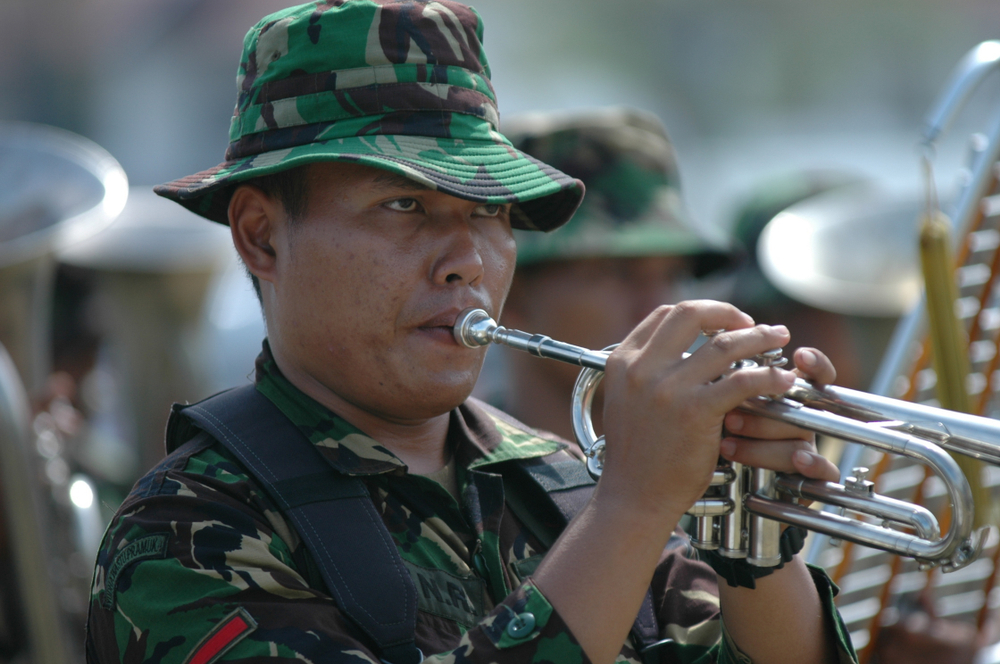
Indonesia’s armed forces are also evolving. It spends about 0.8% of its GDP on defence; and in spite of the emphasis given to the sea, the Army has a greater importance than the Navy. Land forces, notably marines and special forces units trained for asymmetric warfare, are indeed important for such a fragmented country; but the Navy remains underdeveloped. It mainly relies on corvettes, and having only 8 frigates and less than 5 diesel-electric submarines seems insufficient, even though it has a good park of minesweepers and there are talks to buy more subs. Similarly, the Air Force only counts around 40 fighters and some attack aircraft. These two branches have quite advanced equipment and are better than those of most ASEAN countries, but Indonesia will need to expand them to affirm itself as a regional power and to cope with challenges like China’s rise.
Conclusion: Indonesia’s foreign policy today
The maritime dimension, control over the straits, internal stability, autonomy from foreign influences and an active regional role have been the cornerstones of Indonesia’s foreign policy for decades. In 1955, Indonesia held a conference in Bandung that marked the birth of the non-aligned movement of states that did not want to side with neither the US nor the USSR.
Today, it still keeps this stance. Regionally, it supports integration through the Association of South-East Asian Nations, or ASEAN; and it aspires to become its leader. In its relations with external powers, notably the US and China, it attempts maximizing its autonomy by keeping ties with all of them. Indonesia maintains good political and trade relations with both, but it is worth mentioning that it hosts a significant Chinese diaspora which represents around 1% of the population and runs many successful business activities. At the same time, it also cooperates with other powers. Japan and India are important economic partners and security cooperation is growing, especially with the latter. Indonesia also trades with European countries; which are also important arms suppliers.
It is expected that Indonesia’s foreign policy will continue along this line in the next future: trying to maintain its partnership with multiple countries so to maximize its benefit and freedom of action. But in the evolving international scenery of the Indo-Pacific, where the US maintain a strong presence all while China and India are rising, it will be hard for Indonesia not to take sides.