The Strategic Reality
South Asia is transitioning from a period of diplomatic water-sharing to an era of hydropolitical zero-sum competition. The structural integrity of the Indus Waters Treaty and the relative stability of the Brahmaputra basin are failing. This is not driven by an absolute lack of water, but by three concurrent pressures: rapid urbanisation, the strategic 'damming' of upper-riparian flows, and the weaponisation of downstream vulnerability. Power in South Asia no longer flows solely from the barrel of a gun; it flows from the control of the headwaters.
The Geography of Dependency
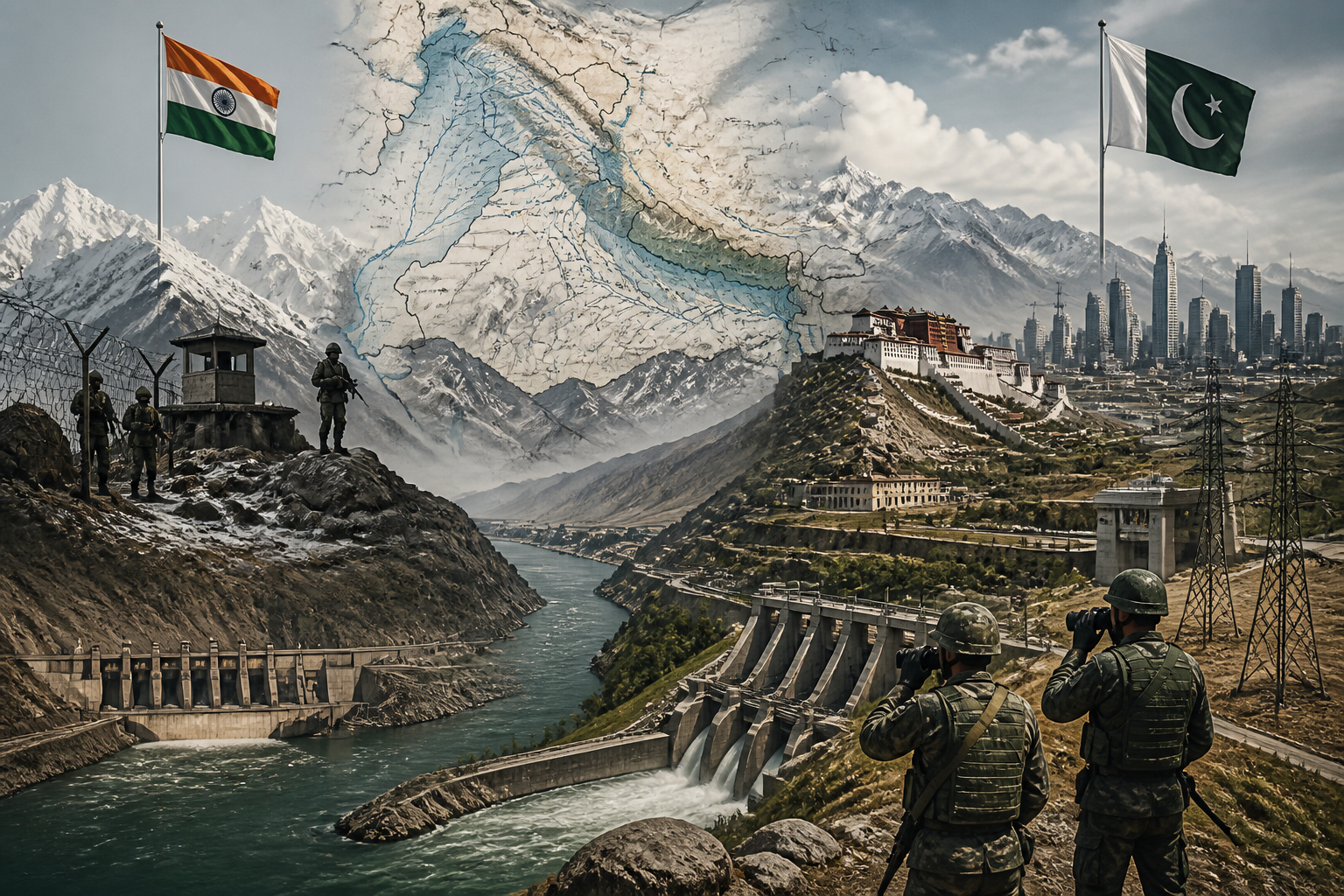
Geography has dealt a complex hand to the region. The Himalayan plateau acts as a water tower for nearly two billion people. To the west, Pakistan is an existential hostage to the Indus River system, with over 90 percent of its agriculture dependent on flows originating in or passing through Indian-administered territory. To the east, the Brahmaputra (Yarlung Tsangpo) serves as a vital artery for Northeast India and Bangladesh, yet its origins lie in Chinese-controlled Tibet. This creates a tiered hierarchy of vulnerability. China sits at the top, India in the middle, and Pakistan and Bangladesh at the base. In geopolitical terms, the upper-riparian state holds a 'water-trigger' that can be used to induce either drought or flood as a tool of coercion.
The Incentive for Escalation
Why is this tension peaking now? The answer lies in domestic political survival. For the governments in New Delhi and Islamabad, water is becoming an identity issue. In India, the drive for energy independence has accelerated the construction of run-of-the-river hydroelectric projects in Jammu and Kashmir. While these are technically permitted under current treaties, they provide India with the physical infrastructure to regulate temporal flow. For Islamabad, any perceived reduction in flow is existential, used by the military establishment to justify its stance against India. Further east, Beijing’s construction of a 'super-dam' at the Great Bend of the Brahmaputra represents a strategic pivot. By controlling the silt and flow, China gains a non-kinetic lever to moderate Indian behaviour along the Line of Actual Control.
A Historical Parallel: The Jordan River and the 1967 War
History suggests that when water is perceived as a matter of national survival, military action becomes a rational choice. In the mid-1960s, the Arab League’s plan to divert the headwaters of the Jordan River to bypass Israel was a primary structural cause of the Six-Day War. Israel viewed the diversion as an act of aggression equal to a border incursion. Today, the Indus and Brahmaputra are reaching a similar saturation point. When a nation perceives that its water security is being permanently altered by slow-motion infrastructure projects, the 'window of opportunity' to stop those projects through conventional force begins to look more attractive than long-term diplomatic decline.
What Most People Miss: The Silt and the Seasonality
The common narrative focuses on the volume of water. This is an oversimplification. The real strategic value lies in silt management and seasonal timing. By building dams, upper-riparian states capture fertile silt, depriving downstream agriculture of natural fertilisers. More importantly, the ability to withhold water during the planting season or release excess during the monsoon serves as a form of 'asymmetric hydrologic warfare'. It does not require a declaration of war to devastate an opponent’s economy; it merely requires the 'maintenance' of a dam at the wrong time for the neighbour. This creates a permanent state of economic anxiety that saps the domestic stability of the downstream state.
Strategic Consequences
The erosion of water treaties will lead to three second-order effects. First, the 'hardened border' will extend into the hydrological sphere; we will see more military assets deployed to protect dam infrastructure. Second, it will drive an unholy alliance in agricultural policy, where downstream states like Pakistan and Bangladesh are forced into deeper subservience to their patrons (China and India respectively) to secure water guarantees. Third, it will accelerate the nuclearisation of the water dispute. If Pakistan perceives that water-starvation is being used as a tool of 'slow-motion genocide', its threshold for the use of tactical nuclear weapons significantly lowers, as its conventional survival is already compromised.
What to Watch
- The Kishenganga and Ratle disputes: Watch for the collapse of World Bank mediation. If the Indus Waters Treaty is formally scrapped, the last guardrail between India and Pakistan vanishes.
- Tibet’s mega-dams: Monitor the completion of the 60-gigawatt project on the Brahmaputra. This will signal China’s final dominance over the riparian flow into South Asia.
- Water-for-Power swaps: Look for India offering electricity to its neighbours in exchange for quietude on water diversion; a strategic attempt to turn a resource conflict into a trade dependency.
KJ Verdict
South Asia is entering a period where the hydrological map is more important than the political map. The relative peace of the last sixty years was built on the assumption of surplus; that is gone. We are moving from the era of 'water-sharing' to 'water-shielding'. India will continue to leverage its middle-riparian position to put pressure on Pakistan while simultaneously feeling the squeeze from China. The risk is not a single 'water war' but a permanent state of low-level hydrological conflict that makes regional cooperation impossible and local instability inevitable. Investors and strategists should prepare for a South Asia where the most valuable commodity is no longer data or oil, but the predictable arrival of the seasonal flow.