The Internal Architecture of Collapse
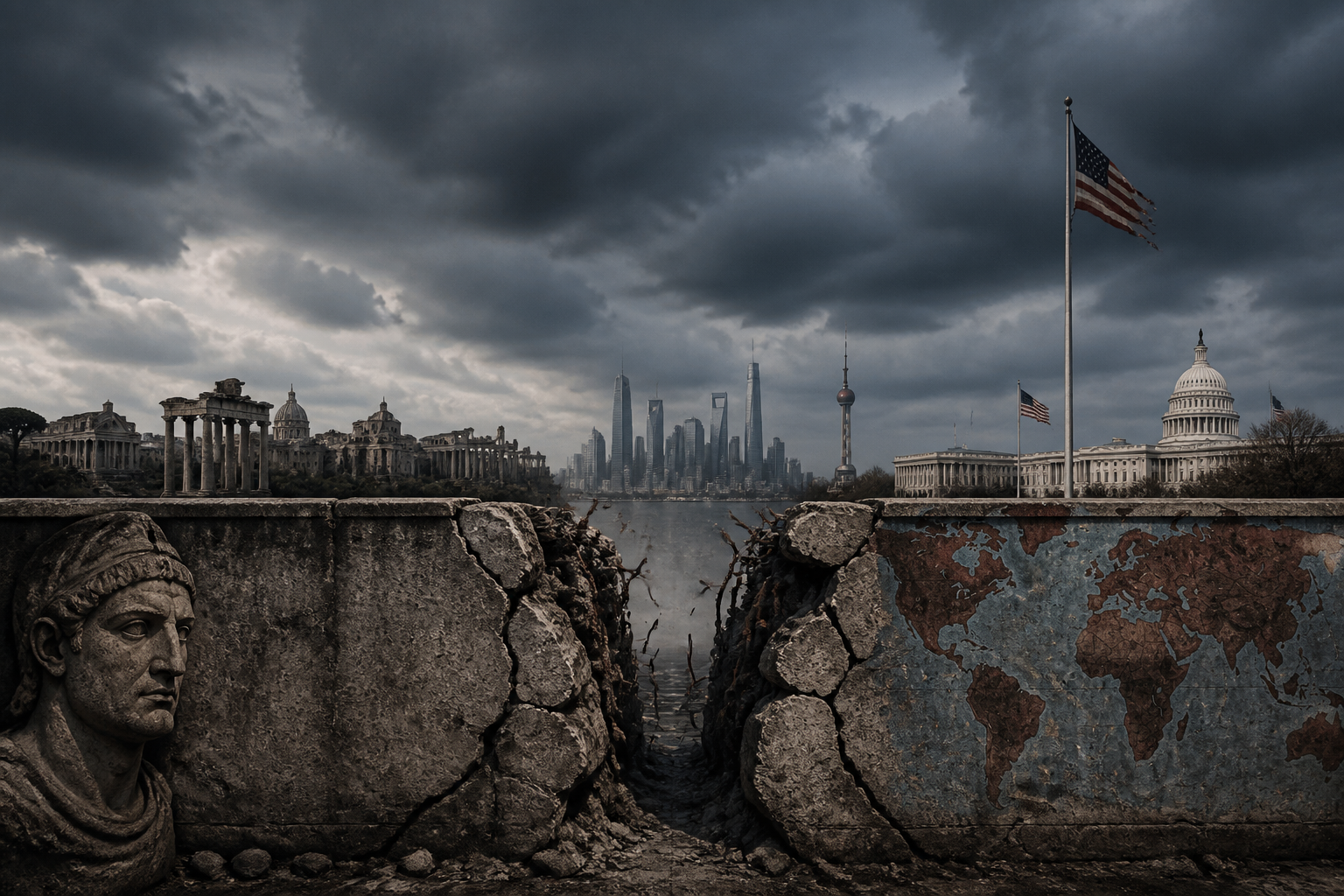
Great powers rarely perish from a single external blow. They are not toppled; they crumble. The historical consensus often fixates on the final barbarian at the gate or the decisive lost naval battle. This misses the point. By the time a rival delivers the coup de grâce, the target state has usually been a hollow shell for decades. The death of a superpower is a process of internal exhaustion where the costs of maintaining the status quo eventually exceed the benefits provided by the system.
To understand the trajectory of modern global powers, we must look past the headlines of regional conflicts and trade wars. We must look at the structural integrity of the domestic engine. Power is a function of three variables: institutional trust, fiscal sustainability, and social cohesion. When these three erode, geography and military hardware become liabilities rather than assets. A sprawling empire with a debased currency and a fractured populace is simply a larger target.
The Roman Blueprint: Beyond the Huns
The fall of the Western Roman Empire is the ultimate case study, yet it is frequently misinterpreted. The Goths and Vandals did not possess superior technology or overwhelming numbers. They simply walked into a room where the floorboards had already rotted through. Rome’s primary failure was not military; it was fiscal and administrative. The empire became a victim of its own success, creating a bureaucracy so vast and an army so expensive that the productive economy could no longer support them.
As tax revenues failed to keep pace with imperial overstretch, the state turned to currency debasement. Under Nero, the denarius was nearly pure silver; by the time of Diocletian, it was little more than scrap copper washed in silver. This destroyed the middle class, incentivised hoarding, and broke the link between labour and reward. When the state can no longer provide a stable medium of exchange, the social contract dissolves. Local elites stop looking to the capital for leadership and start building their own walls. This is how decentralisation begins: not as a policy, but as a survival mechanism.
What Most People Miss: The Complexity Trap
Anthropologist Joseph Tainter argued that societies collapse because they reach a point of diminishing returns on complexity. Most analysts miss this second-order effect. As a great power grows, it solves problems by adding layers of bureaucracy, regulation, and military presence. Initially, this works. However, each new layer carries a maintenance cost. Eventually, the power must spend the majority of its energy simply maintaining its existing complexity rather than innovating or defending itself.
In this state, the system becomes fragile. A minor external shock—a bad harvest, a border skirmish, or a pandemic—that would have been easily absorbed a century earlier now triggers a systemic failure. The state has no reserves left; its 'buffer' has been consumed by the costs of its own administration. We see this today in the rising 'vetocracy' of major powers, where the cost of building a single piece of infrastructure or passing a meaningful reform has skyrocketed because of the sheer density of vested interests and legal hurdles.
The Decoupling of Interests
The fatal stage of decline occurs when the incentives of the ruling elite diverge from the survival of the state. In the late Roman period, the senatorial class became so wealthy and insulated that they no longer cared if the frontiers held. They moved to self-sufficient estates and stopped paying taxes. They were no longer stakeholders in the empire; they were predators upon it.
The ultimate sign of a terminal power is when its leadership perceives the domestic population as a greater threat than its foreign rivals.
When the elite find it more profitable to rent-seek than to create value, the engine of hegemony stalls. This manifests as a shift from investment in the future (infrastructure, education, basic research) to the protection of current assets (stock buybacks, lobbying for subsidies, and regulatory capture). Capital stops flowing toward growth and starts flowing toward preservation.
Strategic Consequences for the 2020s
If we apply these lessons to the current global order, the primary threats are not found in the South China Sea or the plains of Eastern Europe. They are found in the balance sheets of central banks and the polarising algorithms of social media. The 'Guns vs. Butter' debate is a false dichotomy; the real danger is 'Guns vs. Interest on Debt'. When a state’s interest payments on its past exceed its investment in its future, its decline is no longer a risk—it is a mathematical certainty.
Furthermore, technology has accelerated the 'complexity trap'. Modern states are now managing digital infrastructures that are beyond the comprehension of their legislative bodies. This creates a vacuum of authority where private entities exercise sovereign-like power, further hollowing out the state's legitimacy. History tells us that people will only endure the sacrifices required to maintain a superpower if they believe the system is fundamentally fair and functional. Once that belief evaporates, the empire is already gone.
What to Watch
- The Ratio of Interest Payments to Defence Spending: This is the most honest indicator of a power's terminal velocity.
- Demographic Inversion: Watch for states where the 'dependency ratio' forces the government to choose between supporting the elderly and investing in the young.
- Capital Flight and Brain Drain: When the most productive citizens and the most liquid capital begin to seek 'neutral' jurisdictions, the internal rot has reached the critical layer.
- Institutional Sclerosis: The inability to execute basic large-scale projects (like high-speed rail or power grids) on time and on budget.
The KJ Verdict
Great powers do not die because they are conquered; they are conquered because they have already died. The historical cycle of growth and decay is driven by the internal health of the state’s institutions and its currency. We are currently witnessing a global crisis of institutional trust, exacerbated by unsustainable debt loads and an elite class that has largely decoupled from the interests of the governed. The winners of the coming decade will not be those with the most aircraft carriers, but those who can successfully reform their internal structures to reduce complexity and restore the social contract. Without internal renewal, external strength is merely a facade.