The Dual State
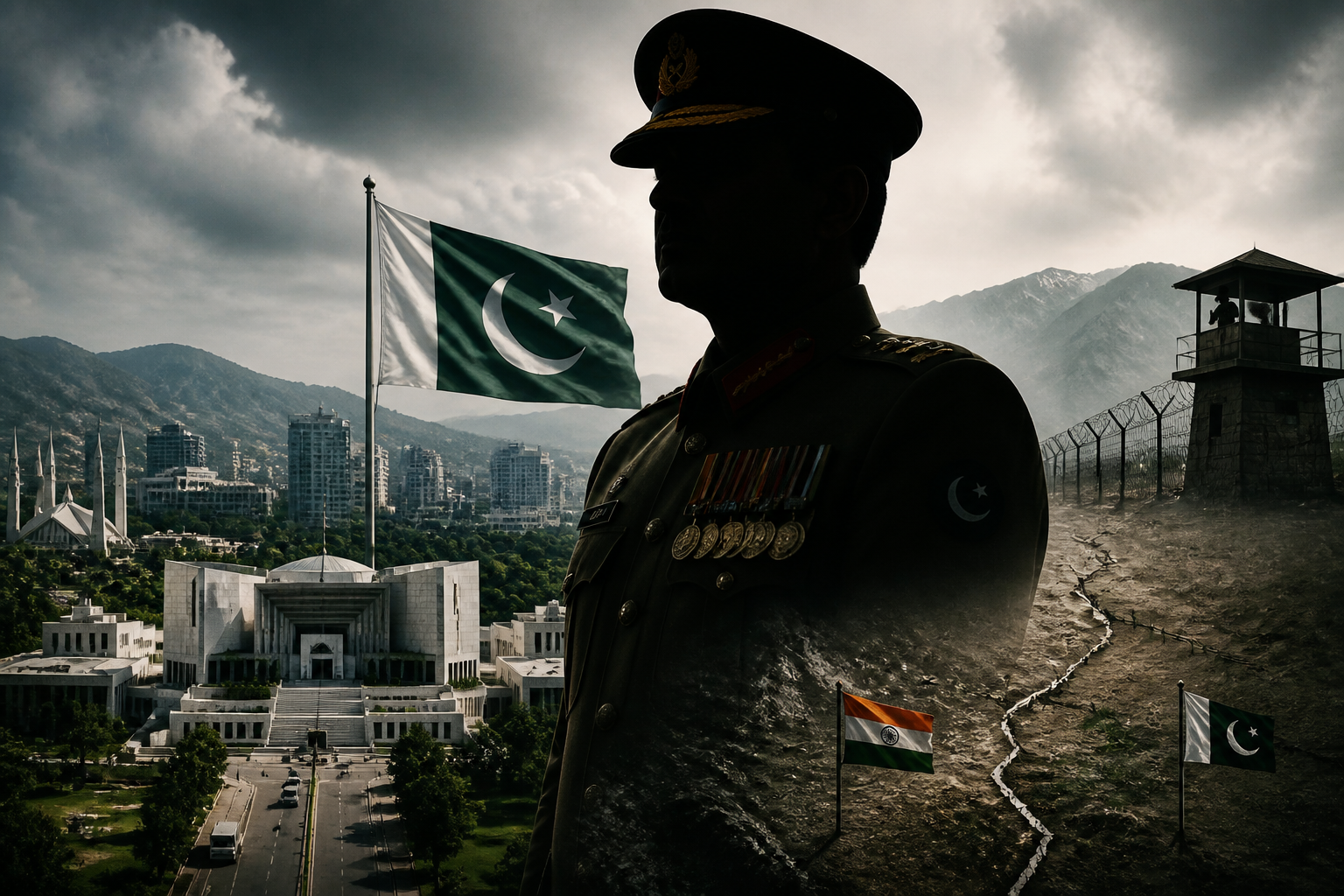
In Pakistan, the transition from military rule to civilian governance is an optical illusion. To understand who really rules, one must look past the Prime Minister’s Office in Islamabad to the General Headquarters (GHQ) in Rawalpindi. The civilian government manages the optics of democracy, handles the arduous task of tax collection, and takes the blame for economic failure. However, the military retains absolute veto power over foreign policy, national security, and the country’s most lucrative economic sectors.
This is not a simple case of a 'rogue' military. It is a structural reality born of Pakistan’s geography and the perceived existential threat from India. Since 1947, the state has been built around the army, rather than the army being built by the state. This creates a self-reinforcing loop: the military claims it is the only institution capable of holding the country together, and then ensures it is the only institution with the resources to do so.
The Business of Defence
The primary driver of military dominance is no longer just ideology; it is capital. The Pakistani military operates a vast commercial empire, often referred to as 'Milbus'. Through various foundations, the military is the country’s largest conglomerate, with interests ranging from fertilisers and cement to cereal and banking. This economic footprint creates a powerful incentive to maintain political control. Any civilian reform that threatens the military’s tax-exempt status or its preferential access to state contracts is viewed as a national security threat.
The Hybrid Experiment
The current 'hybrid' model of governance—where a civilian face fronting for military interests—serves two purposes. First, it provides a veneer of legitimacy for international lenders like the IMF, who prefer dealing with elected governments. Second, it allows the military to avoid the public backlash that follows economic austerity. By letting civilian politicians raise fuel prices and cut subsidies, the military preserves its status as the 'saviour' of last resort.
The Historical Parallel: The Turkish Model
For decades, the Pakistani military looked to Turkey’s 'Deep State' of the 20th century as its blueprint. In Turkey, the military acted as the guardian of secularism, intervening whenever civilian politics deviated from the Kemalist path. Pakistan’s generals have adopted a similar guardian role, though their ideology is based on territorial integrity and a specific brand of nationalism. However, just as Turkey’s military eventually lost its grip due to overreach and the rise of a populist civilian base, Pakistan is seeing the first cracks in the 'custodian' narrative. The difference is that Pakistan’s military is more deeply embedded in the economy than the Turkish generals ever were.
What Most People Miss: The Judicial Pivot
Observers often focus on street protests or parliamentary votes. What they miss is the role of the higher judiciary as the second-order instrument of military power. The Pakistani military rarely uses tanks anymore; it uses lawfare. By influencing judicial appointments and the timing of court rulings, the military can disqualify popular civilian leaders and 'cleanse' the political landscape without declaring martial law. The 'Doctrine of Necessity'—a legal tool used to justify coups—has evolved into a sophisticated system of legalistic engineering.
Strategic Consequences
The persistence of this imbalance has three critical second-order effects:
- Capital Flight: International investors are wary of a country where the rules of the game can be changed by a telephone call from a general. This keeps Pakistan dependent on emergency loans rather than sustainable growth.
- Substandard Governance: Because political survival depends on the military’s favour rather than voter performance, civilian leaders ignore public services and focus on palace intrigue.
- Regional Instability: As long as the military controls foreign policy, the 'threat' from neighbours is likely to be exaggerated to justify the defence budget, making genuine peace with India or a stable border with Afghanistan nearly impossible.
What to Watch
- The SIFC: The Special Investment Facilitation Council is the new mechanism through which the military is formalising its role in the economy. Watch how many state-owned enterprises are handed to this body.
- Debt Restructuring: If the IMF demands cuts to the defence budget as a condition for future bailouts, the civil-military tension will reach a breaking point.
- Social Media Censorship: The GHQ is increasingly losing the 'narrative war' online. Look for heightened technological crackdowns on digital platforms.
The KJ Verdict
Pakistan does not have an army; the army has a state. This arrangement is not the result of a few ambitious men, but a logical outcome of the incentives created by Pakistan’s founding. Until the civilian elite can offer an alternative economic and security vision that does not rely on the GHQ’s patronage, the military will remain the ultimate arbiter of Pakistani life. The imbalance is not an anomaly; it is the system itself. Expect the facade of civilian rule to continue, but the levers of power will remain firmly in the barracks.