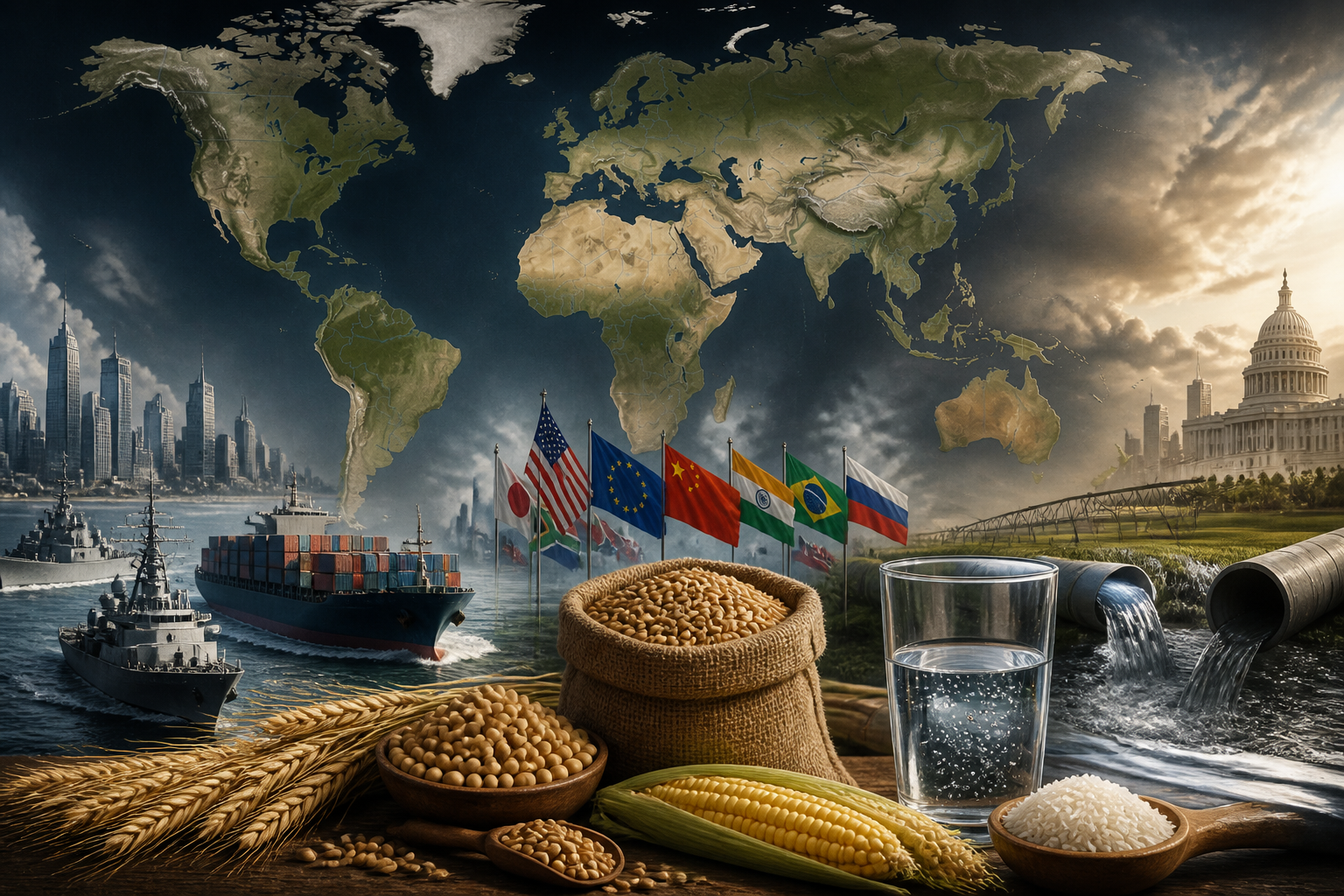
Modern geopolitics suffers from a digital bias. We track the flow of petabytes and the density of transistors as the primary metrics of national strength. But the hierarchy of power remains rooted in the physical reality of the Holocene: a state that cannot feed itself is not a sovereign power, it is a hostage to global logistics. In the coming decade, the ability to generate a massive caloric surplus and control freshwater upstream will replace financial hegemony as the most potent tool of statecraft.
The Strategic Depth of the Soil
Power is the ability to withstand shocks without internal collapse. When we examine the United States, we often focus on the US dollar or the carrier strike group. However, the American core is actually defined by the North American Cereal Belt and the Mississippi River system. This geography allows the US to produce food at a scale and cost that makes it the world’s lender of last resort for stability. When global food prices spike, the US does not face bread riots; it faces a modest increase in the consumer price index. For its rivals, the same event is an existential threat to the social contract.
China, conversely, is an agricultural dwarf relative to its population. Despite holding nearly 20 per cent of the world’s population, it possesses less than 10 per cent of its arable land. This creates a permanent strategic vulnerability. Beijing’s drive for maritime expansion and its Belt and Road infrastructure are not merely about trade; they are about securing a pipeline of calories from Southeast Asia, South America, and Africa. China knows that a naval blockade does not need to sink its navy to win; it only needs to stop the soy and corn shipments for six months.
The Weaponisation of the Upstream
Water is the new geography of conflict. Unlike oil, which can be substituted or transitioned away from over decades, water has no alternative. We are seeing the rise of 'hydro-hegemony', where nations with control over the headwaters of major rivers use that position to dominate downstream neighbours. Turkey’s GAP project on the Tigris and Euphrates, Ethiopia’s Grand Ethiopian Renaissance Dam on the Blue Nile, and China’s dams on the Mekong are the new front lines.
These are not just engineering projects; they are regional remote controls. By adjusting the flow of a river, any upstream power can dictate the industrial and agricultural output of its downstream rivals. This creates a captive diplomatic class. If Egypt must ask Ethiopia for permission to irrigate its wheat, Egypt has lost its strategic autonomy. The same applies to Southeast Asia’s relationship with the Tibetan Plateau.
"A nation that destroys its soils destroys itself. But a nation that controls the breakfast of its neighbours controls their foreign policy."
Historical Parallel: The Grain Fleet and the Fall of Empires
History suggests that food security is the lead indicator of imperial decline. The Roman Empire did not fall simply because of Germanic incursions; it fell because it lost the 'breadbasket' of Egypt. Once the Vandal Kingdom seized North Africa and cut off the grain fleets to Rome, the city’s population collapsed. The central authority could no longer buy the loyalty of the masses with the annona (grain dole). Similarly, the British Empire’s survival in the 1940s depended entirely on the Atlantic convoys bringing North American food. Without the caloric subsidy of the New World, the United Kingdom would have been forced to capitulate within months, regardless of the strength of the Royal Air Force.
What Most People Miss: The Nitrogen Flaw
The global consensus misses the fragility of the nitrogen cycle. Modern agricultural yields are artificial; they are the result of the Haber-Bosch process, which turns natural gas into fertiliser. This means that food security is actually an energy derivative. Most 'food independent' nations are an illusion. If a country does not have domestic natural gas or the ability to secure ammonia imports, its soil productivity would drop by 50 per cent in a single season.
This creates a hidden hierarchy. Russia, even with its outdated technology, is a top-tier superpower in this paradigm because it sits on the world’s largest reserves of natural gas and the raw materials for potash and phosphate. Europe and East Asia are the most vulnerable. They have the technology to grow food but not the chemistry to sustain it. In a fractured world, the 'Green Revolution' becomes a liability for those who do not control the feedstock.
Strategic Consequences
- The Mercantilist Pivot: States will move away from free-market food imports toward long-term, state-to-state bilateral contracts paired with military protection. We will see the return of 'Company' states where agricultural firms are an arm of national intelligence.
- Water as Collateral: Debt restructuring for developing nations will increasingly involve 'water rights' or 'land rights' swaps. A nation that cannot pay its debt will be forced to cede control over its freshwater basins to its creditors.
- Caloric Sanctions: We have seen financial sanctions (SWIFT) and energy sanctions. The next step is caloric sanctions—denying fertiliser or seed technology to a rebellious state. This is a weapon of mass destruction that leaves the infrastructure intact but the population desperate.
What to Watch
- The MEKS Agreement: Any movement toward a formal agricultural alliance between Major Exporting Keys (USA, Brazil, Russia, Argentina, Australia). If these five act as an OPEC for food, they rule the world.
- Desalination Scaling in China: Whether Beijing can decouple its coastal cities from the river systems through nuclear-powered desalination. If they succeed, they remove a major leverage point held by the West.
- The Brahmaputra Standoff: Increased Chinese damming activity on the Yarlung Tsangpo (Brahmaputra) which feeds India and Bangladesh. This remains the most likely trigger for a peer-to-peer conflict between nuclear powers.
The KJ Verdict
We are entering the 'Correction of the Tangibles'. For thirty years, the world operated on the assumption that commodities were infinite and logistical chains were unbreakable. That era is over. In the coming decade, the ultimate currency of power will not be Bitcoin or the Dollar, but the calorie and the cubic metre. The nations that will thrive are those that can secure their own subsistence while holding a surplus over the heads of their enemies. Strategy starts at the stomach; everything else is secondary.