
KJ ReportsKJ Reports

Saudi Arabia footballers ignore minute’s silence for London attack victims

9 June 2017720

Listen to this article

KJ narrates this report in his own voice

Saudi Arabia footballers ignore minute’s silence for London attack victims

Read original article on The Guardian or read some of the key points below;

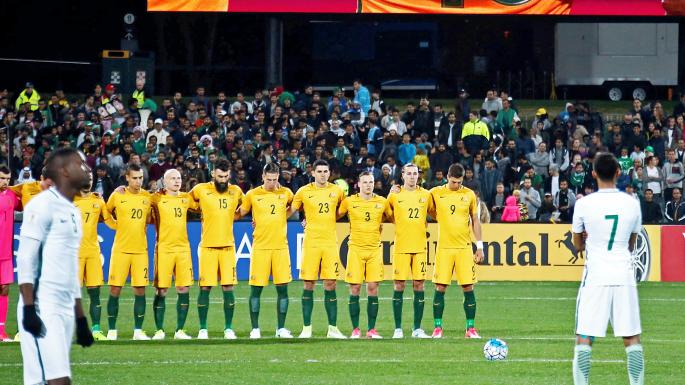
  1. Saudi Arabia’s national football team have been criticised for failing to observe a minute’s silence held before Thursday’s match against Australia in Adelaide.
  2. The footballers lined up in the centre of the pitch before the World Cup qualifier and held the brief silence as a tribute to the two Australians killed in the terrorist attack in London at the weekend.
  3. As they did so, the Saudi Arabia team continued jogging, passing the ball between each other and taking their positions on the field.
  4. Adam Peacock, a presenter with Fox Sports Australia, said on Twitter the Asian Football Confederation has approved the minute’s silence against the wishes of travelling Saudi officials. He said the Football Federation of Australia “tried to reason” with the Saudis but were unable to persuade them to participate in the tribute.
  5. The Saudi Arabian football federation made an “unreserved” apology. “The players did not intend any disrespect to the memories of the victims or to cause upset to their families, friends or any individual affected by the atrocity,” it said in a statement. “The Saudi Arabian Football Federation condemns all acts of terrorism and extremism and extends its sincerest condolences to the families of all the victims and to the government and people of the United Kingdom.”
#qualifier#saudi#saudi-arabia#saudi-arabian-football-federation#saudi-australia#saudi-football-team#world-cup

Related Intelligence

More articles
The Houthi Attrition: Why Riyadh Cannot Buy Maritime Security
Middle East

The Houthi Attrition: Why Riyadh Cannot Buy Maritime Security

Saudi Arabia’s multibillion-dollar military modernisation has failed to break the Houthi maritime siege. The crisis reveals a fundamental misalignment between traditional state power and the low-cost economics of asymmetric Red Sea disruption.

29 Sept 2026

The Persian Siege: How Iran Rewrote the Global Inflation Equation
Middle East

The Persian Siege: How Iran Rewrote the Global Inflation Equation

Tehran has transitioned from conventional deterrence to a permanent strategy of maritime friction. By weaponising chokepoints, Iran is no longer just seeking regional hegemony; it is exporting structural inflation to the West as a geopolitical tool.

27 Sept 2026

Silicon Siege: How the Strait of Hormuz Broke the Tech Supply Chain
Middle East

Silicon Siege: How the Strait of Hormuz Broke the Tech Supply Chain

As the conflict between Washington and Tehran intensifies, the disruption of critical maritime conduits is forcing a permanent migration of high-tech manufacturing away from the Indo-Pacific, ending the era of hyper-efficient global electronics logistics.

26 Sept 2026

The Riyadh Isolation: Saudi Arabia’s Post-American Pivot
Middle East

The Riyadh Isolation: Saudi Arabia’s Post-American Pivot

Saudi Arabia is systematically dismantling its eighty-year security reliance on Washington. This is not a diplomatic spat, but a calculated survival strategy to insulate Vision 2030 from the volatility of American domestic politics and regional entanglements.

25 Sept 2026

The Levantine Buffer: Israel’s Quiet Expansion into Southern Syria
Middle East

The Levantine Buffer: Israel’s Quiet Expansion into Southern Syria

As Tel Aviv establishes a 'de facto' security zone beyond the Golan, the traditional depth of the Axis of Resistance is collapsing. This geographic shift fundamentally rewires the cost of Iranian projection in the Levant.

22 Sept 2026

The Deterrence Mutation: Iran’s Shift to Direct Counter-Escalation
Middle East

The Deterrence Mutation: Iran’s Shift to Direct Counter-Escalation

Tehran has abandoned the strategic patience of the proxy era. By pivoting to direct, persistent counter-escalation, Iran is rewriting the rules of Middle Eastern engagement, forcing a permanent shift in how sovereign states manage regional friction.

22 Sept 2026