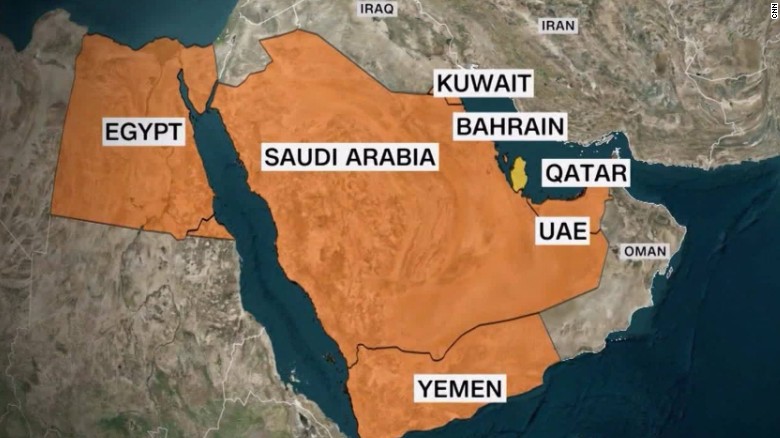

Read original article on Al Jazeera or read just the list of demands below;
1) Scale down diplomatic ties with Iran and close the Iranian diplomatic missions in Qatar, expel members of Iran’s Revolutionary Guard and cut off military and intelligence cooperation with Iran. Trade and commerce with Iran must comply with US and international sanctions in a manner that does not jeopardise the security of the Gulf Cooperation Council (GCC).
2) Immediately shut down the Turkish military base that is currently being built, and halt military cooperation with Turkey inside Qatari territories.
3) Sever all ties to all the “terrorist, sectarian and ideological organisations,” specifically the Muslim Brotherhood, ISIL, al-Qaeda, Fateh Al-Sham (formerly known as Nusra Front) and Lebanon’s Hezbollah. Qatar needs to formally declare those entities as terrorist groups based on the list of groups that was announced by Saudi Arabia, Bahrain, UAE and Egypt, and concur with all future updates of this list.
4) Stop all means of funding for individuals, groups or organisations that have been designated as terrorists by Saudi Arabia, UAE, Egypt, Bahrain, US and other countries.
5) Hand over “terrorist figures,” fugitives and wanted individuals from Saudi Arabia, the UAE, Egypt and Bahrain to their countries of origin. Freeze their assets, and provide any desired information about their residency, movements and finances.
6) Shut down Al Jazeera Network and its affiliate stations.
7) End interference in sovereign countries’ internal affairs. Stop granting citizenship to wanted nationals from Saudi Arabia, UAE, Egypt and Bahrain. Revoke Qatari citizenship for existing nationals where such citizenship violates those countries’ laws.
8) Qatar has to pay reparations and compensation for loss of life and other financial losses caused by Qatar’s policies in recent years. The sum will be determined in coordination with Qatar.
9) Qatar must align itself with the other Gulf and Arab countries militarily, politically, socially and economically, as well as on economic matters, in line with an agreement reached with Saudi Arabia in 2014.
10) Submit all personal details of all the opposition members that Qatar supported and detail all support that Qatar has provided them in the past. Stop all contacts with the political opposition in Saudi Arabia, UAE, Egypt and Bahrain. Hand over all files detailing Qatar’s prior contacts with and support for those opposition groups.
11) Shut down all news outlets that it funds, directly and indirectly, including Arabi21, Rassd, Al Araby Al Jadeed, Mekameleen and Middle East Eye, etc.
12) Agree to all the demands within 10 days of it being submitted to Qatar, or the list becomes invalid.
13) Consent to monthly audits for the first year after agreeing to the demands, then once per quarter during the second year. For the following 10 years, Qatar would be monitored annually for compliance.