Rockets exchange at rapid rate
Israel on Wednesday pressed ahead with a fierce military offensive in the Gaza Strip, killing as many as 10 senior Hamas military figures and toppling a pair of high-rise towers housing Hamas facilities in a series of airstrikes. The Islamic militant group showed no signs of backing down and fired hundreds of rockets at Israeli cities.
In just three days, this latest round of fighting between the bitter enemies has already begun to resemble — and even exceed — a devastating 50-day war in 2014. Like that previous war, neither side appears to have an exit strategy.
Israel carried out an intense barrage of airstrikes just after sunrise, striking dozens of targets in several minutes that set off bone-rattling explosions across Gaza. Airstrikes continued throughout the day, filling the sky with pillars of smoke.
At nightfall, the streets of Gaza City resembled a ghost town as people huddled indoors on the final night of Ramadan. The evening, followed by the Eid al-Fitr holiday, is usually a time of vibrant night life, shopping and crowded restaurants.
“There is nowhere to run. There is nowhere to hide,” said Zeyad Khattab, a 44-year-old pharmacist who fled with a dozen other relatives to a family home in central Gaza after bombs pounded his apartment building in Gaza City. “That terror is impossible to describe.”
Gaza militants continued to bombard Israel with nonstop rocket fire throughout the day. The attacks brought life to a standstill in southern communities near Gaza, but also reached as far north as the Tel Aviv area, about 70 kilometers (45 miles) to the north, for a second straight day.
“We’re coping, sitting at home, hoping it will be OK,” said Motti Haim, a resident of the central town of Beer Yaakov and father of two children. “It’s not simple running to the shelter. It’s not easy with the kids.”
Gaza’s Health Ministry said the death toll rose to 65 Palestinians, including 16 children and five women. Islamic Jihad confirmed the deaths of seven militants, while Hamas acknowledged that a top commander and several other members were killed.
A total of seven people have been killed in Israel, including four people who died on Wednesday. Among them were a soldier killed by an anti-tank missile and a 6-year-old child hit in a rocket attack.
The Israeli military claims the number of militants killed so far is much higher than Hamas has acknowledged.
Lt. Col. Jonathan Conricus, a military spokesman, said at least 14 militants were killed Wednesday — including 10 members of the “top management of Hamas” and four weapons experts. Altogether, he claimed some 30 militants have been killed since the fighting began.
Palestinians revolting
The fighting has unleashed violent clashes between Arabs and Jews in Israel, in scenes that have not been seen since 2000. Netanyahu warned that he was prepared to use an “iron fist if necessary” to calm the violence.
But ugly clashes erupted across the country late Wednesday. Jewish and Arab mobs battled in the central city of Lod, the epicenter of the troubles, despite a state of emergency and nighttime curfew. In nearby Bat Yam, a mob of Jewish nationalists attacked an Arab motorist, dragged him from his car and beat him until he was motionless.
In the occupied West Bank, the Israeli military said it thwarted a Palestinian shooting attack that wounded two people. The Palestinian Health Ministry said the suspected gunman was killed. No details were immediately available.
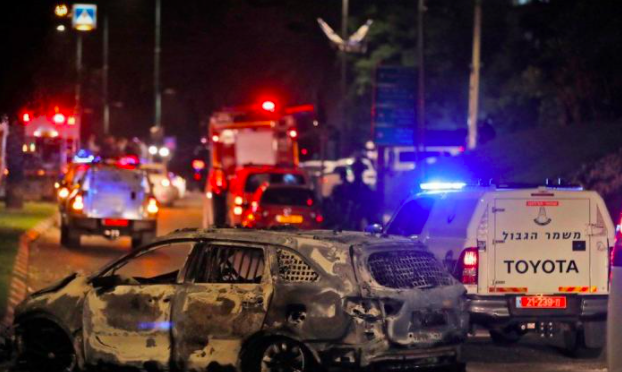
Israel has declared a state of emergency in the central city of Lod after rioting by Israeli Arabs, as conflict between Israeli forces and Palestinian militants intensified.
Cars were set alight and a father and daughter – both Israeli Arabs – died when a rocket from Gaza hit their car.
Palestinian militants fired hundreds of rockets deep into Israel, while Israel carried out heavy air strikes on Gaza.
At least 40 people have died in some of the worst violence in years.
Israeli Arabs in Led showed solidarity with the Palestinian cause, and similar uprisings took place across Israel, with several iconic scenes of Arabs replacing the Israeli flag with the Palestinian one. Such moves could very well be interpreted as the beginnings of a revolution.
Chances of de-escalation
While United Nations and Egyptian officials have said that cease-fire efforts are underway, there were no signs of progress. Israeli television’s Channel 12 reported late Wednesday that Prime Minister Benjamin Netanyahu’s Security Cabinet authorized a widening of the offensive.
U.N. chief Antonio Guterres condemned the “indiscriminate launching of rockets” from civilian areas in Gaza toward Israeli population centers, but he also urged Israel to show “maximum restraint.” U.S. Secretary of State Antony J. Blinken called Netanyahu to support Israel’s right to defend itself and said he was sending a senior diplomat to the region to try to calm tensions.
The International Criminal Court has launched an investigation into possible war crimes by Israel and Hamas. In a brief statement, ICC prosecutor Fatou Bensouda said she had noted “with great concern” the escalation of violence and “the possible commission of crimes.”
The ICC is looking into Israeli actions in past wars in Gaza. Israel is not a member of the court, does not recognize the ICC’s jurisdiction and rejects the accusations. But in theory, the ICC could issue warrants and try to arrest Israeli suspects while traveling overseas.
Conricus, the military spokesman, said Israeli forces respect international laws on armed conflict and do their utmost to minimize civilian casualties. Israel clames Hamas for civilian casualties because the group fires rockets from residential areas.
Emanuel Gross, a professor emeritus the University of Haifa law school, said Israel should “take into consideration the concerns of the ICC.” But he said he believes the military is on solid legal ground while rockets are striking Israeli cities.
“That’s the real meaning of self defense,” he said. “If you are attacked by a terrorist group, you defend yourself.”
Israel has already announced that it plans a long and extensive operations against Hamas, and does not plan on accepting a ceasefire, so the prospects of de-escalation are currently low.