KJ ReportsKJ Reports

Iranian top nuclear scientist killed: Will this spark a war between Iran and Israel?

Hazem Zahab30 November 2020655

Listen to this article

KJ narrates this report in his own voice

Iranian top nuclear scientist killed: Will this spark a war between Iran and Israel?

Iranian nuclear scientist killed

The Iranian nuclear scientist Mohsen Fakhrizadeh was assassinated Friday east of Tehran was shot by a remote-controlled machine gun operating out of another car, the semi-official Fars News Agency. He was the head of the research centre of new technology in the elite Revolutionary Guards and was a leading figure in Iran’s nuclear program.

According to a published report in  Fars News, it is reported that on Friday  Fakhrizadeh was travelling with his wife in a bulletproof car, alongside three security personnel vehicles, when all of sudden he heard some bullet alike sound hitting the vehicle. To which he exited the vehicle to determine what had happened. When he left the vehicle, a remote-controlled machine gun opened fire from a Nissan stopped about 150 meters (164 yards) from Fakhrizadeh’s car.

Fakhrizadeh was hit at least three times, according to Fars News. His bodyguard was also shot. Following the gunfire, the Nissan exploded, Fars News reported, adding the attack lasted three minutes. The semi-official Iranian Students News Agency (ISNA) also reported Fakhrizadeh’s car was hit by gunfire, followed by an explosion and more gunfire, citing Iranian Defense Minister Brig. Gen. Amir Hatami.

Fakhrizadeh was head of the research center of new technology in the elite Revolutionary Guards, and was a leading figure in Iran’s nuclear program for many years.
The killing could further fuel tensions between Tehran and Washington in the final weeks of US President Donald Trump’s term. US-Iran relations have rapidly deteriorated during Trump’s presidency.
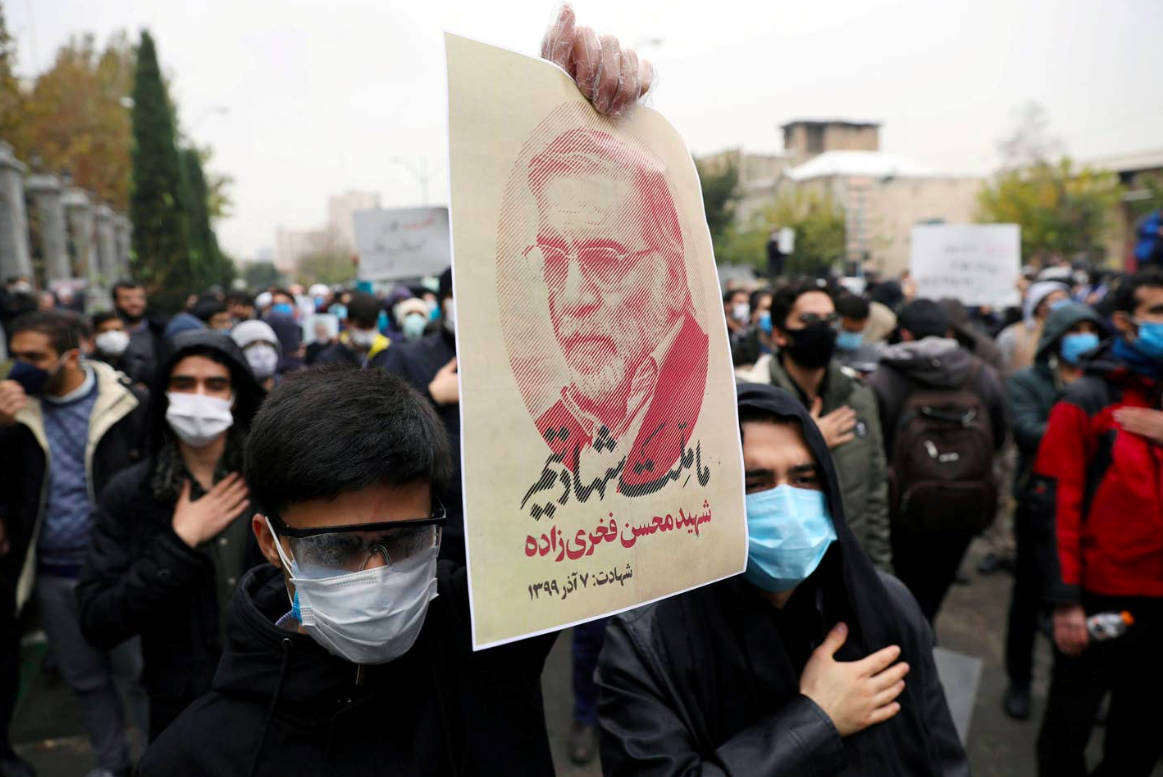
Students and young Iranians have held small protests in Tehran over the past two days outside several government buildings. At one outside the foreign ministry on Saturday, protesters burned posters depicting Trump and US President-elect Joe Biden, as well as US and Israeli flags.

Israel blamed for the attack

Iranian Foreign Minister Mohammad Javad Zarif called on the international community “to end their shameful double standards” and “condemn this act of state terror.” He added that the attack showed “serious indications of Israeli role.” Maj. Gen. Hossein Dehghan, Khamenei’s military adviser, tweeted Saturday that “Zionists” are seeking to create “all-out war” and vowed to “descend like lightning” on Fakhrizadeh’s killers.

Iran’s English-language Press TV reported on Monday that the weapon used in the killing of prominent Iranian nuclear scientist Mohsen Fakhrizadeh last week was made in Israel, the Islamic Republic’s longtime enemy.

“The weapons collected from the site of the terrorist act (where Fakhrizadeh was assassinated) bear the logo and specifications of the Israeli military industry,” an unnamed source told Press TV. In Jerusalem, there was no immediate reply from Israeli officials contacted for comment on the report.

A senior Israeli official told the New York Times on Sunday that the world should thank Israel for killing the father of Iran’s nuclear weapons program, Mohsen Fakhrizadeh.

Bruce Riedel, a former CIA official who also spoke to the Times, called the alleged Israeli operation “unprecedented,” adding it showed “no sign of being effectively countered by the Iranians.”

However, Israel did not officially confirm its involvement in the bombing and shootout in the Iranian city of Absard, near Tehran, in which Fakhrizadeh was killed.

How will Iran respond?

ran’s Supreme Leader Ayatollah Seyyed Ali Khamenei has vowed revenge after the killing of Fakhrizadeh.
“There are two matters that people in charge should put in their to do list: 1- To follow up the atrocity and retaliate against those who were responsible for it. 2- To follow up Martyr Fakhrizadeh’s scientific and technical activities in all fields in which he was active,” Khamenei wrote Saturday in a tweet from an account often attributed to him, making a veiled reference to the country’s nuclear activities.
He added: “Our distinguished nuclear scientist in the defense of our country, Mr Mohsen Fakhrizadeh was killed by the oppressive enemies. This rare scientific mind lost his life for his everlasting great scientific work. He lost his life for God and the supreme leader. God shall reward him greatly.”
In addition to this, an opinion piece published Sunday by a hard-line Iranian newspaper urged Iran to attack the Israeli port city of Haifa if Israel carried out the killing of the scientist who founded the Islamic Republic’s military nuclear program in the early 2000s. Though the hard-line Kayhan newspaper has long argued for aggressive retaliation for operations targeting Iran, Sunday’s opinion piece went further, suggesting any assault be carried out in a way that destroys facilities and “also causes heavy human casualties.”
Such an attack would be an effective deterrent, he said, “because the United States and the Israeli regime and its agents are by no means ready to take part in a war and a military confrontation”.

Related Intelligence

More articles
The Beijing Buffer: China’s Strategic Checkmate in the Persian Gulf
China

The Beijing Buffer: China’s Strategic Checkmate in the Persian Gulf

Beijing’s mediation of the US-Iran accord signals a fundamental shift in maritime power. By positioning itself as the indispensable guarantor of Gulf stability, China has effectively neutralized decades of Western naval dominance.

20 Jun 2026

The APRA Mandate: Australia’s Financial Hedging for a Post-US Order
United States

The APRA Mandate: Australia’s Financial Hedging for a Post-US Order

As Canberra adjusts its regulatory framework to account for intensifying geopolitical shocks, a deeper shift is occurring: Australia is decoupling its financial stability from the total reliance on the American security umbrella.

19 Jun 2026

The Silicon Strait: China’s Data Hegemony in the South China Sea
China

The Silicon Strait: China’s Data Hegemony in the South China Sea

Beijing is transforming the South China Sea from a contested waterway into a high-tech data corridor. By integrating AI infrastructure with maritime power, China is effectively bypassing the strategic vulnerability of the Malacca Strait.

18 Jun 2026

The Bismarckian Pivot: India’s German Deep-Tech Realignment
South Asia

The Bismarckian Pivot: India’s German Deep-Tech Realignment

As New Delhi systematically decouples from its legacy Russian military dependency, a new strategic architecture is emerging. Berlin is no longer just a trading partner; it is becoming India’s primary engine for industrial sovereignty.

17 Jun 2026

The Uralic Lever: Russia’s Strategic Pivot to New Delhi
Russia

The Uralic Lever: Russia’s Strategic Pivot to New Delhi

Moscow is trading short-term energy profits for a permanent strategic alliance with India. This shift signals the end of Russian dependency on European markets and the birth of a new Eurasian power axis.

17 Jun 2026

The Iranian Chokepoint: Why $200 Oil is Tehran’s Strategic Veto
Middle East

The Iranian Chokepoint: Why $200 Oil is Tehran’s Strategic Veto

As regional tensions escalate, Iran’s ability to throttle the Strait of Hormuz has transformed from a military threat into a sophisticated macroeconomic weapon designed to neutralise Western sanctions and leverage global energy markets.

16 Jun 2026