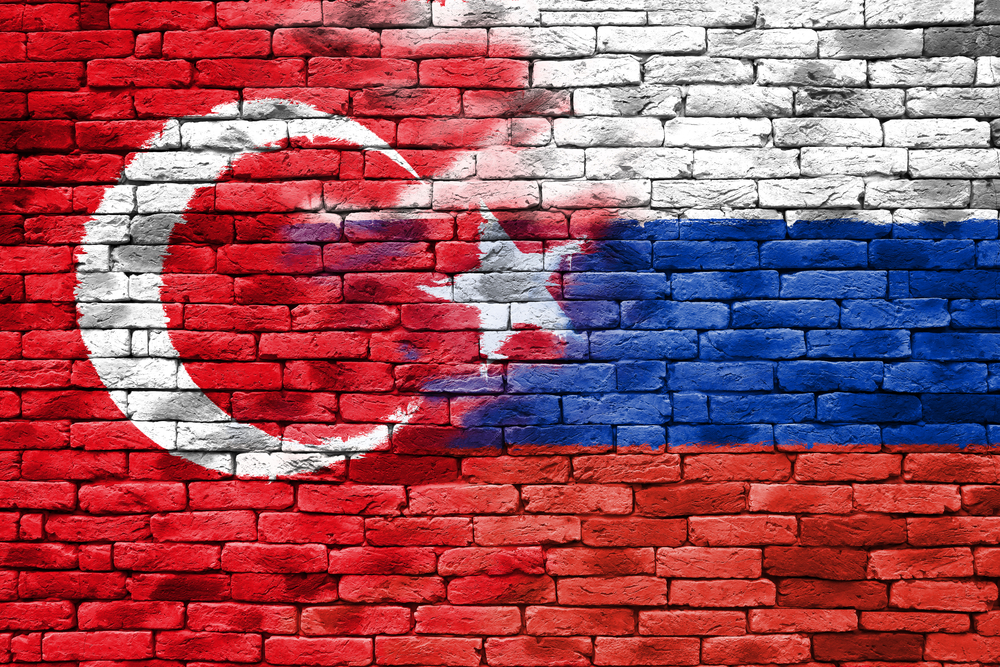
Growing Russia-Turkey relations were always clouded by the looming Syrian problem
Over the past couple of years, it has been increasingly clear that Turkey and Russia are growing relations and increasing bilateral ties. Despite supporting opposite sides in the Syrian conflict, last year, Turkish and Russian leaders seemed to find common ground when saying in a joint statement that they were alarmed about the risk of further deterioration of the humanitarian situation in and around Idlib and had agreed to take “concrete steps” to stop violations of previously negotiated agreements between the three countries.
Despite this, it was already clear last year that Syria would be an obstacle to solidifying Russian-Turkish relations, as glaring issues remained in Syria, and the issue of conflicting interests was still a long way from being resolved. Disagreements appeared to persist, in particular over the threat in Syria from Islamic State, which Erdogan dismissed completely while Putin expressed concern. “Of course, we are worried by the situation in north-east of Syria, where sleeping cells of ISIS are emerging,” Putin told a joint news conference, minutes after Erdogan said that the only threat in northern Syria was from Kurdish militant groups.
The situation has only worsened this year, as, since last April, Syrian government forces have conducted an off-and-on military campaign to retake the final rebel stronghold in northwestern Idlib province. More than 1,000 civilians have been killed while hundreds of thousands of others have been displaced. “Since the start of the offensive, we’ve seen a cycle whereby the regime forces attack, Turkey complains and Russia intervenes to slow the attacks. Then the process starts again,” said Ahmet Evin, a senior scholar at Sabanci University’s Istanbul Policy Centre.
The threat of the war in Syria acting as an obstacle to strengthening Russian-Turkish relations appears to have been realized this year, as relations are at a delicate level, and the recent catalyst that took place and will be discussed in the next point could as well threaten a collapse of relations.
The killing of Turkish troops could collapse relations
In the early hours of Monday, the offensive took a dramatic and potentially critical turn when forces loyal to President Bashar al-Assad killed eight Turkish military and civil personnel.
Already last week, before the killings, Turkey’s Defense Ministry issued a statement on Tuesday that it would retaliate “in the strongest way” against “any move to jeopardize the security” of Turkish observation posts in Idlib, as at least three of them are in close proximity to regime forces. The escalation of fighting in the region triggered a major exodus of civilians heading for the Turkish border.
Regarding the Turkish troops killed, both Russia and the Damascus administration and, according to some claims, Iranian militia forces on the ground knew the location of Turkish troops. As is its custom in multilateral joint military operations, Ankara had the locations where reinforcement troops would be deployed in the region “coordinated in advance” in order to prevent clashes.
The Turkish deaths came on the eve of a visit to Ukraine by Turkish President Recep Tayyip Erdogan, who used the trip to call on Russia to honour the 2017 Astana agreement that seeks to pave the way for a political solution in Syria. It also established a number of “de-escalation zones” in Syria, including Idlib province, which Ankara said have been violated by Assad’s forces.
Turkey answered with an assault of its own, killing several dozen Syrians in a retaliatory strike on some 40 regime positions in the area, according to Turkish President Recep Tayyip Erdogan. However, the Syrian Observatory for Human Rights, an independent monitoring agency based in the U.K., placed the death toll at 13 Syrian soldiers.
It is unclear whether Turkey’s reply will escalate the conflict further with Syria on a direct basis, but if it does, then it is very likely, that Turkey could find itself directly confronting Russia. However, Russia may try to avoid this by forcing Assad to de-escalate, for the reasons explained in the next point.
Russia and Turkey still willing to cooperate
Due to the strong foundations already set of economic and trade relations between Russia and Turkey in the past couple of years, it looks likely that Russia will try to cooperate with Turkey, and relations will not collapse, due to the interests on both sides already developed.
“There’s a deep relationship between Turkey and Russia and they have common interests on many levels,” said Ali Bakeer, an Ankara-based political analyst and researcher, adding that cooperation between them was deep enough to weather such a rift, even the death of the Turkish soldiers in Syria this week.
In particular, Erdogan and Russia’s Vladimir Putin appear to have a good personal relationship, often referring to one another as “dear friend” when they meet. In a sign that the two countries were working to repair the damage from the latest escalation, they spoke directly on the phone on Tuesday. In the call, Erdogan told Putin that the attack on Turkish military personnel had damaged joint peace efforts and that Turkey would defend itself in case of a similar attack, the Turkish presidency said.
Among the mutual interests in play, Gazprom supplied its first billion cubic meters of gas via the TurkStream gas pipeline, which started its commercial supplies on 1 January 2020, says the message published on the website of the Russian energy company on January 27. Of that amount, about 54 per cent went to the Turkish gas market and some 46 per cent was delivered to the Turkey-Bulgaria border. This is the beginning of a long-term economic cooperation plan.
It is clear that Russia and Turkey will continue to cooperate and relations will not collapse in the near future unless a drastic event occurs. The killing of Turkish soldiers by Assad’s forces is a serious blow to their joint geopolitical plans, however, economic cooperation remains a bedrock to a willingness to continue to cooperate despite serious differences in Syria.