The gradual but firm shift in Japan’s defence posture is among the most notable developments characterizing the Asia-Pacific’s international dynamics in the past few years. Its efforts to increase its military power, accompanied by attempts to change the Constitution to expand the means and the duties of its military forces are to be interpreted in a broader context of growing security challenges. But what exactly are the drivers behind Japan’s re-arm?
Japan’s defence policy after WWII
Japan’s past is the first element to consider to understand the importance of its changing defence posture.
After being defeated in WWII, Japan abandoned its pre-war militarism to embrace pacifism and rejection of the use of armed force. This principle was enshrined in Article 9 of its Constitution, which entered into force 1947 with US support. According to its terms, Japan denied its own right to belligerency, rejected war as a mean to solve international disputes, and renounced to develop any war potential. This meant that it could not possess its own armed forces and could not participate in any conflict abroad, not even for collective self-defence. Initially, the US had favoured this constitutional provisions as a guarantee that Japan would never try again to conquer the Asia-Pacific region has it had done in the past. Moreover, immediately after the war it seemed that the area would become a hub of peace and stability.
But the situation changed soon. In 1949 the communists took power in mainland China, thus radically changing the region’s geopolitical landscape. Only one year later, the pro-Soviet North Korea attacked its southern counterpart, triggering the three-years-long Korean War. Following the emergence of these threats, Washington applied the containment policy to counter the assertiveness of Moscow and its allies in Asia as in Europe. In this logic, the US started pressuring Japan to adopt a larger security role. However, this achieved very limited success. In 1951, America and Japan signed a Peace Treaty, and along with it a separate Security Treaty (later revised in 1960) that committed Washington to defend its ally. But under the Premiership of Yoshida Shigeru, Japan preferred to minimize its military expenditures in order to focus on reconstruction and economic growth, all while relying on its powerful American ally for protection. This approach, later named “Yoshida Doctrine” after its inspirer, became the cornerstone of Japan’s foreign policy for decades, and it was an extraordinary success. Thanks to it, Japan managed to avoid international conflicts and to achieve an impressive GDP growth, rapidly turning into one of the world’s leading economic powers. As of today, Japan is still the third largest economy in terms of nominal GDP.
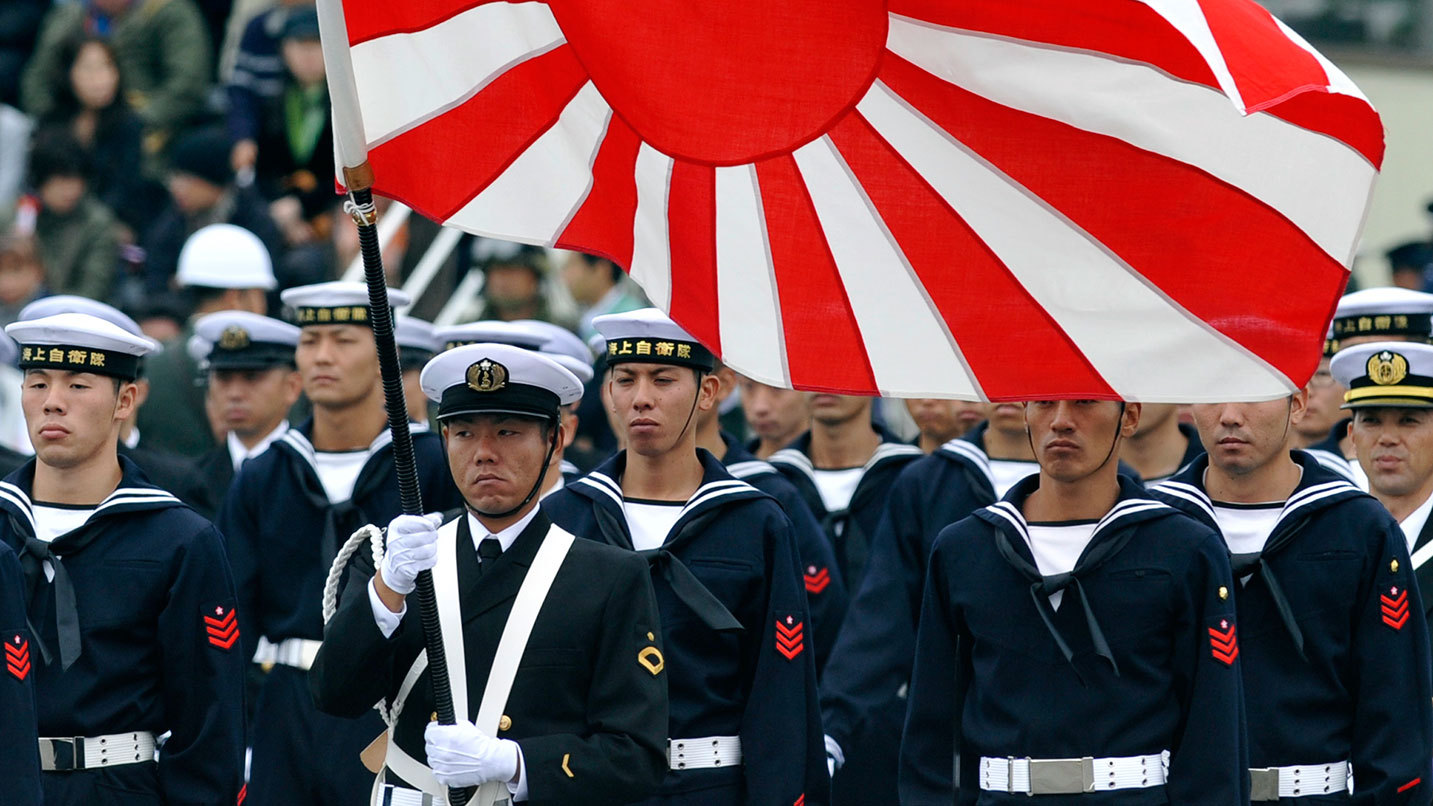
Yet, this does not mean that Japan did not have its own military. The terms of Article 9 notwithstanding, the country still had to make concessions. In 1954, it established its armed forces, which took the name of Japanese Self-Defense Forces (or JSDF). But as their name suggests, they were not comparable to the full-fledged militaries that other states had. The JSDF could not field any equipment considered to be “offensive” such as strategic bombers or aircraft carriers, and their role was strictly limited to defending Japan’s territory from an external (most likely Soviet) invasion. They could not participate to collective self-defence operations, as this would imply fighting abroad to protect an ally, and not even to peacekeeping missions. In 1976, the practice of limiting the defence expenditures to no more than 1% of its GDP became official. All this deeply influenced Japan’s role in overseas conflicts, even those occurring very close to its territory and whose outcome could affect its own national security. The first case is the Korean War: in spite of the geographical proximity and of their anti-communist stance, the Japanese limited their contribution to providing bases and equipment for the US-guided coalition. Still, with time new events pushed Japan to slowly change its stance.
The first one was the outbreak of the Gulf War in 1991. Since Japan was (and still is) largely dependent on Middle Eastern oil for its energy supplies, the US expected that it would give a sensible contribution to the conflict. But on the basis of its constitutional limitations, Japan refused to do so, limiting its participation to providing financial aid to the international coalition. This form of “checkbook diplomacy” was largely criticized by the US, and as a result Japan adopted a new legislation allowing it to take part to peacekeeping missions with strictly non-combat roles. A few years later, North Korea’s withdrawal from the Nuclear Non-Proliferation Treaty and the Taiwan Strait Crisis in 1996 increased Japan’s fear of being involved in a regional conflict. Then, the test of the DPRK’s first ballistic missile in 1998 shocked Japan, thus prompting it to start cooperating with the US on anti-missile defence. Another change occurred in the aftermath of 9/11. As America begun its “War on Terror” under the Bush administration, it asked Japan to contribute to operations in Afghanistan and Iraq. Tokyo was again reticent, but in the end it accepted to deploy its forces to provide non-combat support. In 2004 it also adopted a new national defence document that called for an increase of its military capabilities, and most importantly Article 9 was reinterpreted to allow self-defence in case of attack on American forces defending Japan or even abroad, provided this represented a threat to Japan itself.
In spite of all this, strong restrictions remain on Japan’s military. Still, it maintains a well-trained and well-equipped military. As a matter of fact, despite the 1% GDP gap on defence expenditures, the sheer size of its economy means that its budget is one of the world’s largest in absolute terms. Nevertheless, until recently it has kept a low-profile defence posture. But with the emergence of new challenges, Japan is gradually moving out from its traditional policy to take a more important role in regional security, which also implies increasing its military capabilities and re-interpreting (if not changing) its Constitution.
The drivers of Japan’s re-arm
As seen, the earliest driver of Japan’s efforts to empower its military came from the need to give a greater contribution to international operations. This was the answer to its American ally, which criticized it for being a free-rider who takes benefit from US protection without giving much support to American-led actions. Gradually, Japan started participating more actively in international missions, dispatching its forces for peacekeeping, disaster relief, or maritime law enforcement.
But there are two other factors to be considered, the first of which is North Korea. Its ballistic missiles and the possibility of a new war in the Peninsula are considered serious threats by Japan. This explains both its diplomatic efforts to favour a negotiated settlement of the issue, but also its commitment to deploy anti-missile systems like Patriot Advanced Capability 3 batteries (PAC-3) or AEGIS-equipped destroyers.
Yet, this is only one part of the story. Coping with a potential conflict in Korea does not reveal why Japan is increasing its maritime and air power, nor why it is acquiring Anti-Access / Area Denial (A2/AD) systems and practicing amphibious operations. To understand this, the third factor should be considered, which is by far the main driver of Japan’s military build-up: the rise of China.
After it started its economic boom in the 90s, the PRC soon initiated a military modernization programme. Combined with its increasing assertiveness, this has resulted in heightening tensions with the US. While much remains to be done for China’s armed forces to match America’s military on an equal level, this has turned Beijing into Washington’s near-peer competitor, at least in the Asia-Pacific. In this context, Japan has started feeling concerned about China’s rise as well, something that clearly emerges from its official documents.
The reasons are double fold. First, its relations with China are problematic, and sometimes even tense. There is much animosity between the two about Japan’s invasion of China in the 30s and the war crimes it committed during that period. There is also a territorial dispute between them over the Senkaku / Diaoyu islands. Maritime security is another major issue: Japan’s economic prosperity and energy security depends on the sea lanes of communication (SLOC) connecting it with Europe and the Middle East; therefore, it is afraid that China may cut these maritime routes, thus posing an existential threat to its survival. Then, China does not appreciate Japan’s status as an American ally; which brings to the second aspect to consider: the role of the US.
As noted before, Washington has been asking Tokyo for a greater contribution to regional security. For decades, Japan has resisted these demands, but now that China is emerging as a military power capable of damaging the interests of both Japan and the US, Tokyo is more willing to expand the roles and the capabilities of its military; also because it understands that not doing so would alienate Washington and may ultimately result in the loss of its main ally, which remains essential for its national security.
This was also the main justification behind the reinterpretation of the Article 9 of the Constitution. The text of the Article has not been changed, as that would require a complex procedure including a referendum that would likely fail given the popular attachment to the pacifist principles of the Chart. But in 2014 Abe’s government introduced a new interpretation, which was approved by the National Diet the following year. According to it, Japan will be able to use the military even to protect a foreign country, provided that Japan’s survival is at stake, that there are no other means, and always by limiting its action to the minimum necessary measures. This move was strongly criticized by Japan’s neighbours, first and foremost China.
The axes of Japan’s re-arm
The central importance of China as the main driver of Japan’s re-arm is evident when examining the specific nature of its military reorganization. Its defence expenditures have been growing constantly in recent years, reaching around 4.94 trillion yen.
The land component of the JSDF is being reduced in favour of the air and naval forces. This is because in the case of an open conflict with China, the best defence for Japan would be to achieve the aero-naval superiority over its surrounding seas (in cooperation with the US) so to keep the Chinese forces away from its territory. In this context, Japan is deploying to the south more air squadrons equipped with F-15J fighters, as well as support aircraft like tankers and airborne early warning and control (AEW&C) planes. Recon drones like the RQ-4 Global Hawk could be adopted as well. A total of 42 F-35A fighters are also scheduled to be fielded, the first of which has been deployed at the beginning of 2018.
But it is the maritime part of the JSDF that is being developed the most. There are five notable trends in this. First, surface ships are being modernized and new ones are entering into service to bring the total from 47 to 54. These include new guided missile destroyers equipped with the AEGIS system, whose task is to patrol and protect the SLOC and the seas around Japan, contribute to air and naval superiority, and intercept incoming missiles. Second, the number of attack submarines is to increase from 16 to 22. Their mission is to counter the subs that the PRC is also fielding in larger numbers, to have assets that are not threatened by its anti-ship missiles, and finally to threaten the SLOC that are vital for China as well. Third, in a similar logic Japan is procuring more antisom aircraft for its naval forces. Fourth, it is enhancing its mine warfare capabilities, both in the form of deploying and removing naval mines. But the fifth and most notable development is the introduction of helicopter destroyers, which has also caused controversy. Currently, Japan has four ships of this kind: two belong to the Hyuga class while the other two are more recent Izumo-class units. They are the largest ships in Japan’s maritime force and, in spite of being smaller than their US counterparts, they are often described as de facto aircraft carriers. However, this is misleading. Currently these ships do not operate any fighter jet, but only helicopters; mainly because their deck cannot resist the extremely high temperatures generated by jet engines. Still, while it is a complex endeavour, it is technically possible to modify the deck of the two Izumo units to enable fighter operations, and there have been rumors that Japan is actually considering this option so to allow the ships to operate up to 10 F-35B fighters; something that has caused criticism from the PRC. Moreover, the number of planes they could carry is relatively limited, as their autonomy. As such, rather than for sustaining large-scale naval battles or as power projection means, these ships are more suitable for antisom missions thanks to their helicopters or for supporting amphibious operations along with dedicated landing ships, as they can carry 400 marines and around 50 light vehicles.
This brings us to the role of the land forces, which also have an important role that reflects Japan’s new strategic needs. The marines units are being expanded, a sign that Japan wants its military to be able to defend and if necessary retake remote islands to the south like the Senkaku or the Ryukyu. Also, radars and five regiments armed with anti-ship cruise missile (consisting in the Type 88 and the more recent Type 12) are being deployed on these islands along with anti-aircraft missile units. The aim is to create A2/AD zones over the East China Sea both for protecting the SLOC and for denying the access to the open ocean to China’s aero-naval forces; in the logic of keeping them at bay until the US Navy arrives. New missiles are also under development, among which the most notable is the HVGP (Hyper Velocity Gliding Projectile), a hypersonic missile explicitly designed to defend remote islands and a sign that Japan wants to enter in the race to develop such systems.
What next?
Considering all these aspects, it is clear that Japan is taking a greater role in regional security and that appears more determined to protect its interests in a challenging international environment. Yet, it seems unlikely that it will opt for full militarization. The large majority of Japanese oppose a change in the Constitution and even the recently-approved reinterpretation was met with resistance. Japan remains more willing to solve international issues by diplomacy and economic assistance rather than by the use of force. Yet, to ensure its vital interests and to preserve the alliance with the US, which remains essential for its national security, Japan will likely continue on this course and increase its military capabilities. But this is something that is not only up to Japan: much depends on its American ally; and much, if not the most, on its Chinese rival.