The Illusion of Choice
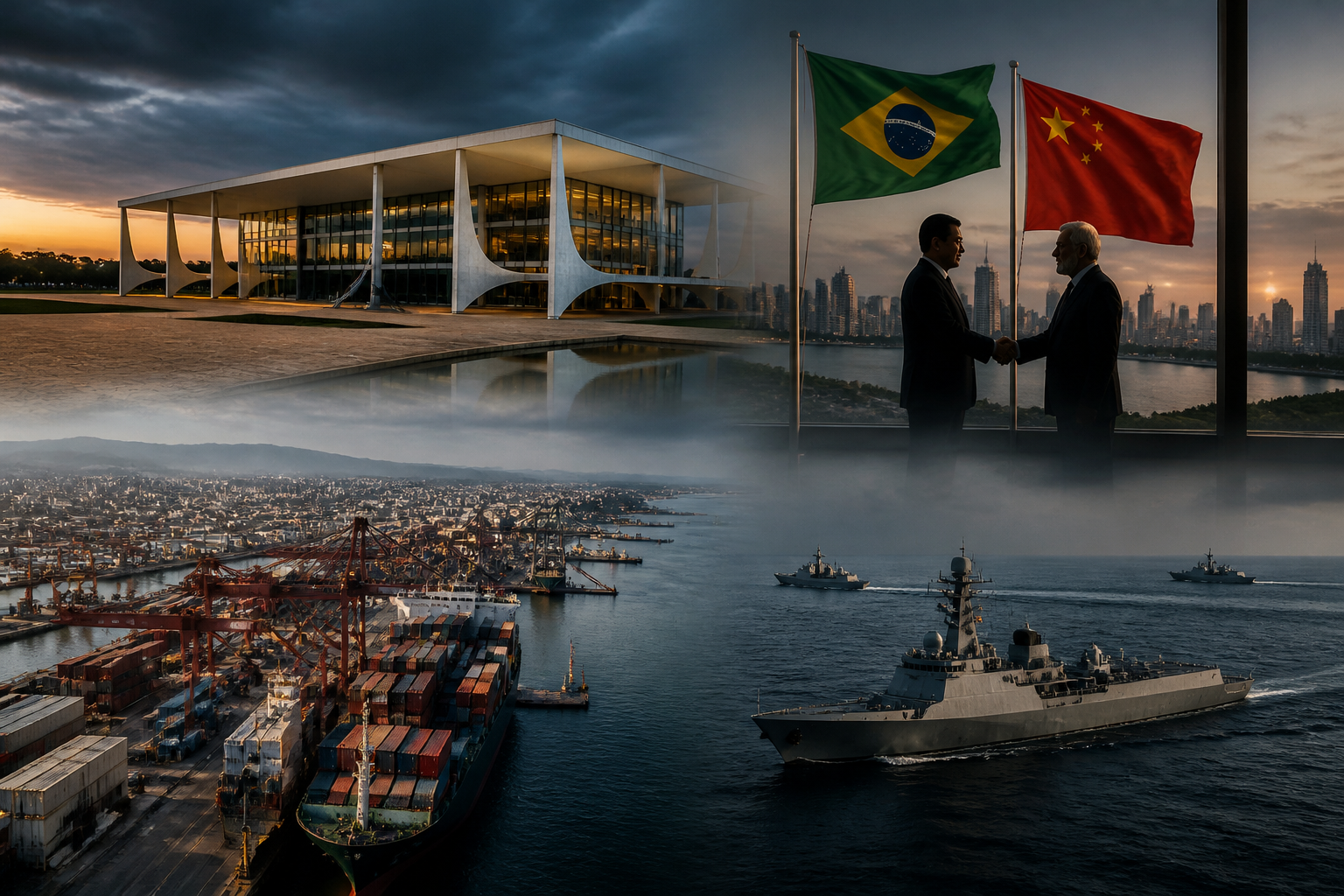
Brazil is currently attempting the most difficult balancing act in modern statecraft. President Luiz Inácio Lula da Silva seeks to position Brasília as the indispensable interlocutor of the Global South, yet this ambition rests on a fragile paradox. Brazil requires Chinese capital to modernise its decaying infrastructure, but it relies on the American-led security architecture to maintain regional stability and access to Western high-tech markets. The tension is no longer theoretical; it is a structural collision of national interests.
For Brasília, the primary objective is development without dependency. However, the global landscape has shifted. The era where a middle power could play both sides for marginal gains is closing. As the rivalry between Washington and Beijing hardens into a systemic conflict, Brazil’s strategy of 'active non-alignment' is being tested by the sheer weight of two competing gravitational pulls.
The Credit Trap and the Security Guarantee
The core of the Brazilian dilemma is an imbalance between what each superpower offers. China is Brazil’s largest trading partner, a voracious consumer of iron ore and soya, and a lender of last resort for massive logistics projects. Through the Belt and Road Initiative and the BRICS New Development Bank, Beijing offers a path to industrialisation that does not come with the fiscal austerity or environmental conditions often attached to Western capital.
However, China cannot offer Brazil security. The Brazilian military, despite its nationalist rhetoric, is deeply integrated into Western doctrines, training, and hardware. More importantly, the 'Blue Economy' and Brazil’s maritime interests in the South Atlantic are protected by the implicit stability of the American naval presence and the Inter-American Treaty of Reciprocal Assistance. When Lula signs 5G contracts with Huawei or accepts Chinese investment in the port of Santos, he is trading long-term security leverage for short-term liquidity.
The Re-industrialisation Gamble
Lula’s domestic survival depends on reviving Brazil’s manufacturing sector, which has withered over three decades of commodity-led growth. To do this, he needs technology transfers that the West is increasingly hesitant to provide to 'swing states' and that China provides only with strings attached. The incentive for Brazil is to extract the maximum amount of technology from Beijing while maintaining enough diplomatic distance from the Chinese Communist Party to avoid American sanctions or technology export bans. It is a high-stakes gamble on the 'Second-Order Effect': by inviting Chinese competition, Brazil hopes to force the United States to offer better terms for investment. So far, Washington has responded not with capital, but with pressure.
Historical Parallel: The Baron of Rio Branco
To understand Brazil’s current posture, one must look back to the early 20th century and the diplomacy of José Paranhos, the Baron of Rio Branco. He shifted Brazil’s focus from London to Washington, recognising that the rising American power was the future of the Western Hemisphere. He achieved this through 'unwritten alliances'—aligning interests without formal subordinating treaties.
Lula is attempting a modern inversion of this. He is trying to create an 'unwritten alliance' with Beijing to offset American hegemony, while maintaining the old ties to Washington to avoid Chinese dominance. The difference today is that the Baron operated in an era of expanding global trade; Lula is operating in an era of fragmentation. The space for such manoeuvres is shrinking rapidly.
What Most People Miss: The Agribusiness Contradiction
The standard narrative suggests that Brazil’s pivot to China is purely a political choice by a left-leaning president. This misses the economic reality: the most pro-China constituency in Brazil is the conservative, right-leaning agribusiness sector. This creates a fascinating internal incentive structure. Even a more right-wing successor to Lula would find it nearly impossible to decouple from China without collapsing the national economy. Brazil is not 'choosing' China ideologically; it is geographically and economically tethered to it. The geopolitical friction arises because this economic reality is now in direct conflict with the Brazilian state’s desire to remain a key player in the Western diplomatic order.
The true cost of Chinese credit is not the interest rate, but the erosion of the strategic ambiguity that has protected Brazilian sovereignty for a century.
Strategic Consequences
The second-order effects of this balancing act are beginning to manifest. First, Brazil’s leadership within MERCOSUR is being challenged as smaller neighbours, like Uruguay, seek their own bilateral deals with China, fearing Brazil will monopolise the regional relationship. Second, the United States is increasingly viewing South America not through the lens of development, but through the lens of 'Integrated Deterrence'. This means Brazil’s refusal to side with the West on issues like the Ukraine conflict or the South China Sea is resulting in a slow-motion exclusion from the inner circles of global intelligence and sensitive technology sharing.
Ultimately, Brazil risks becoming a 'lonely power'. Too big to be a client state, but too dependent to be a truly independent pole in a multipolar world. The 'Brazilian Bridge' could easily become a target for both sides rather than a crossing point between them.
What to watch
- The Semiconductor Frontier: Watch for any Brazilian attempts to build domestic chip capacity with Chinese lithography. This would be a red line for Washington.
- South Atlantic Naval Exercises: Any joint maritime drills between the Brazilian Navy and the PLA Navy would signal a decisive break from the Inter-American security framework.
- The BRICS Expansion: How Brazil manages the entry of new, more anti-Western members will indicate if Lula is losing control of his own platform for non-alignment.
- OECD Accession: If Brazil halts its long-standing bid to join the OECD, it signals a final commitment to the Chinese-led economic bloc.
KJ Verdict
Brazil’s current strategy is a race against time. Lula is betting that he can use Chinese capital to build a developed economy before the geopolitical rivalry between Washington and Beijing forces a definitive choice. This is likely a miscalculation. Power in the 21st century is not just about who buys your commodities, but who controls the networks—digital, financial, and military—through which those commodities flow. Brazil is attempting to build a 20th-century industrial base while the world moves toward 21st-century blocs. The bridge Lula is building may lead to a destination that no longer exists. Expect Brazil to face a sharp economic or security crisis by the end of the decade that will finally break its policy of strategic ambiguity.