
KJ ReportsKJ Reports

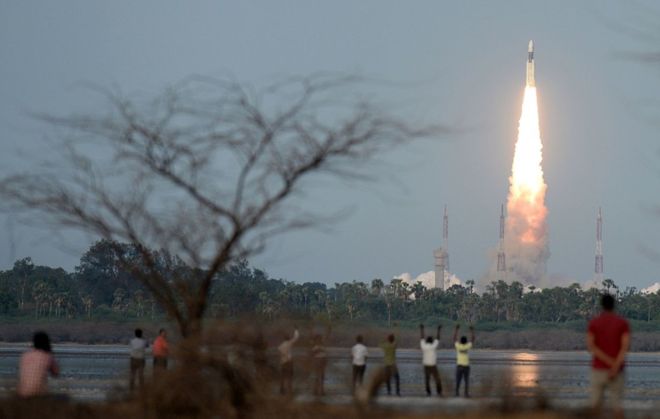
Indian Space Research Organisation Successfully launches its monster rocket GSLV MK III

6 June 2017597

Listen to this article

KJ narrates this report in his own voice

Indian Space Research Organisation Successfully launches its monster rocket GSLV MK III

The Economic Times

Read original article on The Economic Times or read some of the key points below;

  1. Indian Space Research Organisation, today, launched its monster rocket, Geosynchronous Satellite Launch Vehicle Mark III (GSLV Mk III), with 3,136 kg communication satellite GSAT-19 from the spaceport of Sriharikota, in Andhra Pradesh. The launch will give India self-reliance in delivering large payloads and also prepare the country for its attempt to put astronauts into space.
  2. The GSLV MkIII-D1 carried payloads of up to 4,000 kg into the Geosynchronous Transfer Orbit (GTO) and 10,000 kg into the Low Earth Orbit. The rocket was developed for 15 years at a cost of around Rs 300 crore.
  3. The rocket’s main and bigger cryogenic engine was developed by space scientists indigenously. It will help India get a greater share of the multi-billion dollar global space market and reduce dependency on international launching vehicles.
  4.  The 43.43 metre tall, 640 ton rocket, will, just over 16 minutes into its flight, sling the GSAT-19 at its intended orbit at an altitude of 179 km.
  5. The satellite, which has a life span of 10 years, also features certain advanced spacecraft technologies including miniaturised heat pipe, a fibre optic gyro, micro electro-mechanical systems (MEMS) accelerometer, Ku-band TTC transponder, as well an indigenous lithium-ion battery.

#crore#india#india-rocket#indian-space-research-organisation#isro#mkiii#monster-rocket#pradesh#space-research#sriharikota

Related Intelligence

More articles
The Rupee-Riyal Axis: Energy Debt as Geopolitical Leverage
South Asia

The Rupee-Riyal Axis: Energy Debt as Geopolitical Leverage

As Islamabad swaps sovereign equity for Saudi oil credits, a new security architecture is emerging. Riyadh is no longer just a donor; it is the silent arbiter of the Indo-Pakistani strategic balance.

19 Jul 2026

The Pashtun Fracture: The Durand Line’s Structural Collapse
South Asia

The Pashtun Fracture: The Durand Line’s Structural Collapse

As conflict destabilises Tehran, the artificial border between Afghanistan and Pakistan is dissolving. KJ examines why the 2026 regional upheaval has finally broken the 133-year-old territorial status quo, threatening Pakistan’s western integrity.

13 Jul 2026

The Himalayan Bypass: New Delhi’s Pivot to Bilateral Coercion
South Asia

The Himalayan Bypass: New Delhi’s Pivot to Bilateral Coercion

As Bangladesh's internal stability fractures, India is abandoning decades of regional multilateralism. New Delhi is shifting toward a strategy of bilateral force and infrastructure bypass to secure its restive Northeast against a deepening chaotic void.

12 Jul 2026

The Indus Prerogative: India’s Turn Toward Hydrological Hegemony
South Asia

The Indus Prerogative: India’s Turn Toward Hydrological Hegemony

New Delhi is abandoning decades of water diplomacy. Faced with a cooling economy and warming climate, India is leveraging its upstream geography to redefine power dynamics with Pakistan, risking the collapse of a sixty-year-old peace treaty.

5 Jul 2026

The Bismarckian Pivot: India’s German Deep-Tech Realignment
South Asia

The Bismarckian Pivot: India’s German Deep-Tech Realignment

As New Delhi systematically decouples from its legacy Russian military dependency, a new strategic architecture is emerging. Berlin is no longer just a trading partner; it is becoming India’s primary engine for industrial sovereignty.

17 Jun 2026

The Islamabad Pivot: Trading Strategic Depth for Economic Survival
South Asia

The Islamabad Pivot: Trading Strategic Depth for Economic Survival

Pakistan is discarding decades of military doctrine to position itself as the vital gateway for Central Asian trade. As domestic pressures mount, Islamabad is prioritising economic rent and connectivity over traditional territorial security.

15 Jun 2026