Pakistan wants to strengthen relations with Qatar
President Dr. Arif Alvi has said that Pakistan and Qatar enjoyed excellent relations in all areas of mutual interest and Pakistan wants to further strengthen and broaden bilateral cooperation with the brotherly country. He made these remarks while talking to the visiting Commander of Qatar Air Force, Major-General (Pilot), Salem Hamad Eqail Al-Nabet, who called on him, at Aiwan-e-Sadr.
The meeting was also attended by Chief of the Air Staff, Air Chief Marshal Mujahid Anwar Khan and Qatar’s Ambassador to Pakistan, Mr. Saoud Abdulrehman Al-Thani.
The President said that Pakistan and Qatar had great scope for cooperation in the areas of defence and military training and Qatar needed to benefit from defence expertise and training facilities of Pakistan. He also highlighted anti-terrorism efforts made by Pakistan that resulted in defeating militancy and terrorism.
The President said Pakistan’s economy is improving despite the COVID-19 pandemic. He said Pakistan offers enormous investment opportunities and Qatar can benefit from Pakistan’s investment-friendly environment in various sectors.
Qatari aid to Pakistan
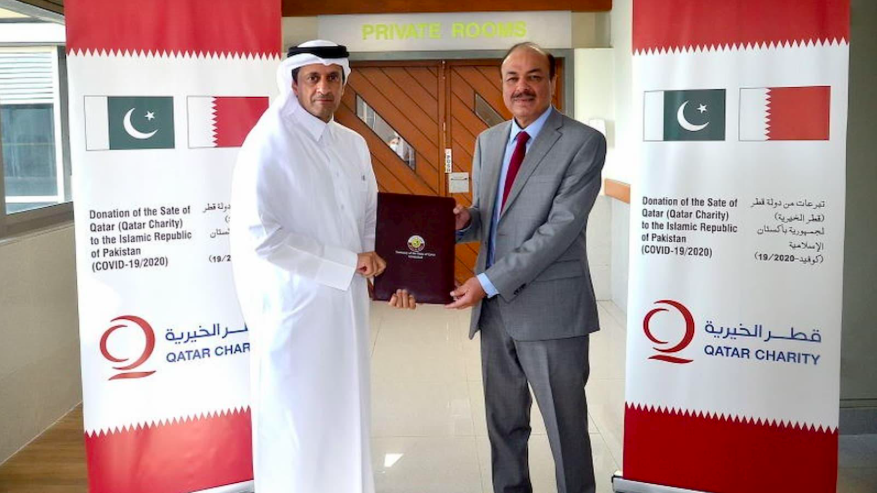
Last month, Qatar Charity, in co-operation with the UNHCR, distributed 3,400 parcels of relief and health supplies in the Khyber Pakhtunkhwa region in Pakistan.
As many as 15,000 Afghan refugees benefited from the aid at refugee camps in Pakistan. Nearly 5,400 people benefited from food aid and personal hygiene items in Khorasan camp in Peshawar province, while about 10,000 people benefited in Baraki camp in Swabi Province. The parcels included basic food items and personal hygiene items.
Commissioner of Afghan Refugees in the Khyber Pakhtunkhwa region, Abbas Khan, praised the services provided by Qatar Charity to Afghan refugees and said that Qatar Charity’s intervention was effective in the context of the response to Covid-19. There are 1.4mn Afghan refugees registered in the camps in Pakistan. The number of camps currently in Pakistan for Afghan refugees is 54, of which 43 are in the Khyber Pakhtunkhwa region which contains nearly 1mn people.
Qatar Charity has provided support to government health institutions in Pakistan by distributing 4,000 parcels of hygiene and prevention supplies, materials in quarantine centres and as well as in rural health centres in all regions of the nation, in co-operation with local authorities. This comes as part of the aid that Qatar Charity has provided and is still offering to many countries around the world, in coordination with the relevant government agencies, which include Lebanon, Palestine, Pakistan, Bangladesh, Sudan, Kyrgyzstan, Mali, Chad and Kenya. To achieve this goal, Qatar Charity has signed several co-operation agreements with a number of international and UN organisations, such as the United Nations Children’s Fund (Unicef), the High Commissioner for Refugees and the United Nations Office for the Co-ordination of Humanitarian Affairs (OCHA), to finance and support preventive and awareness-raising efforts to confront the current crisis.
Qatari commander praises Pakistani army
Commander of Qatar Emiri Air Force Maj Gen (Pilot) Salem Hamad Eqail Al-Nabet has appreciated Pakistan Army’s contributions to the maintenance of regional peace and security and role in the training of Qatar’s armed forces.
The Qatari commander said this during his meeting with the Chief of the Army Staff (COAS) Gen Qamar Javed Bajwa here on Wednesday.
During the meeting, matters of mutual and professional interest and regional security situation were discussed, said an Inter-Services Public Relations press release.
The COAS said Pakistan valued its brotherly relations with Qatar and Pakistan Army looked forward to enhanced defence and security cooperation with Qatar’s armed forces.
Also, Commander Qatar Emiri Air Force Staff Major General (Pilot) Salem Hamad Eqail Al-Nabet alongwith his delegation visited Air Headquarters here on Monday. Chief of the Air Staff Air Chief Marshal Mujahid Anwar Khan received the distinguished guest upon his arrival, said a statement issued by a spokesperson of Pakistan Air Force (PAF). A smartly turned-out contingent of the PAF presented guard of honour. The visiting dignitary also paid homage to PAF martyrs by laying a floral wreath at Yadgar-i-Shuhada (Martyrs Monument). Commander Qatar Emiri Air Force lauded the professionalism of PAF personnel, and the exceptional progress made by PAF over the years, especially through indigenization, the statement said.