Is heroin being smuggled on Pakistani planes?

25 May 2017684

Listen to this article

KJ narrates this report in his own voice

Pakistan’s national carrier says it is taking measures to ensure its planes are not used to carry drugs after heroin was found on two of its London-bound aircraft.

Aviation authorities are also investigating how the drugs might be making their way on to the planes of Pakistan International Airlines (PIA).

What happened?

On 15 May, UK’s Border Force officials impounded a PIA flight from Islamabadon arrival at London Heathrow airport and searched it for several hours.

The National Crime Agency later said that a quantity of heroin had been found hidden in different panels of the plane.

There were suggestions that the British authorities had acted on a tip-off from Pakistan.

No-one was charged. The pilot was allowed to return to Pakistan the next day, while the crew members were given their passports back a day later.

The episode caused considerable embarrassment to PIA, which was already reeling from a plane crash in that killed dozens of people in December and a number of near-misses subsequently, sparking allegations of corruption and mismanagement.

Then on 22 May, Pakistani officials at Islamabad airport seized more than 20kg (44lb) of heroin from another aircraft headed to Heathrow.

An investigation is continuing.

What is Pakistan doing about it?

Investigations were launched to identify suspects within the PIA and the Civil Aviation Authority (CAA) with possible links to a drug trafficking ring that may have been using PIA to smuggle the drug abroad, Mashhood Tajwar, a PIA spokesman, told the BBC.

The investigation is being conducted by a team of officials from airport security, customs and the anti-narcotics force (ANF).

Mr Tajwar said pre-flight searches of aircrafts had been a part of standard operating procedures in the past, but surveillance had been stepped up since the May incident at Heathrow.

On Friday, a high-level meeting presided by the prime minister’s adviser on aviation, Mehtab Ahmad Khan, finalised new security measures and a Central Operational Committee headed by the CAA chief was constituted to oversee their implementation.

On Monday, four aircraft expected to fly to foreign destinations were scheduled for checking, one of which – as mentioned above – was carrying drugs.

How surprising is this?

This is not the first time drugs have been found on PIA planes.

Last December, 17kg (37lb) of heroin was seized by officials at Karachi airport from a plane being readied for a flight to Jeddah, in Saudi Arabia. The flight was delayed for over 11 hours as a result.
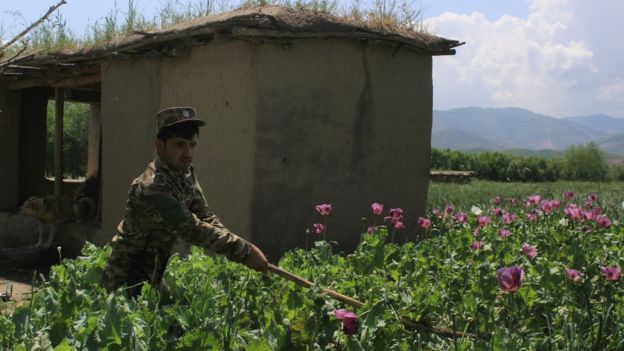
An Afghan security personnel destroys an illegal poppy crop on the outskirts of Badakhshan on 17 MayImage copyrightAFP
Image captionPoppy crops are still found in large parts of Afghanistan

Pre-flight checks are part of routine procedure and sniffer dogs are regularly used to clear aircraft for operations, PIA officials say.

But the presence of heroin on some aircraft shows that officials responsible for such checks may either have been complacent or linked to drug mules among employees.

While poppy crops across Pakistan have largely been eliminated, it is still grown in large parts of southern Afghanistan where insurgent groups wield influence and officials have little power.

Analysts say poppy and heroin are among the main sources of income for these groups.

And since some of them are said to have the tacit support of Pakistani authorities, they are said to be able to enter the country and smuggle heroin into Pakistan for onward shipment to the West.

Such smuggling is further helped by large-scale movement of Afghan refugees across the Pakistan-Afghanistan border, experts say.

How damaging is this for PIA?

Pakistan International Airlines has also courted controversy recently for other reasons.

In February its management was accused of trying to cover up an air safety breach when it boarded seven extra passengers on a flight from Karachi to Medina, Saudi Arabia. They were allowed to stand in the aisle during the flight.

In April, a passengers photographed the chief pilot of a London-bound flight taking a nap in the passenger compartment, leaving the controls in the hands of a first officer and a trainee pilot.

The pilot denied he had breached safety rules, but the PIA management said they were investigating the incident.

In early May, another pilot on a flight from Tokyo was accused of allowing an unauthorised foreign national into the cockpit. The passenger, a Chinese woman, remained there for two hours during the Tokyo-Beijing leg of the flight.

The incident was filmed by a journalist who was traveling on the same flight.

In 2013 a PIA pilot who admitted being over the legal alcohol limit to fly after being arrested in the cockpit was jailed for nine months in the UK.
 

#heroin-smuggled-pakistan#pia#pia-drugs-smuggled#pia-heroin#pia-pakistan-drugs

Related Intelligence

More articles
Are Malaysia and Turkey on a challenging quest to unite the Muslim world?
Indonesia

Are Malaysia and Turkey on a challenging quest to unite the Muslim world?

Malaysia leading efforts to unite the Muslim world In recent years, Malaysia has been trying to increase its engagement and cooperation with the Muslim world. We saw many signals of this in 2019, as the nation significantly strengthened relations with Pakistan, as well as Iran and several other Muslim nations in Asia. Furthermore, Malaysia has been vocal on the oppression of Muslim minorities, namely, the Uighurs in China and the Rohingya in Myanmar. After a call for a Muslim summit currently taking place in Malaysia, coming after many calls by Malaysian PM Mahathir Mohammad for the Muslim world to come together, many believe that Malaysia is trying to unite the Muslim world, and consequently increase their say in world politics. Can Malaysian Prime Minister Mahathir Mohamad bring together a divided Muslim world riven by conflict, oppression and under-development? That’s the question observers will ask as Islamic world leaders and representatives convene in Kuala Lumpur for a four-day summit chaired by the outspoken 94-year-old Malaysian leader. “Islam, the Muslims and their countries are in a state of crisis, helpless and unworthy of this great religion which is meant to be good for mankind,” said Mahathir in his opening address to the summit, at which he said Muslim nations had “lost the respect of the world” due to rampant terrorism and disrespect for human rights. In addition to this, Economic Affairs Minister Datuk Seri Azmin Ali said foreign direct investment (FDI) within Muslim economies would stimulate wealth creation of Muslim economies. He said this could be done even as these states continued their current efforts to promote FDIs and trade with other members of the international community. “There is a lot we can benefit from if we increase trade among Muslim countries. This allows us to correct the imbalances in supply and demand among Muslim countries. The demand may be high but we lack the ability to produce the products. We have a huge human capital who are talented and are skilled workers which can be leveraged on.” Malaysia appears to be trying to unite the Muslim world for some sort of economic revival, but as point 3 will illustrate, this will not be easy. Subscribe to read the full article We wish we didn't have to do this, but only paid subscribers can read the full article, Unlike other publishers, we are not the beneficiaries of State funds and are entirely dependent on our supporters to keep KJ Vids functioning. Please subscribe to read the rest of the article. The First 1,000 subscribers will receive a 50% lifetime discount to our content. - Access over 500 videos explaining global politics - Full access to all articles - Vote on future video topics - Secure Questions for Video Q&As Sign Up - https://www.kjreports.com/product/lifetimediscount/

20 Dec 2019

Is the US letting the Taliban loose at the cost of Afghanistan? 5 Geopolitical Effects You Need to Know
Afghanistan

Is the US letting the Taliban loose at the cost of Afghanistan? 5 Geopolitical Effects You Need to Know

1. Does the latest suicide bomb put the deal with the US at risk? On Saturday night, a suicide bomber killed at least 63 people and wounded 182 in an explosion at a packed wedding hall in Kabul. An Afghan government spokesperson said the bomber detonated inside the wedding reception, where more than 1,000 guests had gathered to celebrate a marriage. “Everybody was running,” a waiter at the hall, Sayed Agha Shah, told Reuters. “Several of our waiters were killed and wounded.” A spokesperson for Afghanistan’s president, Ashraf Ghani, called the attack a “heinous crime against our people,” Glasse says. No group has claimed responsibility for the bombing and the Taliban denied being behind it. However, it is possible that the Taliban is behind it and trying to cover up the attack in light of ongoing negotiations with the US. If this is true, it could put negotiations with the US for its withdrawal from Afghanistan at risk, as the Taliban would be seen as untrustworthy. 2. Taliban says differences with the US resolved Meanwhile, the Taliban have appeared to have found a deal with the US regarding the withdrawal of US troops from Afghanistan, as Zalmay Khalilzad, the American envoy who has been leading the talks since they began late last year, tweeted that they had made “excellent progress.”The Taliban have kept up a near-daily rate of deadly attacks, despite holding several rounds of peace talks with Khalilzad since his appointment almost a year ago. The Taliban now control roughly half of Afghanistan and are at their strongest since 2001, when the U.S.-led invasion toppled their government after it harboured al-Qaida leader Osama bin Laden. The US is, therefore, withdrawing at the wrong time according to some. Subscribe to unlock the other 3 Points We wish we didn't have to do this, but only paid subscribers can read the full article, Unlike other publishers, we are not the beneficiaries of State funds and are entirely dependent on our supporters to keep KJ Vids functioning. Please subscribe to read the rest of the article. The First 1,000 subscribers will receive a 50% lifetime discount to our content. - Access over 500 videos explaining global politics - Full access to all articles - Vote on future video topics - Secure Questions for Video Q&As Sign Up - https://www.kjreports.com/product/lifetimediscount/

19 Aug 2019

Is Kashmir and Uyghur repression uniting Pakistan and Malaysia? 5 Geopolitical Effects You Need to Know
Kashmir

Is Kashmir and Uyghur repression uniting Pakistan and Malaysia? 5 Geopolitical Effects You Need to Know

1. Pakistan counted on Malaysian support regarding Kashmir When the Indian government issued a presidential order to scrap the constitutionally mandated special status of Kashmir, Pakistan launched a diplomatic mission to gain support in opposition to the move. Pakistan counted on Malaysia for support due to commonalities between the nations and Pakistan Prime Minister Imran Khan spoke to Malaysian Prime Minister Mahathir Muhammad over the phone to discuss the unfolding situation in Kashmir. 2. Malaysian parliament voices support for Pakistan on Kashmir Malaysia has appeared to confirm its allegiance to Pakistan, as the Malaysian parliament voiced their support for the region and Pakistan, saying that India’s move is an assault on the rights of the besieged people in Kashmir. The Malaysian government has said it is carefully monitoring the situation and is calling for the dispute to be resolved in favour of the Malaysian people. Subscribe to unlock the other 3 Points We wish we didn't have to do this, but only paid subscribers can read the full article, Unlike other publishers, we are not the beneficiaries of State funds and are entirely dependent on our supporters to keep KJ Vids functioning. Please subscribe to read the rest of the article. The First 1,000 subscribers will receive a 50% lifetime discount to our content. - Access over 500 videos explaining global politics - Full access to all articles - Vote on future video topics - Secure Questions for Video Q&As Sign Up - https://www.kjreports.com/product/lifetimediscount/

19 Aug 2019

How does India’s Kashmir move affect relations with China? 5 Geopolitical Effects You Need to Know
China

How does India’s Kashmir move affect relations with China? 5 Geopolitical Effects You Need to Know

1. China warns of breach of their territory China has been concerned by India’s actions in Kashmir, and now China Foreign Minister Wang told S Jaishankar that the Indian government’s announcement of the establishment of the Ladakh Union Territory, “which involves Chinese territory, has posed a challenge to China’s sovereignty and violated the two countries’ agreement on maintaining peace and stability in the border region”. India should be concerned by this response and should reconsider their decision on Ladakh, to avoid conflict with China. 2. India to expect ‘consequences it can’t control’ In another worrying sign from China to India, India’s unilateral decision on Kashmir is a ‘geopolitical trickery’ that may have ‘actual consequences that India can’t control’, Chinese government’s mouthpiece Global Times said in an editorial. Warning India that “a nationalist India has no future” in an editorial titled ‘Unilateral move will incur risks for India’. Despite this, India seems unaffected by China’s comments and staying on track to its plans in Kashmir. It remains to be seen if India will eventually buckle under pressure, or maintain its position. Subscribe to unlock the other 3 Points We wish we didn't have to do this, but only paid subscribers can read the full article, Unlike other publishers, we are not the beneficiaries of State funds and are entirely dependent on our supporters to keep KJ Vids functioning. Please subscribe to read the rest of the article. 3. India and China won’t let this cloud stable relations 4. The promise of economic co-operation 5. Cultural ties to grow? By investing in KJ Vids, you are investing in yourself Our content succinctly contextualises the key geopolitical trends you need to know in order to make sense of world events. We can assure you that a regular dose of our content will be as healthy as fruit and vegetables for your mind. Subscribe for only £10 a month.

14 Aug 2019

Will Kashmir Split? – 5 Geopolitical Effects You Need to Know
China

Will Kashmir Split? – 5 Geopolitical Effects You Need to Know

1. India’s bill to split Kashmir India’s house of parliament has ratified a bill that will split the region of Kashmir into two “union territories”. The bill in Lok Sabha came one day after a presidential order dissolved Article 370. The Lok Sabha is expected to easily ratify the bill downgrading Kashmir from a state to a union territory with a legislature and carving out the Ladakh region as another union territory without a legislature. This is another move of escalation from India, that has not received the approval of the population of the region in question. 2. India divided over the split The latest bill passed by India, splitting Kashmir, has even got widespread opposition in India, and has left the nation divided, for instance India’s surprise move to carve out sparsely populated Ladakh from the state of Jammu and Kashmir to make it a territory directly controlled by New Delhi has been met with protests in Kargil, a Muslim-majority border city in Ladakh that identifies culturally with Kashmir, suggesting that the Government’s plan to redraw the country’s political map will be far from easy. It remains to be seen whether India will reconsider its decision. Subscribe to unlock the other 3 Points We wish we didn't have to do this, but only paid subscribers can read the full article, Unlike other publishers, we are not the beneficiaries of State funds and are entirely dependent on our supporters to keep KJ Vids functioning. Please subscribe to read the rest of the article. 3. China reacts negatively 4. Effect on Pakistani administered Kashmir 5. Restrictions to be eased By investing in KJ Vids, you are investing in yourself Our content succinctly contextualises the key geopolitical trends you need to know in order to make sense of world events. We can assure you that a regular dose of our content will be as healthy as fruit and vegetables for your mind. Subscribe for only £10 a month.

9 Aug 2019

India Strips Kashmir of Special Status: 5 Geopolitical Effects You Need to Know
India

India Strips Kashmir of Special Status: 5 Geopolitical Effects You Need to Know

1. India takes aggressive action Kashmir was long protected by article 370, which allowed Kashmir a certain amount of autonomy – its own constitution, a separate flag and freedom to make laws, while the defence, communications and foreign affairs were controlled by the central government. This was long opposed by PM Modi and the BJP, and India has now taken the provocative step, scrapping article 370, and forcefully placing Kashmir on the same footing as the rest of India. Many in Kashmir believe India wants to change the demographics of the region, to integrate it into Indian society as the government please. As a result, Kashmir will no longer have a separate constitution but will have to abide by the Indian constitution much like any other state and all Indian laws will be automatically applied to Kashmiris, and people from outside the state will be able to buy property there. The government has shown no regret or stalling, as they said it would help develop the region. But that is not all, as in another move that has outraged both Indian opposition and the UN, The government is also moving to break up the state into two smaller, federally-administered territories. One region will combine Muslim-majority Kashmir and Hindu-majority Jammu, while the other is Buddhist-majority Ladakh. This is a bold move that will be very hard to implement. 2. Unrest in Kashmir After the latest actions from India, Kashmir has been in a state of panic and unrest, as people queued for hours outside petrol stations and cash machines on sunday, and thousands of tourists and Hindu pilgrims have been evacuated since Friday after the Indian government cancelled the annual Amarnath Yatra, a 45-day pilgrimage to a Himalayan cave shrine. This was not only sparked by India’s latest scrapping of article 370, but also the deployment of 10,000 extra troops by India to the region last week. Furthermore, one of Kashmir’s most popular politicians, Omar Abdullah, the former Chief Minister, is set to be placed under house arrest. Such an arrest is not good for the economy and public opinion of Kashmir, but such hard-line policies of India in Kashmir so far may only be the beginning. Subscribe to unlock the other 3 Points We wish we didn't have to do this, but only paid subscribers can read the full article, Unlike other publishers, we are not the beneficiaries of State funds and are entirely dependent on our supporters to keep KJ Vids functioning. Please subscribe to read the rest of the article. 3. Will the US act as mediator? 4. Pakistan responds as expected 5. The UN interferes By investing in KJ Vids, you are investing in yourself Our content succinctly contextualises the key geopolitical trends you need to know in order to make sense of world events. We can assure you that a regular dose of our content will be as healthy as fruit and vegetables for your mind. Subscribe for only £10 a month.

6 Aug 2019