US withdrawal from Afghanistan
The departure of the bulk of the more than 4,000 troops that have been in the country in recent months is unfolding well before President Joe Biden’s Sept. 11 deadline for withdrawal. And it comes amid accelerating Taliban battlefield gains, fueling fears that the Afghan government and its military could collapse in a matter of months.
Roughly 650 U.S. troops are expected to remain in Afghanistan to provide security for diplomats after the main American military force completes its withdrawal, which is set to be largely done in the next two weeks, U.S. officials told The Associated Press on Thursday.
The officials were not authorized to discuss details of the withdrawal and spoke to the AP on condition of anonymity.
The departure of the bulk of the more than 4,000 troops that have been in the country in recent months is unfolding well before President Joe Biden’s Sept. 11 deadline for withdrawal. And it comes amid accelerating Taliban battlefield gains, fueling fears that the Afghan government and its military could collapse in a matter of months.
The Taliban fighters, who are brimming with confidence, are engaging the Afghan forces in bloody tit-for-tat battles in several provinces. The fears that the Taliban could overrun the Afghan security apparatus have become all too real. The Afghan forces fear that they might be left in the lurch after the US withdrawal since they heavily relied on NATO intelligence and logistics support.
Enayat Najafizada, the founder of Kabul-based think-tank Institute of War and Peace Studies, says the withdrawal has already created a security void and led to intensified fighting between the Afghan government and the Taliban across the country.
“The US decision to withdraw its troops from Afghanistan proved to be a rushed decision without taking ground realities into consideration.The Taliban have overrun nearly 40 districts across the country in the past month. Out of 387 districts in Afghanistan, the fighting is ongoing in 116 districts in the country”, Najafizada told TRT World.
Officials have repeatedly stressed that security at the Hamid Karzai International Airport in Kabul is a critical requirement to keeping any U.S. diplomatic staff in Afghanistan. Still, the decision to keep additional troops there for several more months makes it more complicated for the Biden administration to declare a true end to America’s longest war until later this fall. And it keeps the embattled country near the forefront of U.S. national security challenges, even as the White House tries to put the 20-year-old war behind it and focus more on threats from China and Russia.
Officials have repeatedly stressed that security at the Hamid Karzai International Airport in Kabul is a critical requirement to keeping any U.S. diplomatic staff in Afghanistan. Still, the decision to keep additional troops there for several more months makes it more complicated for the Biden administration to declare a true end to America’s longest war until later this fall. And it keeps the embattled country near the forefront of U.S. national security challenges, even as the White House tries to put the 20-year-old war behind it and focus more on threats from China and Russia.
Turkey’s plans to operate Kabul airport
In addition, several hundred additional American forces will remain at the Kabul airport, potentially until September, to assist Turkish troops providing security, as a temporary move until a more formal Turkey-led security operation is in place, the officials said.
Turkey will likely run and guard Kabul Hamid Karzai International Airport in Afghanistan if the necessary conditions are met, Defense Minister Hulusi Akar said Thursday, adding that no additional personnel is to be sent there.
Speaking at a ceremony in the capital Ankara, Akar said that a delegation from the United States came to the ministry early Thursday and talks about the future of Kabul airport after the withdrawal of U.S.-led NATO troops have been launched.
“No decision has been taken as of now. Apart from our current personnel, we do not have any personnel going to the region,” he said.
Describing Afghanistan as “the heart of Asia” and a country of critical importance, Akar said that there are deep-rooted historical and cultural ties between Turkey and Afghanistan.
Highlighting that it is the 100th anniversary of Turkish-Afghan diplomatic relations, he said: “As stated in the Turkish-Afghan alliance agreement of 1921, ‘the fate and happiness of the two countries belong to each other.’ Therefore, Turkey has made great efforts to ensure that our Afghan brothers live in peace, security and stability, and we will continue to do so.”
Underlining that Turkey has contributed to the International Security Assistance Force since its first assignment in 2002 and to NATO’s Resolute Support Mission since 2015 within the framework of U.N. resolutions, Akar said that Turkey’s achievements in this regard are highly appreciated by all.
“We will continue to take on the responsibility of operating the Hamid Karzai International Airport, which we have been doing for the past six years, if the necessary conditions are met,” Akar said adding that: “Discussions on this matter are continuing. No decisions have been reached for now.”
“We want to achieve the best result for the interests of our country and for those of Afghanistan. That’s what we are working for. Our aim is to continue working for the security, peace and welfare of our Afghan brothers.”
US Turkey mending ties
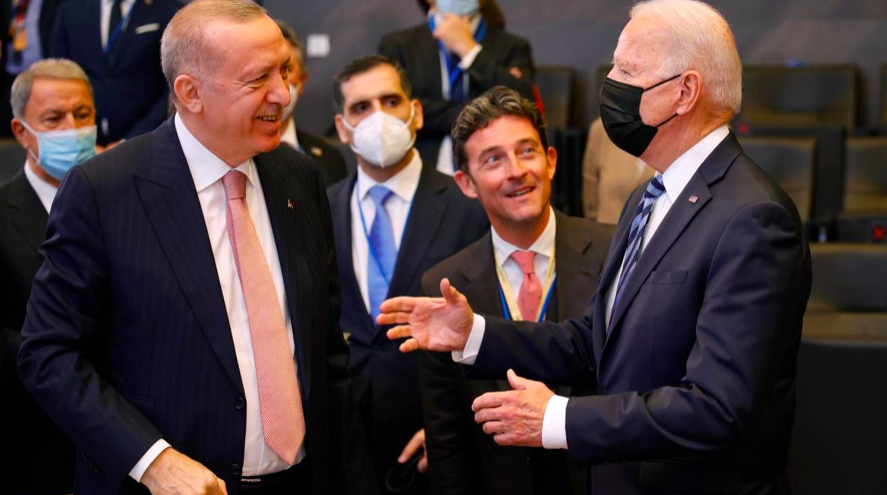
The US has used Turkey’s interest in operating the Kabul airport as a means to mend ties between itself and Turkey in the recent NATO summit. Indeed, this was the main focus and positive outcome of discussions at the summit in Brussels.
Erdogan-Biden relations hit a rough start when the latter assumed his presidency. Biden avoided contact with Erdogan, and adopted a hostile stance towards Turkey and its foreign policy. The Biden administration recognized the Turkish role in the widely contested Armenian ‘genocide,’ and expanded support for the Syrian Kurdish militant group YPG. The Biden administration has openly criticized Erdogan’s human rights record, and what it believes to be human rights abuses in Turkey, leading to a further rift in both personal, and geopolitical ties.
Now, it looks like there is finally light in the tunnel, and prospects of a working relationship between the two powerful NATO allies can return.
Turkish and U.S. military officials met in Turkey’s capital on Thursday to discuss plans for Turkish troops to continue securing Kabul’s airport after the withdrawal of the U.S. and other NATO troops from Afghanistan.
Defense Minister Hulusi Akar said a technical delegation from the United States had arrived for talks.
“We will continue to take on the responsibility of operating the Hamid Karzai International Airport, which we have been doing for the past six years, if the necessary conditions are met,” Akar said Thursday. “Discussions on this matter are continuing. No decisions have been reached for now.”
Akar said: “We want to achieve the best result for the interests of our country and for those of Afghanistan. That’s what we are working for. Our aim is to continue working for the security, peace and welfare of our Afghan brothers.”
Although Afghanistan is an important opportunity to re-initiate Turkey-US ties, it is not enough to provide a longterm basis for the relationship. To do so, Turkey and the US must resolve the S400 issue. Related to this, the US must recognize the importance of Turkey in countering the Russian threat at the Eastern flank of NATO, especially shown by the fact that Turkey is selling its cutting edge TB2 Bayraktar drones to Poland and Ukraine, and openly supporting Ukraine’s territorial integrity. However, Turkey must also clearly establish the state of its relations with Russia, and set limits that do not threaten NATO’s integrity.