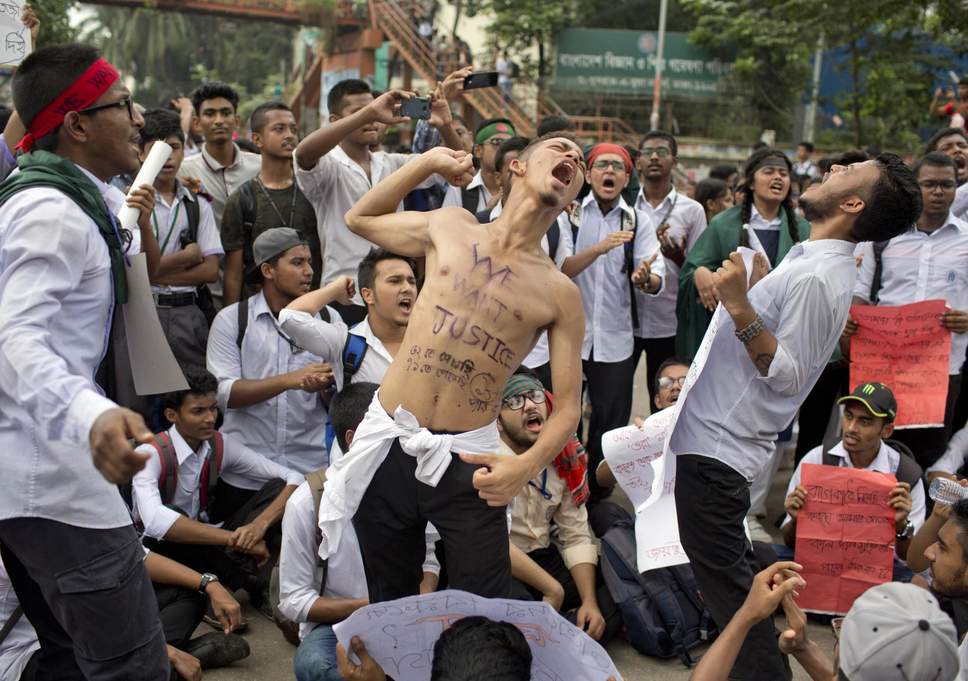
Students of Bangladesh have brought parts of Dhaka to a standstill after two teenagers were killed by a speeding bus. The protests took a violent turn in Dhaka’s Jigatala neighbourhood with more than 100 people injured as police fired rubber bullets at demonstrators.
Despite the outcry and numerous reports by students on Social Media, the Bangladeshi police have denied they fired rubber bullets or teargas at the protestors and Awami League has denied allegations that its officials beat up students.
The students have made a charter of 9 demands for the authorities to meet before they stop protesting that call for stricter enforcement of traffic laws and an improvement in road safety.
Bangladesh’s transport sector is widely seen as corrupt, unregulated and dangerous. The transportation sector has long operated above the law, with powerful officials either owning private bus companies or relying on its workers for political support.
By bribing officials, transportation companies obtain driver’s licenses for employees, who are often first-time drivers. They also bribe the police to get out of deadly accidents or allow their decrepit buses to continue along commuter routes.
The students outcry is totally understandable considering that Bangladesh’s roads are among the worst in Asia. According to the Global Competitiveness Index of 2017-2018, Bangladesh has the second-worst roads in Asia.
The index has a scorecard of 1-7 and Bangladesh scored just 3.1 for quality of roads for a subsection under infrastructure and in terms of overall infrastructure, Bangladesh scored worse with 2.9, the second-worst among Asian countries.
The only country below Bangladesh is Nepal – which has a dismal 2.8 score and is prone to earthquakes, floods, and landslides.
According to statistics published by the Passenger Welfare Association of Bangladesh, over 7000 people were killed and over 16,000 were injured in just under 5000 road accidents in 2017.
The fatal accidents took place on several highways and national, inter-district and regional roads across the country.
From the approximately 5000 accidents 1249 were caused by public buses. The survey also found at least 87 percent of public buses to be violating rules, and 72 percent of vehicles to be unfit for use on the roads.
These figures make for grim reading, and conditions are getting worse: from 2016 to 2017 road accident deaths rose by 22.2 percent.
But how did public transportation get this bad?
A special report published by Prothom Alo in 2013 sheds light on how politics is the root cause of these issues.
The report notes that Shajahan Khan, a government minister with ties to powerful transport unions, and his family own multiple bus companies throughout the country, giving him vested interest in keeping regulations lax and profits high.
Khan is also a member of the Bangladesh Road Safety Council, in which he has disproportionate say given his position as serving minister. This direct conflict of interest keeps road safety measures from being implemented.
The government attempted to divert the protests by framing it as pre-election conspiracy concocted by the opposition party. When this failed, they attempted to pacify the protestors, offering to address the issues raised, but the promises were viewed as empty and protestors refused to leave the streets until all conditions were met. The Education Ministry issued an order to keep all schools closed on 1 August in an attempt to keep the students home. This tactic failed.
Ultimately, the fact that it took students to raise an issue that has been neglected for decades and has led to thousands of deaths, shows that we can expect little from the Bangladeshi Government. Bangladesh has seen four major mass protests in the last four years, and the frequency of protests in the country will only increase further.