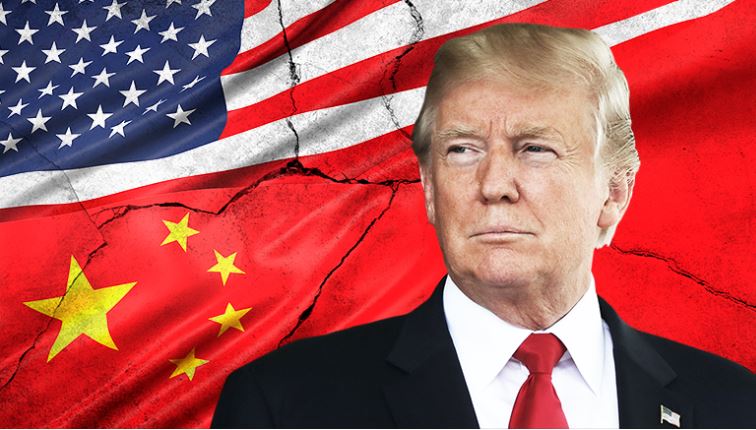
Trump signs legislation backing protesters in Hong Kong
US President Donald Trump has signed into law congressional legislation backing protesters in Hong Kong, sparking a furious response from the Chinese government. The legislation, approved unanimously by the Senate – the US’s upper house – and by all but one member of the House of Representatives – the lower house – last week, requires Hong Kong’s special trade status with the US to be reviewed annually by the State Department, and also threatens sanctions for human rights violations.
Congress passed a second bill, which Trump also signed, banning the export to the Hong Kong police of crowd-control munitions, such as tear gas, pepper spray, rubber-coated bullets and stun guns.
Hong Kong has been in turmoil for months after protests were sparked by a bill that would have permitted extradition to mainland China. Since then, the protests have transformed into broader anti-government demonstrations.
The protests, along with Trump’s decision to sign those measures, come as China and the U.S. try to work out a trade deal. Both sides have slapped tariffs on billions of dollars worth of their goods since last year.
This decision is something of a break from Trump’s earlier balanced position towards the Hong Kong protests, with light-worded support for the Hong Kong protesters, but also showing understanding to the Chinese government.
China furious with the decision
Trump’s decision appears to have come as a shock to the Chinese government, and one they are not taking very well. They have reacted furiously to the decision, sparking worldwide fear as to how their reaction could not only destabilize the situation in Hong Kong even further but the world economy, if this fuels the US-China trade war.
Le Yucheng, China’s vice foreign minister, told US Ambassador Terry Branstad in their meeting on Thursday that Washington’s move constituted “a serious violation of international law”, a foreign ministry statement said. Le urged the US not to implement the bills approved by Trump on Wednesday – to prevent greater damage to Washington-Beijing relations, the ministry said.
State media also published a statement from the Hong Kong liaison office, emphasizing its commitment to defending its “one country, two systems” policy. “We are officially telling the U.S. and the handful of opposition politicians in Hong Kong who follow America’s lead to not underestimate our determination to protect Hong Kong’s prosperity and stability, don’t underestimate our belief to protect the ‘one country, two systems policy’ and don’t underestimate our capabilities and strategies in protecting our country’s sovereignty, safety, growth and rights,” the officer said, according to a CNBC translation of an online-Chinese language statement.
Furthermore, the Chinese-backed Hong Kong government on Thursday expressed strong opposition to U.S. legislation backing protesters in the Chinese-ruled city, saying the bill will send the wrong signal to demonstrators.
It hence appears that for now the decision has made the situation more fierce, from China and Hong Kong’s side, but should also send a powerful signal, that the US is not simply standing by.
A possible trade deal between the US and China in grave danger
Highlighting the boldness of the move by Trump, on face value, the decision could not have come at a worse time, as the US and China appear to have approached a decisive moment in their negotiations for a trade deal. President Donald Trump declared Tuesday that talks with China on the first phase of a trade deal were near completion after negotiators from both sides spoke by phone, signalling progress on the accord in the works for nearly two years. “We’re in the final throes of a very important deal,” Trump told reporters at the White House. “It’s going very well.”
In a statement, China’s Ministry of Commerce said officials “reached consensus on properly resolving relevant issues” and agreed to stay in contact on the remaining points in phase one.
Investors fear the signing of these measures could complicate negotiations as a key Dec. 15 deadline approaches. If a deal is not reached by then, an additional round of U.S. tariffs on Chinese products would take effect.
It certainly now appears that the deal will not go through, given China’s fury over the US’s decision on Hong Kong, which will have a big impact on the progress made so far in negotiations between the US and China.