1. Current geopolitical state of Puerto Rico
Puerto Rico, similarly to Hong Kong in China, is an unincorporated, self-governing territory of the United States. After winning independence from the Spanish Crown on December 10, 1898, Puerto Rico became a Free Associated State in 1952. On the basis of the “insular cases,” the US Supreme Court decided that Puerto Rico belongs to but is not a part of the US. With a population of four million people, in line with the country’s constitution, the President of the USA is also the President of Puerto Rico, however, the executive power is held by a governor whose responsibilities are similar to those of a head of state or government. The governor is assisted by a secretary of state whose prerogatives are similar to those of his American counterpart (however they are all at a level similar to that of American states, not of the federal government). Therefore it is clear that Puerto Rico is officially part of the US, but the US does not have the same influence over it as China has over Hong Kong. That may change depending on the new governor, however.
2. Political and social unrest in Puerto Rico
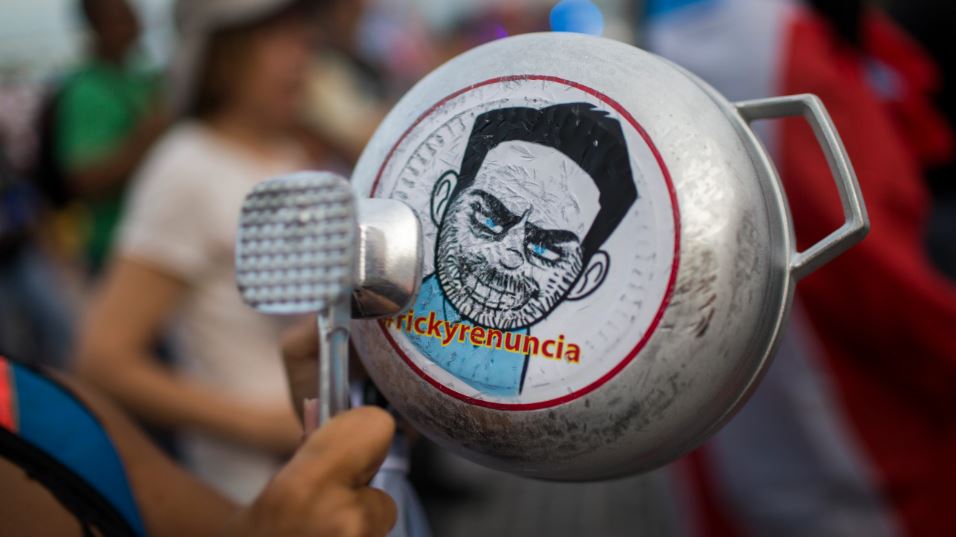
Thousands of people swarmed to the streets of Puerto Rico in the last week, in opposition to Governor Ricardo Rosselló, who is embroiled in a scandal over hundreds of pages of leaked text messages that contained misogynistic and homophobic language. Initially, Rossello apologized and asked for forgiveness, but refused to resign, which infuriated the protesters even further. The texting scandal, which is informally known as “Chatgate,” erupted a day after Rosselló’s former secretary of education and five other people were arrested on charges of steering federal money to unqualified, politically connected contractors. The private chats between the governor and members of his Cabinet mocked women, disabled people and even victims of Hurricane Maria. Some notable celebrities like singer Ricky Martin joined the Puerto Rican protesters swarming outside the governor’s residence. Since the scandal broke out, Rossello had been keeping a low profile and trying to stay away from the media. In addition to this, several Latin American states have been critical of the political situation in Puerto Rico for a long time.
3. Puerto Rico governor resigns
However, it seems Rossello could not hold on for much longer, as he announced his resignation yesterday. He recorded a video statement that was broadcast on Wednesday evening, saying: “I announce that I will be resigning from the governor’s post-effective Friday, 2 August at 5 pm. I feel that to continue in this position would make it difficult for the success that I have achieved to endure.” There were celebrations on the streets across Puerto Rico after the announcement. Mr Rosselló’s announcement came just hours after the leader of Puerto Rico’s House of Representatives said that lawmakers were planning to commence impeachment proceedings to remove the governor. Many view his resignation as a positive step towards ending corruption in Puerto Rico. However, it remains to be seen whether that will be the case.
4. Power struggle expected
Rossello’s resignation has inevitably left a power vacuum and led to a power struggle on who will succeed the governor. In line with the U.S. territory’s constitution, Secretary of Justice Wanda Vázquez is next in line to succeed Rosselló, based on current Cabinet vacancies. Protesters who forced Rosselló from office have vowed to oppose Vázquez, saying she is too close to the disgraced governor. This will be further explained in point 4. This unpopularity has prompted leaders of Rosselló’s pro-statehood party to look to a former Puerto Rico representative in the U.S. Congress as a possible successor, and that is Pedro Pierluisi. Either way, there is clearly an uncertainty as to who is the right choice to replace Rossello, but the Puerto Rican people will continue to make themselves heard.
5. US congress member could become governor
Meanwhile, another candidate has arisen that would form a direct link to Washington, which may be in US interests, but in Puerto Rican interests as well as they would have a hand in important decisions. That is Jenniffer González-Colón, who is Puerto Rico’s representative in Congress. Ms González-Colón’s news releases refer to her as “congresswoman,” but her official title is resident commissioner, which means she has far less power than others in the House of Representatives. She can propose legislation and vote on bills in committees and on the House floor, but with a telling asterisk: Should her ballot be the deciding one, the House votes again, this time without her participation. The next days will be crucial in determining the next Puerto Rican governor.