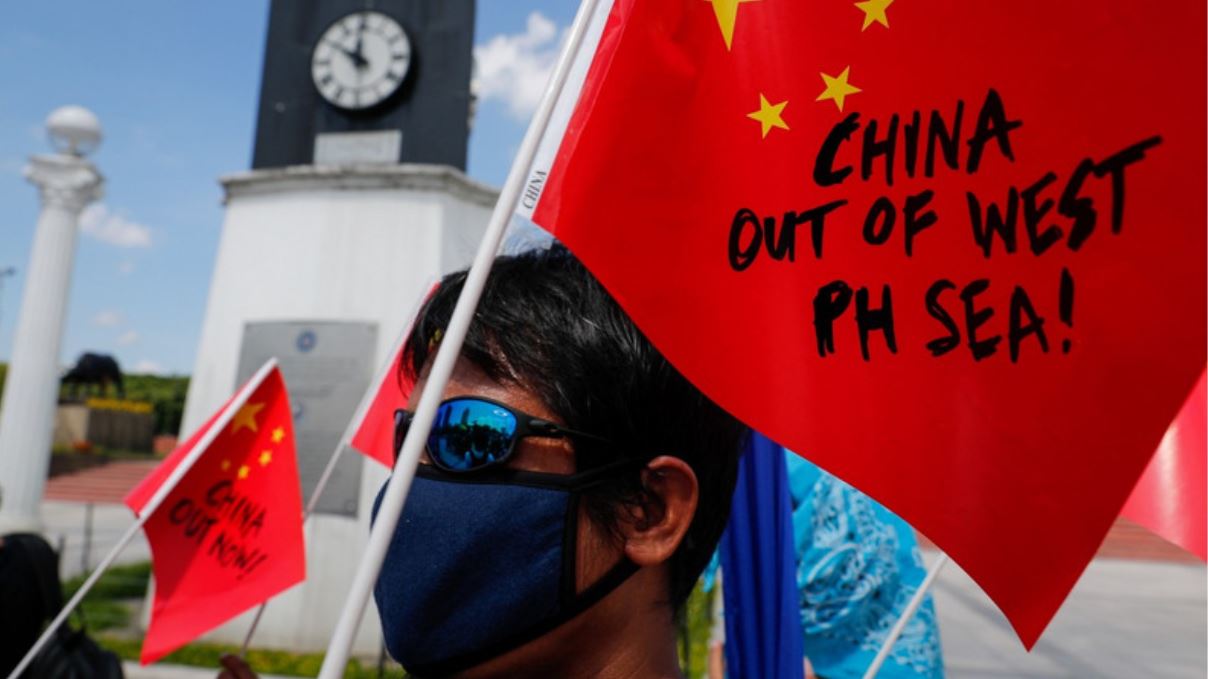
1. Philippino public protest China’s aggression
After reports of over 100 Chinese fishing vessels being spotted a Philippine-administered island in the South China Sea, at the end of July, thousands of Philippinos took to the streets in a diplomatic protest against China. The country’s national security adviser, Hermogenes Esperon Jr, revealed the event, and said he recommended the filing of the protest against China, but added that the government was unsure on the motivations of the Chinese vessels. The Philippines, China, Brunei, Malaysia, Taiwan and Vietnam, all have overlapping claims in the South China Sea, and China has recently acted aggressively in the area. The Philippino people fear further escalation and are hence speaking out.
2. Philippines want to resolve through negotiations
In response to China’s aggressive action in the South China Sea, Philippine President Rodrigo Duterte is set to meet Chinese president Xi Jingping to discuss the issue. Although this is a response to the growing domestic pressure to stand up to China, it is also a sign that the Philippines want to resolve the issue peacefully. In fact, many political opponents and critics have said he is sacrificing the Philippines’ integrity in favour of appeasing his new close ally China.
3. China ignores warnings
Despite the Philippines reserved approach towards Chinese geopolitical actions, China has ignored warnings from the nation, and once again, a Chinese Navy vessel passed through the Balabac Strait, near Palawan. A meeting between Philippine Defense Secretary Delfin Lorenzana and Chinese Ambassador Zhao Jianhua in Manila during the July Philippine State of the Nation Address seemed to soothe the tensions, but China appears to continue its maritime challenges. With these latest passages, the Chinese vessels ignored radio warnings by WesCom. Vice Admiral Rene Medina, the WesCom chief, said the first vessel was “unresponsive in the succeeding challenges made by our operating unit.” On the 8:00 AM passage Medina said, “Said vessel responded to the radio challenge but did not disclose any information except its bow number.” He added that it was accompanied by two more “unresponsive” Chinesese navy vessels.
4. Fears of China’s influence in the nation
The Department of National Defense (DND) and the Philippine Navy have raised concerns over a reported government plan to allow Chinese firms to develop three Philippine islands into tourist destinations. “All we can do now is to monitor what else they are doing that may impact on our security,” Defense Secretary Delfin Lorenzana said yesterday. It is clear that the majority of the Philipino people want to fight China’s influence in the nation, and for that to work, the government needs to align itself with them.
5. US sees the wrong side of the coin
The US has stepped down ties with the Philippines, after Manila’s embrace of China’s Huawei. The Sino-Philippine economic entwinement is largely facilitated by Filipino-Chinese tycoons who run many of the Southeast Asian country’s big businesses. It is hence hard to stop them even if the government wanted to. The US has not taken this kindly however, and it seems are supporting the majority in the Philippines who want to stand up to China. China’s already established economic sphere in the nation will however, make the task almost impossible.