The outbreak of war between Azerbaijan and Armenia
Armenia and Azerbaijan’s conflict in the disputed Nagorno-Karabakh region has once again erupted, and it appears this time, full-blown war has erupted between the 2 nations, with 4 consecutive days of intense fighting, including drone attacks, trench warfare, and large-scale mobilisation from both sides. The conflict has now entered its fifth day of intese fighting.
Armenian Prime Minister Nikol Pashinyan said in a televised address that Azerbaijan’s “authoritarian regime has once again declared war on the Armenian people.”
“We are on the brink of a full-scale war in the South Caucasus, which might have unpredictable consequences,” he added. “We are ready for this war.”
He later urged his compatriots to pledge “that we won’t retreat a single millimeter” from defending the disputed breakaway region in Nagorno-Karabakh. Meanwhile, the president of Azerbaijan declared a partial military mobilization in the country as part of a presidential decree on Monday morning. Armenia began a general mobilization on Sunday.
Azerbaijan making significant advances
The Azerbaijani army liberated some critical points in the western Aghdara province from Armenian occupation as border clashes entered their sixth day and Yerevan expressed readiness to work with mediators for a cease-fire.
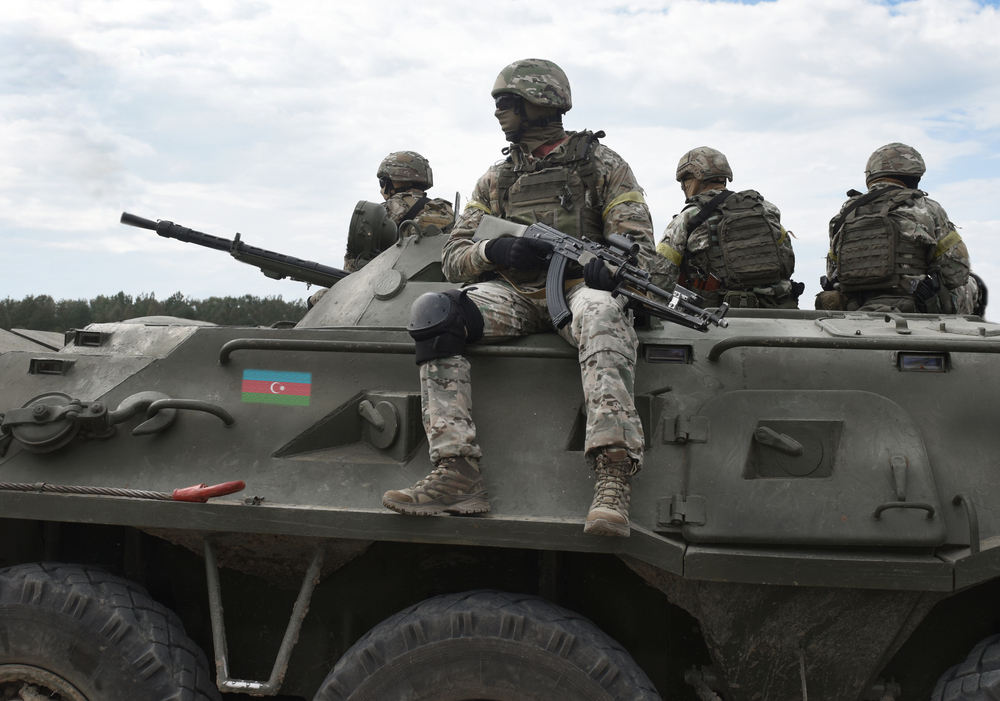
The Azerbaijani defense ministry on Friday said in a statement that the army forced the Armenian army to withdraw from the Jabrayil-Fuzuli region, adding that some strategic hills in Aghdara’s Madagiz region were also liberated from occupation. During night clashes, five Armenian armored vehicles were destroyed and a large number of soldiers killed, it added.
The success in clashes and the liberation of various strategic positions boosted the fighting spirit and determination of the Azerbaijani soldiers, it underlined.
During a night clashes, five Armenian armored vehicles were destroyed and a large number of soldiers neutralized, it said. The ministry said volunteers brought from Armenia to the occupied areas refused to fight, fearing the intensity of the conflict and heavy losses. The success in clashes and the liberation of various strategic positions boosted the fighting spirit and determination of the Azerbaijani soldiers, it underlined.
The Azerbaijani Armed Forces seized a large number of weapons, ammunition and vehicles belonging to the Armenian military in an operation to liberate its territory under occupation. According to Anadolu Agency (AA), Armenian soldiers fled their positions in the face of the Azerbaijani advance, leaving behind their weapons and military vehicles. Among the seized military vehicles were Russian-made 2019-model Ural trucks.
Another ministry statement said Armenian forces targeted the villages of Hindiristan, Alibeyli, Ahmadaghali and Safarli in the southwestern Agdam province. Heavy Armenian attacks resulted in civilian deaths and injuries, it added.
Armenian authorities in the Karabakh region have reported at least 84 military deaths thus far. Azerbaijan has not confirmed any casualties, but has announced 35 civilian deaths due to Armenian artillery fire. Officials in Armenia claim that hundreds of Azerbaijani soldiers have been killed. At the same time, Azerbaijan’s ministry of defence claims that at least 2,300 Armenian soldiers were killed and wounded since the fighting broke out.
Azerbaijan’s military has significantly expanded its drone fleet, most recentlywith Turkey’s increasingly sought-after Bayraktar TB2 unmanned drone. It has already seen action, destroying a number of Armenian mobile surface-to-air sites and tanks.
Armenian-backed forces in the occupied Karabakh have also destroyed multiple Azerbaijani tanks and military vehicles using largely Russian-producedanti-tank guided missiles (ATGM).
Armenia seeks ceasefire
It appears Armenia has warmed to the idea of a ceasefire, after the losses it has suffered up to now.
Armenia has said it is prepared to work with international mediators to reach a ceasefire with Azerbaijan as the two rivals fight over the breakaway Nagorno-Karabakh region, where fierce clashes spilled into a sixth day.
Armenia “stands ready” to engage with France, Russia and the United States, who co-chair the OSCE group of mediators to the conflict, “to re-establish a ceasefire regime”, the Armenian foreign ministry said in a statement on Friday.
However, the statement added that “this aggression against Nagorno-Karabakh will continue to receive our strong and resolute response”.
The development came after ethnic Armenian officials in the breakaway Nargorno-Karabakh region reported another 54 military casualties among Armenian-backed troops, bringing the death toll to 158 soldiers.
Armenia’s statement on Friday marks the first sign that dialogue could be possible in resolving the latest flare-up, after days of Yerevan and Baku refusing to heed calls by Western leaders and Russia to back down.