The war over Karabakh
Armenia and Azerbaijan’s conflict in the disputed Nagorno-Karabakh region has once again erupted, and it appears this time, full-blown war has erupted between the 2 nations, with over a week of intense fighting, including drone attacks, trench warfare, and large-scale mobilisation from both sides. The conflict has now entered its second week of intese fighting.
“We are on the brink of a full-scale war in the South Caucasus, which might have unpredictable consequences,” he added. “We are ready for this war.”
He later urged his compatriots to pledge “that we won’t retreat a single millimeter” from defending the disputed breakaway region in Nagorno-Karabakh. Meanwhile, the president of Azerbaijan declared a partial military mobilization in the country as part of a presidential decree on Monday morning. Armenia began a general mobilization on Sunday.
The Azerbaijani army liberated some critical points in the western Aghdara province from Armenian occupation as border clashes continued and Yerevan expressed readiness to work with mediators for a cease-fire. The Azerbaijani defense ministry last Friday said in a statement that the army forced the Armenian army to withdraw from the Jabrayil-Fuzuli region, adding that some strategic hills in Aghdara’s Madagiz region were also liberated from occupation. During night clashes, five Armenian armored vehicles were destroyed and a large number of soldiers killed, it added.
The success in clashes and the liberation of various strategic positions boosted the fighting spirit and determination of the Azerbaijani soldiers, it underlined. Azerbaijan claims to have taken a dozen villages in the Jabrayil district, one of seven that ring Nagorno-Karabakh and were occupied by Armenian forces. Azerbaijani cluster munitions have struck Stepanakert, the capital of the breakaway province. Armenian forces have shelled Ganja, Azerbaijan’s second-biggest city. Both sides seem to have used ballistic missiles, and a few stray rockets have landed in next-door Iran.
Peace talks open
As a result of heavy pushes to open talks from the Armenian side to Putin, propably as a result of their heavy losses, Russia has agreed to initiate talks, and both Armenia and Azerbaijan have opened up to talks.
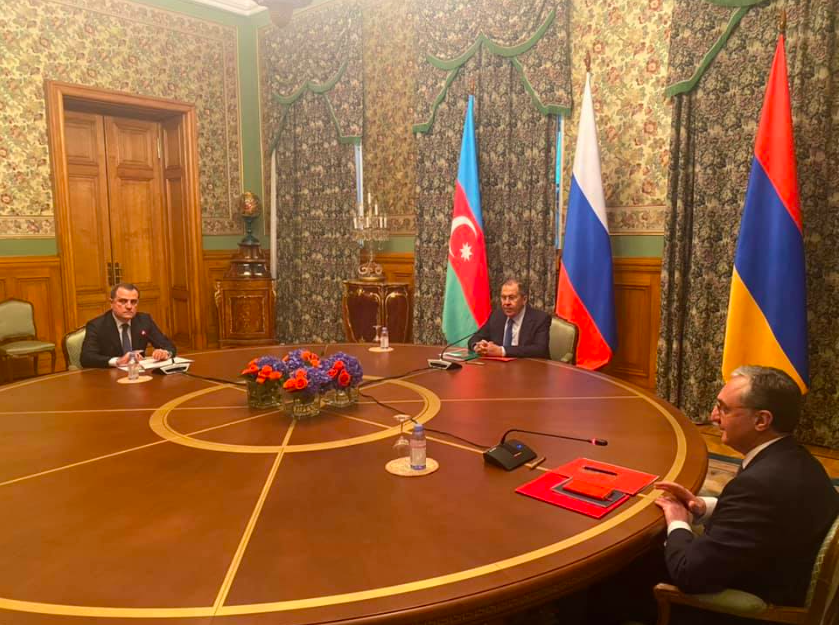
Armenia and Azerbaijan have begun their first high-level talks after nearly two weeks of clashes.
“It has begun,” Russian foreign ministry spokeswoman Maria Zakharova said on Facebook, posting a picture of the foreign ministers of Russia, Armenia and Azerbaijan sitting at a round table in Moscow.
Azerbaijan’s President Ilham Aliyev has repeatedly said there would be no halt to fighting until Armenian troops withdraw and vowed to continue the intervention until his army captured all of Karabakh. Russia’s Foreign Ministry said on Friday the two countries’ top diplomats would hold talks in Moscow from 12:00 p.m. GMT.
In a televised address to the nation, Azerbaijani President Ilham Aliyev has said that Baku is giving Armenia a “last chance” to peacefully resolve their conflict, as talks between the two sides begin in Moscow. “We are giving Armenia a chance to settle the conflict peacefully. This is their last chance,” Aliyev said. “We will return our lands in any case. This is their historic chance.”
Previous diplomatic efforts to find a lasting solution to the decades-old stalemate have faltered. Putin’s announcement of talks in Moscow came shortly after international mediators from France, Russia and the United States launched their first efforts to resolve the fighting in Geneva. The countries make up the “Minsk Group” that has sought a solution to the Karabakh conflict for decades but have failed to stop sporadic outbreaks of fighting. The negotiations in Geneva went ahead without Armenia, which refused to participate if the fighting was ongoing, and there were no public statements following the closed-door talks.
Iran pushing for peace
Iran has established itself as a mediator in the conflict, as it has ties with both Armenia and Azerbaijan, and the war is detrimental to its interests. Iran’s connection to both sides could prove crucial in reaching a peace agreement.
Iran’s stand is to sit over a mediation but the situation in Iran itself is going-out-of-control as there is a very sizeable ethnic Turkish Azerbaijani population in Iran, which conservatively speaking is about 20 million and have gone into protest-mode against Iran to announce support for Azerbaijan in the war over Nagorno-Karabagh conflict.
The problem is that Iran finds itself sandwiched between Turkey’s full support to Azerbaijan and Russian support to Armenia, and also that, Iran finds itself too much under the Russian weight for its unstinted support to the Syrian regime in the last eight years, while also when Russia has given a ‘positive signal’ to sell S-400 missile system to Iran.
Iranian news reports have said that stray mortar shells have landed on Iranian border villages and towns, leaving buildings damaged and a six-year-old child wounded.
The situation is getting all heated up around Armenia-Azerbaijan and it is here when Russia, Turkey, Iran with both Armenia and Azerbaijan need to iron-out a middle path, as if it would warrant the US to jump into it after the November 2020 elections it would be a catastrophe, which might be just-waiting-to-happen.Rouhani also warned that Tehran will not tolerate any nation sending “terrorists” to Iran’s borders under any pretext.